

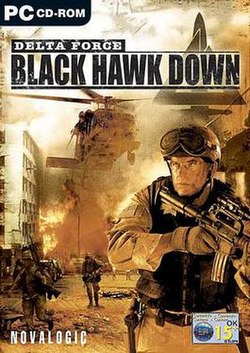

There are videogames that aspire to be history textbooks and there are videogames that aspire to be pacifiers for the short attention span. Delta Force: Black Hawk Down on PlayStation 2 sits uneasily between both ambitions, like a correspondent who insists on wearing combat boots with a tuxedo. Based on NovaLogic's take on the early 1990s Somali operations and the events of Mogadishu in 1993, the game promises gritty urban warfare, squad-based tension, and the kind of cramped, chaotic close-quarters engagements that made that chapter of modern conflict infamous. The PS2 port arrives later than the PC original, and it carries with it all of the compromises and concessions that have become a familiar smell on the console porting floor.
Delta Force: Black Hawk Down marks a departure from the series' earlier, more methodical outings. Where the Delta Force games of old favored long-range engagements and a certain fondness for ballistics spreadsheets, this sequel trades the sniper's solitude for cramped alleys, rooftop scrambles, and scripted bursts of cinematic violence. The player starts as a Task Force Ranger and, after a few opening missions, graduates into Delta's more elite units; you command a three-man fireteam - Huck, Mother, and Preacher - whose names read like they were voted on by a particularly laconic writer's room. The combat is action-first. Long-range bullet physics and weapon sway are downplayed in favour of simpler, run-and-gun mechanics. The AI teammates are serviceable for the era: you can hand them basic orders (hold fire, hold position, lob a grenade) and the game will generally oblige. They will not reinvent squad tactics for you, but they will not stand idly while you bleed out on the tarmac. Missions are largely linear and heavily scripted, a design philosophy that trades sandbox freedom for tightly directed set-pieces. Most of the time you will have three missions available and can tackle them in any order; the instant action menu lets you replay completed maps without having to re-run the campaign, which is welcome for those of us who like a particular firefight and want to revisit it like a dog returning to the same puddle. Multiplayer is the headline feature that refuses to be modest. On consoles this title claimed a record for large-scale matches, boasting support for up to 50 players - a number that reads like the score of a small war. Powered by NovaWorld on other platforms, the multiplayer suite offers the expected deathmatch, team deathmatch, king of the hill, and objective modes, with class-based choices harking back to older series conventions. Matchmaking and stat tracking are present on the PC ecosystem; on PS2 you get much of the same design intent, albeit tempered by the console's network limitations and the realities of 2005 infrastructure. For players who enjoyed piling into a LAN room and seeing a map filled with human opponents, this was a siren call. The game also ships with a mission editor on the PC; PS2 players received the Team Sabre expansion in tandem on some releases, introducing campaigns beyond Somalia, though the core PS2 experience remains focused on Mogadishu's tangle of streets and checkpoints.
Graphically the lineage is clear: the engine began life in the Comanche series and was refashioned into the so-called Black Hawk Engine on PC, but the PS2 build uses the Asura technology to translate that ambition onto console silicon. On the PC the game was often praised for its graphical fidelity and battlefield vistas; on the PlayStation 2 the picture is less flattering. The environments retain a lot of texture and urban clutter - crates, burned-out vehicles, and desperate crowds that add atmosphere - but the PS2's memory constraints and CPU budget show up in lower-resolution textures, pop-in, and frame-rate drops when the action gets particularly crowded. Character models are functional rather than arresting. Animations are competent, though repetitive; the same reload, the same shout, the same body flop make repeated appearances. Lighting and shader effects that give the PC iteration its more cinematic feel are present here in scaled-down form; the night missions have an agreeable murk to them, and daylight firefights display a dusty, sunlit grit that suits the setting. Overall, the game looks like a faithful field sketch rather than a glossy painting: it communicates the essentials and the mood, but it won't make you stop and study the brushwork. Sound design fares better than visuals in some respects. Weapon reports are satisfyingly weighty for console ears, and the radio chatter - terse, clipped, identical to what you'd expect from a military drama script - helps sell the illusion. The soundtrack and effects do their job: they put you in the tinny boots of a man on a mission without asking too many questions about nuance or historical subtlety.
As a piece of interactive reportage, Delta Force: Black Hawk Down on PS2 is uneven. Its strengths are obvious: it is unabashedly an action game that places you in claustrophobic urban battles, it offers a decent suite of multiplayer options that appealed to groups chasing large-scale skirmishes, and it packages familiar squad mechanics into a console-friendly wrapper. Its weaknesses are equally plain: the single-player campaign is more hand-holding than strategy, the port dilutes some of the technical sheen seen on PC, and the ambitious multiplayer promise feels a touch gilded when you consider the era's network realities. For players who want a kinetic shooter that occasionally feels like a disaster movie you can run around in, this will scratch an itch. For purists who bought the earlier Delta games for their long-range tactics and austere realism, the changes here will read as concessions. The PS2 version is competent, occasionally compelling, and never quite transcendent. It is a respectable relic from a time when developers were still learning how to translate PC battlefield ambitions onto living-room hardware. If you pick it up at a reasonable price and an evening to spare, you'll find firefights worth remembering; if you're chasing nuance, bring a notebook and a healthier dose of patience.
 Call of Duty: Black Ops 7 on PS4
 Never Stop Sneakin' on Switch
 Warhammer 40,000: Boltgun 2 on Xbox Series X/S
 PixelJunk Shooter 2 on PS3
 Primal Carnage: Extinction on PS4
 Tower of Guns on PS3












 Another SquareThought Site