

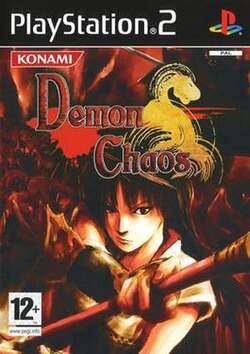

Demon Chaos is what happens when someone looks at Dynasty Warriors, squints, and says: 'What if we had more enemies?' Developed by Genki and Now Production for the PlayStation 2, the game sports the less subtle Japanese title Ikusagami (literally 'War God') and a premise that reads like a haiku written by a medieval bureaucrat. Set in 16th-century feudal Japan, you play a priestess given eternal youth until she exterminates every demon. Her battle buddy is Inugami, a mythic beast under the player's command. The marketing hook - and the thing that lets you tell people 'no, really, 65,535 enemies' without blinking - is the game's claim to handle tens of thousands of on-screen adversaries at once. This is the sort of promise that can be read two ways: as technical bravado and also as a polite excuse for calling 'crowd control' a feature. Demon Chaos arrives wearing the hack-and-slash badge: single-player, waves of enemies, and a comforting lack of pretense. It received tepid critical notices on release and sits in the middle of the road on Metacritic, which is appropriate. It's not broken so much as resolutely specific - a tool for stomping scenery, not examining it.
At its most basic, Demon Chaos plays like a classic Musou affair. You ride into a battlefield, press buttons, enemies fall over, and the battlefield score tally increases by an amount consistent with how much button-pressing you have done. If you enjoy clicking 'smash' until the world makes sense again, this will feel familiar and efficient. Where it tries to be different is in scale. The '65,535 enemies on-screen' headline is both a technical flex and a design statement. There are moments when the camera pulls back and the horizon fills with tiny, moving black dots - a respectable approximation of an apocalypse. It is satisfying in the same way as watching a cup overflow: messy, inevitable, and somehow thrilling. The hordes give the illusion of an enormous, living battlefield, and there is a certain animal joy in carving through them with Inugami's moveset. Mechanically, the game keeps things uncomplicated. Your primary interface is the beast - combos, a few heavy attacks, and some special moves. The priestess functions as the narrative center and a framing device for the mission objectives: kill demons, free areas, progress the plot (which does not overstay its welcome). There is a rhythm to the stages: move to point A, clear, push to point B, clear, encounter a named enemy with slightly better shaders, repeat. The goals are rarely subtle and thereby allow the player to indulge in the main attraction: mass carnage. Replayability comes from the variety within each mission rather than deep systems. Enemy types change, boss encounters provide temporary tension, and some strategy emerges when you need to prioritize objectives rather than mindlessly swipe at every blade in sight. Those seeking loot trees, deep progression, or complex tactical choices will be disappointed. If you require multiple layers of game systems to feel like a 'real' game, Demon Chaos will feel like a TV show that has the channel, but not the remote control. Combat is competent. It won't surprise veterans, nor will it particularly alienate novices. The satisfaction curve is immediate - press buttons, watch numbers inflate - and that is both its strength and its limitation. The novelty of the sheer enemy count carries much of the emotional weight. Once the initial 'oh' moment of watching the map turn into a sea of bodies passes, the sameness of the encounters becomes the headline. Levels are serviceable but sometimes repetitive; variety tends to come from how many enemies are on screen and the odd visually distinct boss rather than from creative objectives. Also worth noting is that Demon Chaos is purely single-player. It does not pretend to be a competitive war sim or a social experience. It is an introspective sort of violence - the player and their beast versus the immensity of the enemy. For some, that is a comforting, almost meditative formula. For others it is a treadmill. Your enjoyment will depend largely on how much you like the sensation of being numerically superior and how willing you are to forgive repetition for spectacle.
Graphically, Demon Chaos is a product of its era with a few ambitions that show and many limitations that don't bother to hide. On the positive side, the impression of scale is the game's main visual trick, and it works. Crowd density, marching formations and the small, frantic sprites of unnamed soldiers create a convincing battlefield tableau. From a distance, the world looks like a painted scroll come to life, which fits the feudal Japan setting and helps the spectacle feel a little more cinematic than it otherwise would. Up close, however, things are simpler. Character models for generic enemies are designed to be cheap and reusable; texture work is functional rather than lovely. Environments are serviceable backdrops for your rampage - they establish mood without demanding attention. When the camera is zoomed in on Inugami executing a special move, you can appreciate a few tasteful design flourishes in the creature's animations. When you zoom out to appreciate the 65,535 claim, those flourishes become abstract patterns in a charmingly chaotic tapestry. Technical performance is understandably conservative. The PS2 isn't a miracle machine, and the developers' engineering effort goes into keeping the hordes coherent rather than into lavish lighting or ultra-smooth frame rates. That tradeoff will please the players who came for context-free carnage and frustrate those who wanted high-fidelity closeups. In short: it looks like a PlayStation 2 game that decided to spend its polygon budget on population instead of polishing every polygon. This is probably intentional, and it's hard to argue with the result if your priority is spectacle.
Demon Chaos lives up to a very specific promise and ignores everything else with admirable consistency. It is a hack-and-slash playground where the main variable is how many attackers you can place on a map before the universe takes it personally. The setting provides a pleasant backdrop - feudal Japan, a priestess with a divine dog, and a tidy resignation about violence - but the real selling point is the joy of seeing huge numbers of enemies collapse into charming, repetitive defeat. Critically, the game landed in the middle ground. It earned a 62 on Metacritic and middling scores from outlets; that feels fair. Demon Chaos is not bad, it is not brilliant, and its appeal is straightforward: if you want spectacle and uncomplicated combat, it will deliver. If you want depth, variety in mission structure, or long-term progression, it will feel thin. The score here is a nod to the technical novelty and the sheer, simple fun of mowing down impossibly large armies: 6.2 out of 10. If you buy it, go in knowing that you're paying for the experience of being numerically overwhelming and leave your expectations of nuance at the door. Then you and Inugami can go out and politely exterminate a nation or three.
 Just Cause 2 on PS3
 Stranger of Paradise: Final Fantasy Origin on PS5
 PlayStation Home on PS3
 Gaelic Football '25 on Xbox Series X/S
 Together! The Battle Cats on Switch
 Ōkami on PS2












 Another SquareThought Site