

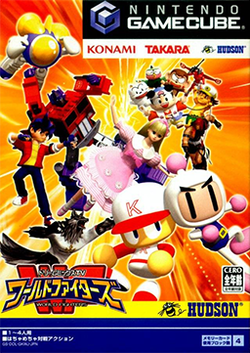

DreamMix TV World Fighters is the kind of crossover you get when a TV studio, three publishers' IP closets, and RenderWare all walk into a bar and decide to make a game. Released exclusively in Japan in late 2003 for GameCube and PlayStation 2, the Bitstep-developed title wears its influences on its sleeve: it's a platform fighter for up to four local players that grafts character tropes from Hudson, Konami and Takara onto a surprisingly mechanical core. On the surface it looks like a cutesy brawler stuffed with cameos - Bomberman, Solid Snake, Simon Belmont, Optimus Prime - but under the bright palettes is a cluster of systems worth digging into if you care about frame budgets, collision envelopes, and how a life system can reshape combat priorities.
At its base DreamMix TV behaves like a platform fighter: lateral movement across 2D arenas, variable stage geometry, ledges and hanging bars, and a mix of normal attacks, throws and special abilities. The thing that differentiates its mechanical DNA is the coin-based life system. Rather than a health bar that ticks down, opponents shed discrete coins when damaged. A meter aggregates remaining coins for an at-a-glance life readout, but the coin-dropping mechanic introduces spatial and timing choices absent from pure-percent fighters. Getting hit is doubly punishing because coins scatter into the stage and become a contested resource; recovering your own coins prevents a temporary shrink-and-soul phase, while letting opponents scoop them up converts damage into score and positional advantage. That interplay creates instant meta-goals: aggression to force coin drops, precision to snatch your own coins, and stage control to deny retrievals. The shrink/soul mechanic is an elegant state change with clear gameplay ramifications. When a character loses all coins they shrink and their soul flies free; the shrunken player still moves and can obstruct the arena but is functionally out of the primary fight until the soul is recovered. This creates mid-round comeback windows and multi-layered win conditions - eliminate the soul carrier or dominate the arena timing. From a state-machine perspective it's a neat way to maintain player agency after a fatal blow while keeping the core round tension focused on the last standing character. Movement and defensive tools are straightforward but with thoughtful touches. Characters can guard and dodge to mitigate attacks, throw opponents, and latch onto hanging bars for temporary evasion or repositioning. Throws are an important part of the neutral game because they bypass some defensive options, while guarding and dodging map into risk/reward trade-offs that make spacing matter in small-stage fights. Collision detection is tuned for bit-sized combat: hitboxes are generally tight enough to avoid the frustration of invisible hits, yet generous enough so that melee characters with shorter reach still feel useful in cramped multi-person skirmishes. Special moves vary between characters - most get one or two unique specials - and the roster's eclectic sources force interesting design compromises. Licensing quirks influenced move sets; for instance Takara's Licca couldn't perform direct attacks, so the devs implemented her damage output via dance animations that function as offensive tools. That constraint led to creative encoding of hitboxes into nonstandard animations, which in turn affects animation blending and hit stop timing. The cast ranges from nimble fighters like TwinBee and Power Pro-kun to large, hulking entries like Optimus Prime; the engine handles these size disparities by scaling hurtboxes and animations rather than inventing entirely separate physics profiles. World Fighters, the primary single-player loop, layers a meta system on top of standard arcade progression: the DreamMix TV ratings meter. As you fight, audience approval rises or falls based on actions, and if ratings hit zero you immediately lose. The ratings mechanic acts as a soft timer and difficulty governor - it's a clever way to pressure players into stylistic play rather than safe turtling, and it also reduces the need for complex AI tuning because the metric rewards spectacle. Unlock gating for characters and stages is tied to completing World Fighters with specific fighters, which encourages experimentation and unlock-driven progression. Multiplayer is local-only but robust: up to four players in Character Soul Survival mode, and several challenge-based Caravan stages for score-focused runs. The lack of online play is hardly surprising for 2003, but it does mean the game's balancing leans heavily toward local chaos: with four controllers the CPU framerate and camera management are the key concerns - more on that in the graphics section. From a technical-balance standpoint the game sits between party brawlers and competitive platform fighters. It isn't deep enough to unseat a dedicated competitive scene, but the systems - coin economy, shrink/soul phase, stage hazards - give it enough mechanical hooks to reward players who learn interactions and stage control. The designers traded a bit of precision for spectacle, and that's a defensible choice given the TV-show framing.
DreamMix TV runs on RenderWare, a pragmatic choice for cross-platform projects of the era. On PS2 that translates to relatively efficient memory and shader usage, which the devs exploited by keeping character models low-to-moderate polycount and leaning on bold textures and cel-adjacent shading to sell personality without heavy geometry. Character silhouettes are clear - crucial in 4-player fights - and animation timing is snappy, which helps maintain perceived responsiveness even when many effects populate the screen. Stage design balances static geometry with intermittent hazards: examples include floating Medusa heads in Dracula's Castle that alter the rhythm of a fight. Those hazards are handled as scripted collisions with predictable timing, which is good for players because it makes stage knowledge valuable and avoids the frustration of telegraphed-but-unavoidable damage. Particle effects and attack FX are intentionally punchy but not overdrawn; there's an obvious effort to preserve framerate headroom when four characters and several projectiles are active. If you shove the camera to accommodate four players, you can see texture streaming and occasional pop-in on the PS2 hardware, but that's endemic to the platform and the cross-platform engine rather than sloppy optimization. The UI is functional: the coin meter and ratings indicator are prominent without obscuring combat. HUD scaling for split-screen chaotic fights is acceptable - things remain legible even when the action fragments. Lighting is basic but serviceable: neither a showcase for PS2 lighting tricks nor a drawback. Overall, the graphical package prioritizes clarity and performance over cinematic sheen, which is the right move for a local, fast-paced brawler.
DreamMix TV World Fighters is a technically competent platform fighter that chooses design clarity over aesthetic overreach. Its coin-based life system and shrink/soul mechanic add meaningful, tactical variety to the usual 'damage percent' template, and the World Fighters ratings system cleverly pressures playstyles without resorting to brittle AI. RenderWare and the PS2 hardware are used judiciously: character models are readable, animations are responsive, and stage hazards are well-integrated. The trade-offs are obvious - no online play, some platform-era graphical concessions, and a design leaning more toward party entertainment than hardcore competition - but those are tolerable given the game's goals. If you're into oddball crossovers, local multiplayer chaos, and systems that reward stage control and timing, DreamMix is a pleasant technical curiosity and a surprisingly sane-sounding piece of design under its cartoon veneer. Pick it up for nostalgia, import collectors, or anyone who enjoys platform fighters with unique resource dynamics; just don't expect a polished competitive ecosystem out of the box.
 Harvest Moon: One World on Switch
 Nobody Saves the World on Xbox Series X/S
 Ultraman Fighting Evolution on PlayStation
 ACA Neo Geo: Art of Fighting 2 on Xbox One
 ACA Neo Geo: The King of Fighters '98 on Xbox One
 Nickelodeon All-Star Brawl on Switch












 Another SquareThought Site