

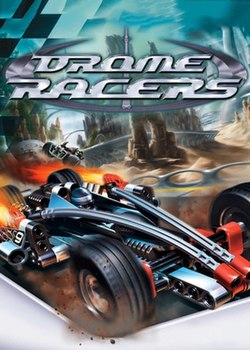

Drome Racers arrives like a box of Lego parts dumped onto the PS2 era: colorful, promising, and with more potential than the final assembly suggests. Built by Attention to Detail and published by Electronic Arts and Lego Interactive, the game tries to graft arcade-style racing onto the Lego license, casting you as Max Axel in a 2015-branded championship. Technically it is a curious mix: a handful of original systems, like the multi-challenge races that carry time between heats and qualifying drag races with gear-shifting, are tucked into an otherwise familiar arcade racer skeleton. Critics generally gave the PS2 release a middling welcome, and the numbers reflect that; Metacritic averaged the PS2 score in the high 50s, which feels about right when you balance ambition against execution.
At its core, Drome Racers is an arcade racer with a mechanical layer meant to add longevity: vehicle building, modular part selection, and a five-staged upgrade system. You can buy or build cars by choosing wheels, chassis, and body types, each flagged as better suited to particular environments and conditions. The upgrade tree is straightforward and discrete: engine, aerodynamics, turbo, armor, and tires, each with five levels. That design is commendable from a systems perspective because it separates hard stats from cosmetic choices and lets players tune trade-offs explicitly. From a balancing point of view, however, the granularity is coarse; five levels per category mean binary shifts in feel rather than the smooth gradient a sim-style racer might offer. The result is meaningful progression but not fine-tunable handling curves. Where the game's design becomes interesting is its Multi-Challenge race format. Instead of independent heats, elapsed gaps carry over between rounds, effectively turning a series into a live time-attack ledger. This introduces a deterministic balancing problem for the AI: if the computer inherits a head start equal to your deficit, it must be calibrated so that the lead is neither trivial nor unbeatable. Implementationally, this is a clever way to keep single-session tension high without resorting to artificial rubber-banding. The flip side is that any mistake early in the chain can cascade, making certain series feel punishing rather than competitive. Complementing the multi-heat approach is a qualifying drag race mechanic that requires good starts and gear-shifting. That injects a brief skill-based microgame into qualification, rewarding timing and input precision rather than pure track mastery. Weapons and power-ups are staples here, and they function as the game's social equalizer. Arcade racers have always used power-ups to compress competitive variance, and Drome Racers adheres to that tradition. The interplay between raw upgraded stats and the stochastic influence of weapons creates emergent scenarios, but because the core driving model favors arcade looseness, weapon outcomes can sometimes feel decisive rather than strategic. Quick Race and multiplayer modes let you randomize cars, tracks, and weather, which is great for replayability; the engine's procedural selection keeps sessions fresh without needing a complex meta. Control and feel are where the game is most divisive. The label 'arcade' is accurate: handling prioritizes responsiveness and spectacle over nuanced traction modeling. That design choice speeds onboarding for younger players, but it leaves racers who like tactile feedback wanting. Reviews at the time noted the controls as 'loose,' which is visible in how cars change direction and react to collisions. Collision shapes and hitboxes are tuned for readable gameplay rather than physical fidelity, and that matches the Lego aesthetic, but it also makes precision racing-like shaving tenths of a second in that multi-heat chain-less satisfying. AI behavior leans toward competitive pacing with occasional bursts that feel engineered to reseed races, a common tactic in console racers of that era. The game's content scaffolding is solid: career mode with NPC team members who handle upgrades and advice, an arcade mode with Normal or Time Attack, and a Quick Race for instant action. The GameCube port added a Battle Mode and an extra power-up, showing there was room in the codebase for additional rule layers; on PS2 those extras are absent, which makes the PS2 experience cleaner but also slightly leaner feature-wise.
Graphically, Drome Racers presents the Lego world with the expected charm: bright palettes, blocky geometry, and tracks that read clearly at speed. The PS2 hardware suits this aesthetic-low-to-mid polygon models feel intentional rather than budgetary because the Lego style forgives blockiness. Track variety is decent, with weather conditions and route splits that create visible gameplay differences. From a technical standpoint, the engine opts for readable LOD transitions and conservative draw distances to keep frame pacing stable; that was a pragmatic choice given the target hardware and the need to maintain multiplayer responsiveness. That pragmatism is also a limitation. Textures are serviceable but not particularly detailed, and particle effects for turbo and collisions are simple sprites rather than high-density effects. Lighting is functional, with clear day-night and wet-surface cues, but lacks the dynamic global illumination that would have elevated immersion. The camera system is the standard third-person chase cam with occasional jitter during tight maneuvers; it's tuned to follow the action rather than convey a cinematic perspective. Overall, the visuals are competent and fit the Lego license, but they don't push the PS2 technically. The Game Boy Advance version was actually singled out as technically impressive for its platform, which underscores that Drome Racers was doing adequate work relative to each system's constraints rather than trying to be a showcase title on PS2.
Drome Racers is a technically tidy arcade racer wrapped in Lego colors: it has interesting systems, like the multi-challenge carryover and modular car building, and it makes sensible engineering choices to keep gameplay readable across weather, routes, and multiplayer. The weaknesses are also structural: the handling is deliberately loose, upgrade granularity favors broad jumps over subtle tuning, and the visuals, while faithful, are not ambitious for PS2. Critics were right to call the experience 'mixed'-the game contains flashes of originality but rarely exploits them fully, and the execution often plays it safe. For a player who wants a family-friendly, pick-up-and-play racer with a few smart mechanical hooks, Drome Racers is a reasonable time. For someone chasing precision driving and deep tuning, it will feel like a promising kit missing a few necessary instructions. The history of its developer, Attention to Detail, folding shortly after release adds a footnote of melancholy: this was their last finished console effort, a competent but unfulfilled final project.
 PixelJunk Racers 2nd Lap on PS3
 PixelJunk Racers on PS3
 Roary the Racing Car on DS
 Team Sonic Racing on Switch
 Garfield Kart: Furious Racing on Switch
 Ben 10: Galactic Racing on PS3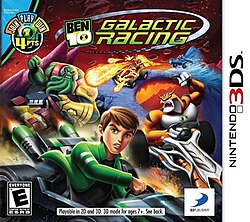
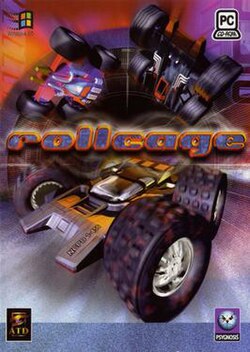 Rollcage Stage II on PlayStation
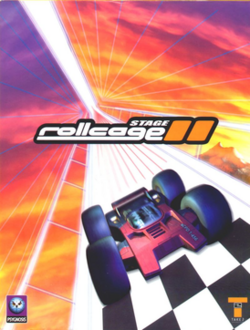 Firebugs on PlayStation
 Blast Chamber on PlayStation
 Lego Racers 2 on PS2
 Ducati World Racing Challenge on PlayStation












 Another SquareThought Site