

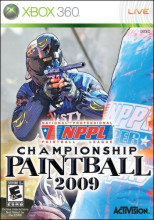

NPPL Championship Paintball 2009 is the kind of game that announces itself with the quiet dignity of someone showing up to a gala in a paint-splattered duffel bag. Developed by Sand Grain Studios and published by Activision, it attempts something mildly ambitious: take the weird, glorious chaos of competitive paintball and turn it into a first-person simulation you can play in front of your television without risking a concussion. The cover art is confident. The manual, presumably, contains sensible safety advice. The game itself understands that paintball is half tactics, half theatrical sprinting and half furious crouch-shooting, which confusingly makes it one and a half things. It markets licensed gear and real-world layouts from the National Professional Paintball League, the Millennium European Paintball Series and XPSL, which is the video game equivalent of name-dropping at a party.
The gameplay is straightforward enough to describe: you point your marker, you squeeze the trigger, and sometimes you celebrate briefly before realizing you've been outmaneuvered by someone who understands cover better than you do. NPPL Championship Paintball 2009 plays like an earnest first-person shooter trying to learn the sport's etiquette. There is a career mode where you can work your way from modest regional tournaments to the big leagues, unlocking licensed gear as you go. The progression system leans on familiar videogame rewards: better markers, slicker masks, and the sort of camo that promises nothing and delivers slightly less. It's satisfying in the same way collecting stickers is satisfying - a small, sticky dopamine hit. Matches are based around classic paintball rules. The object is to eliminate opponents by splattering them with paint, escorting a flag, or capturing points depending on the mode. The AI teams are competent enough to give you a run for your money in single-player. Teammates will occasionally make choices that suggest they are either following a complex tactical plan or suffering an existential crisis; it's hard to tell which. Enemies tend to use the sidelines well and will flank, duck, and pop out of cover with the frequency you expect from people who have probably watched a few too many action movies. Controls on the PS2 are sensible, with aiming and firing mapping neatly to the shoulder and face buttons. Movement emphasizes short bursts and cover usage rather than marathon strafing sessions, which fits paintball's stop-go flow. Reload mechanics are present and can be surprisingly tense; nothing sharpens your senses like being low on paint while a flurry of opponents advances. There's a tactile satisfaction to the moments where you execute a clean flank, lay down suppressing fire, and let a teammate sweep in - the kind of coordination that makes you briefly consider forming a real-world paintball team before remembering the part where paint stains everything you own. The licensed gear adds depth without handling it heavy-handedly. The inclusion of real markers and masks gives the career mode a touch of authenticity - collectibles that matter in small, convincing ways. You feel a little like a sponsored athlete the first time you lop off a cheap plastic marker and replace it with something that looks like it could fire a small, judgemental thundercloud. The locations and layouts take their cues from actual NPPL and Millennium maps, which means the maps are designed for positioning, angles, and sneaky plays rather than just random placement of barrels and bunkers. For a fan of the sport, that conscientious design choice is the game's quiet flex. Multiplayer exists, and it is what it is: an invitation to either glorious teamwork or polite, chaotic betrayal by strangers. The game lists multiplayer as a mode, though on the PS2 experience it's less of a massively connected festival and more of a local or modestly networked skirmish. If you enjoyed LAN parties and shouting instructions at friends across a couch, you'll get something out of this. If you hoped for modern online matchmaking with eloquent leaderboards and ranked seasons, you'll find it quaintly absent - like finding a VHS in a streaming world. Balance-wise, the game mostly avoids the trap of turning into a gear shop where the wallet always wins. Better equipment helps, but strategy, timing, and choosing the right moment to sprint like a startled gazelle are still the main currencies. Difficulty ramps up in career mode with increasingly coordinated opposition and stricter objectives. Matches sometimes descend into paint-splattered chess matches where patience wins; other times they're glorified hunts where the loudest player gets all the attention. Both moods fit the sport, and the game manages to capture them without over-explaining.
On the PS2, NPPL Championship Paintball 2009 looks like a game that learned to be economical with its ambitions. The textures are functional rather than photogenic; grass looks like grass if you squint and pretend indifference is art. Character models are serviceable - faces don't say much, which, if nothing else, prevents them from lying to you about how bruised your pride is after being splattered. Bunkers and course elements are clearly modeled after real-world layouts, which helps with readability during play: you can tell where to hide, which objects block line of sight, and which props are purely decorative and therefore safe to ignore. Animations are competent, though occasionally they remind you you're watching a puppet show that has discovered the joys of kinetic urgency. There are moments where a player's movement snaps from heroic to slightly embarrassed, the kind of staccato motion that makes you respect the animation budget. Particle effects - paint splats, smoke, celebratory puffs - are satisfying in the micro, with paint leaving visible marks that feel good to see. The PS2's hardware limitations mean lighting and draw distance are modest, but the essential readability is preserved, which is what matters most in a tactical game. Sound design follows a similar philosophy: pragmatic, confident, mildly amused. The thwack of a paintball hitting fabric has a punchy, almost comical weight to it. Announcers are terse, keeping commentary to the basics rather than narrating your entire life story. Music is unobtrusive; it knows the game is not a rave but a competitive sport where your pulse should come from the game and your own poor life choices. Overall, the package looks and sounds like a mid-generation console title that focused its efforts on making the core experiences clear and fun rather than blowing your socks off with spectacle.
NPPL Championship Paintball 2009 on the PS2 is not a revolution wrapped in camo, nor does it pretend to be. It is, however, an honest attempt to translate a niche but energetic sport into a playable, if occasionally dour, videogame. The career mode's steady progression and licensed gear give the game a satisfying backbone, while the map design - drawn from NPPL, Millennium and XPSL layouts - rewards tactical thinking. The AI and multiplayer provide a range of experiences from satisfying coordination to the kind of glorious chaos friends and strangers bring to the field. If you come expecting a AAA spectacle polished to the sheen of a showroom helmet, you'll be disappointed. If you want a paintball experience that values tactics, positioning, and the minor thrill of a perfectly executed flank, then this game will deliver. Its graphical presentation is pragmatic and readable, and its sound design does its job without grandstanding. It's a competent sports sim with character but not swagger. Score: 6/10. This is the videogame equivalent of a well-organized weekend paintball event: occasionally muddy, sometimes exhilarating, and overall more fun than you might have predicted when you first looked at its modest ambitions. It's a game that knows what it is, mostly does it, and leaves you with a reasonable amount of satisfaction and a faint desire to wash the imaginary paint out of your virtual wardrobe.
 TOCA Championship Racing on PlayStation
 Showtime Championship Boxing on DS
 PixelJunk Shooter 2 on PS3
 Primal Carnage: Extinction on PS4
 Accolade Sports Collection on Xbox Series X/S












 Another SquareThought Site