

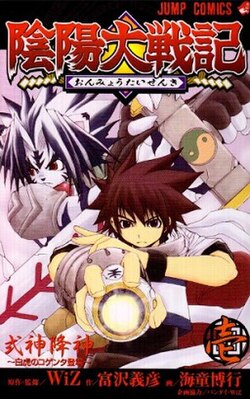

If you grew up collecting anime cards, pretending your childhood plushies were secret ritual monsters, or whispering dramatic one-liners into your hairbrush at 2 a.m., then Onmyō Taisenki: Hasha no In is basically a nostalgia sandwich with extra mystical mayo. Based on the mixed-media Onmyō Taisenki franchise (manga, a 52-episode Sunrise anime, and a small army of toys), Hasha no In drops you into the weird and wonderful world of shikigami, Drives, and seals - where being twelve and emotionally volatile is apparently a prerequisite for world-shaking destiny. Released for the PlayStation 2 in June 2005, this tie-in title leans heavily on the series' plotline: Riku Tachibana, his white-tiger shikigami Kogenta, and their crew are tangled in the classic anime business of stopping sinister corporate cults (Chi-ryū, naturally) from opening ancient seals and unleashing millennia-old chaos. The game is unabashedly a fan service machine - if the anime ever invited you to scream "Byakko power!" into your pillow, the game answers by letting you do it button-press style. This review is for the person who enjoys the charm of an era when PS2 was still king and licensed anime games were a niche of equal parts earnest care and budgetary wizardry. I came for the shikigami, and stayed for the melodrama - and also for the occasional baffling design choices that make you nostalgic for the days of manual memory card saves and strange joystick rituals. If you haven't seen the anime, expect to be spoon-fed the gist: Ten-Ryū vs Chi-ryū, giant spiritual seals, the enigmatic Utsuho who can control yōkai, and a troupe of characters who take bonding and destiny very seriously. If you have seen the anime, congratulations: you will get to re-live many moments while also wondering why the camera still thinks a close-up on Kogenta's nose is cinematic genius.
Let's talk about what you actually do when you're not admiring character portraits and reading subtitles that feel like they were translated by a poet who hates commas. Onmyō Taisenki: Hasha no In is structured like a fan-centric action/adventure with heavy story leanings. The backbone of the game is the relationship between human characters and their shikigami - in the show's terms, the Drive is the thing that calls forth contract spirits (yes, even the word 'Drive' sounds like a gadget you should've gotten with an instruction manual and three black-and-white stickers). In the game, summoning your shikigami is a frequent and satisfying part of combat; it feels like pairing a playable avatar (Riku) with his belligerent spirit buddy (Kogenta), who is equal parts sarcastic mascot and literal deus ex machina. Combat revolves around switching between human and shikigami roles: you're not just mashing face buttons hoping for fireworks - there's an emphasis on timing special Seals (In), which echo the anime's motif that hand gestures and rituals matter. Executing these Seals allows for flashy special attacks, which are often the cinematic, health-sapping finishers that make you feel like the heroes of a Saturday morning show. Enemies range from ordinary yōkai goons to big-budget boss characters like Daikōjin-level threats and the scheming executives of Chi-ryū. Because the franchise likes stakes, many encounters are framed as "defend the shrine" or "stop the ritual," and the game obligingly stages a few fights that end with the camera trying very hard to sell you the emotional toll of the last hit. Party composition is where the anime's roster comes into play: Riku and Kogenta are your bread-and-butter duo, but you'll be joined by the likes of Souma, Nazuna, Teru, and other Ten-Ryū members across the story. Each character brings a flavor of their anime persona - Souma's combustible youth, Nazuna's understated competence, Teru's hilariously tragic broke-ness - to combat through unique skills and shikigami summons. The voice cast from the series (including Jun Fukuyama as Riku) shows up to deliver the dramatic beats, making the cutscenes feel less like game exposition and more like episodes squeezed into loading screens. The campaign is largely story-driven; if you liked the episode list from the anime - everything from "God Descend! Byakko no Kogenta" to "With Our Bonds At Stake" - you'll recognize beats and arcs adapted into mission format. Expect plot-heavy chapters where combat is only the punctuation to exposition-heavy sequences. That's a polite way of saying some missions feel like walking simulators with combat interruptions, but if you're emotionally invested in Ten-Ryū's interpersonal drama, those sections play out like a choose-your-own-meltdown diary (which is good, because anime feelings deserve an audience). On the systems side, progression feels classic mid-2000s: unlock character abilities, upgrade your Drive's potency, and occasionally gain access to higher-tier transformations (the anime's Daikōjin and Master Drive moments get represented as powerful in-game states). There's a modest sense of customization - assign seals and select which shikigami attacks to slot - but this is not a deep RPG; it's a narrative action game with light progression. Expect to replay some stages for better rewards or to unlock extra scenes if you're completionist-inclined. There are points where the design shows its licensed-game roots: pacing can be lumpy, tutorials feel like they were written by someone who assumes you already read the manga, and camera angles sometimes adopt the 'dramatic but inconvenient' school of thought (perfect for emotional reveal, terrible for platforming sections). Still, the core combat has enough charm to carry a playthrough: landing a perfectly timed Seal to unleash Kogenta's über-attack or swapping to Nazuna's shikigami mid-frenzy has a tangible, satisfying snap to it. The balance leans toward fans first, curious players second, and those looking for tight competitive systems third.
For a 2005 PS2 title, Hasha no In dresses respectably. The cutscenes are anime-style, which is what you want from a tie-in: character art that looks like it slid straight out of an episode, complete with dramatic lighting and occasional suspiciously shiny hair. In-game models are serviceable, with shikigami designs getting extra love - after all, the whole point is to make Kogenta look imposing and slightly opinionated, which the team accomplishes. Environments are varied enough to keep missions from feeling like a continuous shrine backdrop; you'll fight in shrines, corporate interiors (because of course the villainous group is a financial conglomerate with a taste for ancient evils), and the occasional beach episode moment that screams of filler done right. There are compromises, naturally: texture resolution and polygon counts show their age, and some facial animations during dialogue land in the uncanny-valley soap-opera area where lips move and the eyes are emotionally processing war. Particle effects for special attacks still manage to look pretty good, though - they capture the anime's penchant for flashy, spiritually-charged explosions. Color palettes favor saturated tones during climactic moments, and the developers leaned into cel-shaded-esque presentation in cutscenes to glue the PS2 visuals to the franchise's aesthetic. If you play it now, you'll get a comforting wash of early-2000s charm: not modern, but nostalgic in a way that makes you forgive polygonal hair.
Onmyō Taisenki: Hasha no In is the kind of licensed anime game that knows exactly who it's for and doesn't pretend to be anything else. If you're a fan of the anime or manga, it's a pleasant, sometimes thrilling way to step back into the Ten-Ryū saga and spend a dozen hours beating up strange spirits while reciting ritual gestures like a budget sorcerer. The story-heavy structure, faithful voice cast, and shikigami-focused combat deliver more moments that feel lifted from the series than departures from it. For newcomers, the game is a mixed bag: there's enough context provided that you won't be totally lost, but Hasha no In assumes some affection for the tropes it brings to the table. Mechanically, it's enjoyable but not deep; it's got the heart of a classic mid-2000s action tie-in and the occasional design wobbles to match. Visually, it holds a certain dated charm - good-looking in cutscene form, perfectly nostalgic in-game. If you love spirited anime battles, enjoy summoning creatures with flair, and want to be emotionally blackmailed by the power of friendship one more time, give Hasha no In a go. If you're looking for a modern, mechanically rigorous action game, there are better choices. Ultimately, it's a solid piece of fan-focused nostalgia: equal parts ritual drama and goofy fun, scoring an earnest 6 out of 10. Consider it a comfortable, familiar ride with a soundtrack of spiritual melodrama and a companion (Kogenta) who will cheerfully insult you while saving your life.
 SaGa 3 Jikū no Hasha: Shadow or Light on DS
 Daisenryaku Perfect: Senjou no Hasha on PS3
 Tintin: Destination Adventure on PlayStation
 One Piece Grand Adventure on PS2
 Taiko no Tatsujin: Dokodon! Mystery Adventure on Switch
 Darkwood on PS4
 Demon's Tilt on Switch
 Demon's Tilt on PS4
 Lies of P on PS5
 Lies of P on Xbox Series X/S












 Another SquareThought Site