

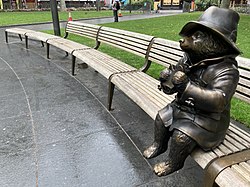

When a beloved piece of children's literature is shepherded into the arcade corridor it is easy to imagine two outcomes: a gentle, faithful translation of charm, or a corporate marmalade sandwich-sticky on the outside, bland on the inside. Paddington Bear for the PlayStation 2 sits somewhere between those two fates. Drawing openly from Michael Bond's Paddington stories (and their long-standing presence in British culture), the game promises an earnest, family-friendly adventure in which the spectacled bear from "darkest Peru" finds himself worrying less about where he will sleep and more about where the next collectible jar of marmalade is hiding. A reviewer trained in the austere traditions of the 1990s will approach such a licensed title with caution and memory of many rushed tie-ins; this release attempts to win you with personality rather than high-octane mechanics.
The core loop is straightforward and intentionally gentle: Paddington wanders a sanitised, storybook London, solves small puzzles, performs helpful errands for the Browns and Mr Gruber, and thwarts the predictable annoyance of Mr Curry. Levels are set pieces drawn from the franchise's most recognisable locales-Paddington Station, Portobello Road, the Browns' house at 32 Windsor Gardens-and each acts as a hub for a handful of bite-sized missions. Tasks range from fetching lost items, staging improvised solutions to misunderstandings (a recurring theme in the books), and rescuing runaway marmalade jars from awkward places. Missions are presented as short, tagged objectives which the player can tackle with an almost toy-like freedom. There's a mild emphasis on exploration-Paddington's inventory fills with curios and a few narrative tidbits that echo the books' vignettes-but the game disciplines curiosity with fetch quests that rarely evolve beyond the second tier. Puzzle design is forgiving: switch-and-lever chores, mild physics fiddles with crates, and the occasional logic puzzle that asks the player to apply Paddington's trademark politeness to coax cooperation out of NPCs. Character interaction is the game's secret sauce. Scripted lines borrow heavily from the source material's tone: polite, bewildered, and frequently self-correcting. Mrs Brown, Mr Brown, Judy and Jonathan appear as quest givers rather than full companions; Mrs Bird's supervision is present in the doorways of scenes. Mr Gruber offers small minigames themed around antiques and bargaining on the Portobello stalls; these are pleasant interludes that display the developers' respect for the books' supporting cast. The much-maligned Mr Curry serves as the comic antagonist and is most often the reason Paddington's errands go sideways. A modest innovation is the "hard stare" mechanic, a nod to Bond's invention: Paddington can issue a polite yet piercing look that temporarily freezes certain NPCs, allowing the player to solve timing puzzles or retrieve items. It is as whimsical as it sounds and is implemented with tasteful restraint rather than as a superpower. Control is where the game's age shows. The PS2's dual-analog era hardware gives Paddington a respectable range of movement, but camera behaviour is occasionally officious. In narrow alleys and between market stalls the follow camera prefers its own sense of rhythm; this can make delicate platforming awkward and frustrate players used to the tighter, faster platformers of the era. Combat is essentially non-existent-thankfully-replaced by slapstick avoidance and procedural embarrassment for Mr Curry, which keeps the title family-suitable but also light on challenge for older players. Save systems are generous and checkpoints are frequent, a design choice that squarely places this title in the hands of younger audiences or players with limited patience. Minigames (baking, market bartering, and a cheeky item-matching memory test) pad out the playtime and often reward the player with marmalade jars that act as both currency and collectible. These jars are a smart piece of licensing: they tie gameplay to character and can be used to unlock storybook vignettes or embroidered hats and duffel coats for Paddington's wardrobe.
Visually the game adopts a charming compromise between storybook illustration and early-2000s polygonal practicality. Paddington himself is modelled with care: the duffel coat, battered hat and the hint of an ever-present marmalade stain are all present and correct, and his animations capture the awkward politeness that defines the character. Backgrounds regularly employ a hybrid approach-a three-dimensional Paddington and props in front of gently textured, almost hand-drawn backdrops. That stylistic decision feels like a deliberate homage to the 1976 BBC stop-motion series which combined dimensional puppetry with two-dimensional art, and it mostly works in the player's favour by lending the game a warm, nostalgic sheen. Architectural touches around Paddington Station and Portobello Road are affectionate and often literate: market stalls loaded with knick-knacks, Mr Gruber's antique shop cluttered with curios, and Windsor Gardens' tidy brickwork. The palette is inviting-autumn browns, Portobello pastels, and the recurring marmalade orange-but the PS2's era limitations show in texture pop-in and occasional polygonal harshness on distant objects. Cutscenes lean on framed, almost illustrated panels that unfold with gentle pans and captions rather than cinematic camera gymnastics. This is an aesthetic choice that preserves the source material's bookish roots, and it spares the developers from expensive motion capture. Non-player characters are expressive, if somewhat economical in their ranges, and the HUD is tidy and unobtrusive: a modest map, objective blips, and a count of marmalade jars that grows like a pantry tally. Audio design deserves a compliment: a soft, orchestral score underlines each level with an English-heritage warmth. Voice work is unshowy; Paddington's murmured lines are pitched to be more endearing than sharp, and the supporting cast deliver performances that read like radio players rather than blockbuster thespians. The result is a soundscape that rarely distracts and often complements the slower, domestic rhythm of the game.
Paddington Bear for PS2 is not a revolution; it is a polite, well-intentioned adaptation that privileges fidelity over flashy gameplay. For parents seeking a mild, undemanding introduction to 3D adventure games for younger players, or for fans of Michael Bond's books who want to wander again through Windsor Gardens and Portobello Road, the title is a comfortable choice. Serious platformers of the 1990s and early 2000s will find its mechanical simplicity and camera quirks limiting, and older players chasing the adrenaline of speedruns or technical platforming will be disappointed by the game's leisurely heartbeat. Where the game scores points is in atmosphere and character: a Paddington-shaped experience that remembers marmalade, manners, and the occasional hard stare. Where it loses them is in ambition; this is a quiet, modest title not made to challenge the player, but to reassure them that kindness, like marmalade, is best spread thin and savoured slowly. Given those aims, a 6 out of 10 reflects a work that is commendable in spirit and execution but not strictly necessary in a library of PS2 classics. If you love Paddington for the books, the TV shows or the films, you'll smile through this one; if you love games for the grappling hooks and technical polish of the era, consider borrowing a marmalade sandwich before you buy.
 Cozy Grove on Switch
 Bear with Me on Switch
 Tintin: Destination Adventure on PlayStation
 One Piece Grand Adventure on PS2
 Taiko no Tatsujin: Don to Katsu no Jikū Daibōken on Switch
 Taiko no Tatsujin: Dokodon! Mystery Adventure on Switch












 Another SquareThought Site