

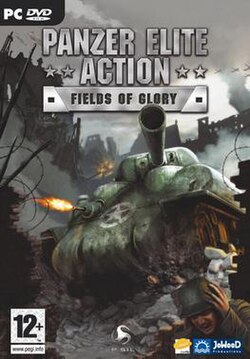

Panzer Elite Action: Fields of Glory felt like a promising concept on paper: platoon-based tank action with historically timed vehicle availability, crew progression, and a surprisingly deep set of systems for a mid-2000s arcade-sim hybrid. The PS2 version, handled by Wizarbox, landed in July 2006 in Europe and promptly revealed the classic console-port tension: solid mechanical ideas inherited from the PC roots, but a delivery that struggle to reconcile ambition with the limitations of the hardware. If you expect a pristine simulation, this is not it; if you expect arcade thrills with a dash of detail, there's fun to be had-provided you can tolerate the technical compromises and design rough edges.
Under the hood the game is refreshingly system-driven for its era. You command a platoon (four German tanks or five American) across multiple theatres-Tunisia, Italy and Normandy-while the single-player campaign presents explicit missions rather than open-ended encounters. The designers baked in a crew-management loop: each crew member has skills that improve over time, new replacements become available, and you can even earn historical medals. That sort of RPG-lite persistence is impressive for a vehicular action title, and it directly affects survivability and performance in a way that rewards investment rather than button-mashing. The ship-to-shore of gameplay mechanics is the weapon and station model: each battle station on your tank can be crewed, and weapon usage mirrors real-world roles. The main cannon and coaxial machine gun are present as expected, and there is an option to toggle gun-sighting into a "very realistic" mode. This is where the game tries to straddle realism and playability: with realistic sighting enabled your engagements become patient, geometry-based affairs where range and turret alignment matter; with it off the game tilts toward arcade sensibilities. Repair and ammo stations placed every few kilometres act as tactical checkpoints that encourage forward planning instead of reckless brawling. Missions are scripted and often cinematic, including night missions that use captured enemy tanks as plot devices. Campaign structure is broad: 18 missions across German, Russian and Allied arcs with historically flavored objectives (encirclements, stopping armoured trains, taking Stalingrad, hunting tank aces). Progression unlocks better tanks in a historically plausible timeline-Tiger I for Germans, later Shermans for Americans-so there's a measurable tech curve that impacts how you approach encounters. Where the mechanics start to creak is in AI and balance. Enemy and friendly AI behavior can feel inconsistent: sometimes opponents flank intelligently, other times they get stuck or make improbably aggressive runs into your crosshairs. The crew chatter is a nice touch-short on voice-over polish but useful as feedback-but friendly-fire penalties are only as meaningful as the collision and hit-detection systems allow. Multiplayer is a notable feature: seven maps, server support for up to 32 players, and configurable server rules (friendly fire percentage, score/time limits, player caps). Multiplayer rewards map knowledge and vehicle roles: light tanks get airstrikes, mediums can place mines, and heavies call in supply drops-an asymmetry that helps diversify matches. On PS2, however, access to robust online play historically depended on server availability and the platform's network infrastructure, making multiplayer a mixed bag depending on when and where you played. Control mapping on DualShock2 is serviceable but reveals compromises from the PC design. Turret rotation, throttle, and sighting need to share a limited set of inputs, so precision aiming-even with realistic sighting-feels less natural than with mouse and keyboard. The result is a control surface that requires players to adapt: long-range shots demand patience and compensatory maneuvering, while close-quarters fights resolve with frantic joystick spazzing. The game gives you tools for tactical play, but the interface occasionally fights you when you try to use them.
Visually the PS2 port is competent but dated. Models for major tanks are recognisable and include the important silhouettes-Panther, Tiger I, Sherman-so historical flavour is intact. Texture resolution and LOD are visibly downscaled from what PC players would have seen, with characteristically PS2-era texture shimmering and pop-in on distant geometry. Lighting is pragmatic rather than cinematic: daytime missions rely on flat ambient lighting with simple shadowing, while night missions use darker palettes and limited light sources that occasionally hide enemies in mud and silhouette. Performance is where the technical trade-offs show. Frame rates dip in large encounters and during heavy particle effects (explosions, smoke), which hurts the responsiveness of turret control and makes aiming feel floaty at times. Draw distance and object streaming are tuned conservatively; this keeps memory pressure manageable but results in noticeable pop-in of enemy units and buildings as you close. The HUD is straightforward and functional-ammo counters, crew status and quick hit indicators are readable-but lacks the polish of contemporaries: menus are slow to navigate, and loading times between missions are longer than you want when the whole experience leans on repeated sorties. Despite limitations, there are flashes of design-savvy: map layouts have tactical choke points and cover opportunities that reward positional play, and destructible elements-though limited-contribute to a sense of impact when shells find their mark. The audio design is similarly utilitarian: weapon sounds are keyed to type and tone, crew voice lines are sparse but contextually useful, and music is unobtrusive. Taken together the audiovisual package communicates the game's systems, if not the full sensory fidelity a modern tank sim might promise.
Panzer Elite Action: Fields of Glory on PS2 is a textbook example of interesting ideas bumping into mid-generation hardware limits and a bumpy porting process. It's earnest: the crew progression, historically staged tank unlocks, realistic sighting mode and multiplayer rule depth demonstrate that the developers wanted a strategic tank game, not just an explosion button. The execution, particularly on PS2, is hamstrung by control compromises, visual downgrades and uneven AI and performance. Reviews reflected that gap-Metacritic places the PS2 release well below the PC and Xbox versions-and the game's rough edges are impossible to ignore if you're playing for precision tank simulation. If you want a quirky time-sink that lets you herd a platoon, tinker with crew builds and occasionally pull off a gratifying long-range kill while tolerating pop-in and control inertia, there's value here. If you demand tight handling, spotless performance, or a modern online ecosystem, this PS2 outing will frustrate more than it delights. In short: a mechanically ambitious tank action game that gets a lot right on paper and some memorable moments in play, but is ultimately a compromised ride on the PlayStation 2. Take it for the systems and historical flavour, not the polish.
 Action Man: Operation Extreme on PlayStation
 Combat Elite: WWII Paratroopers on PS2
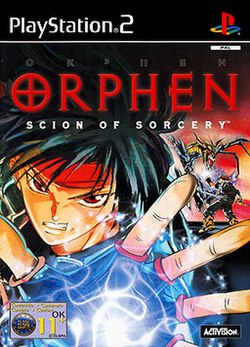
 Orphen: Scion of Sorcery on PS2
 Project Sakura Wars on PS4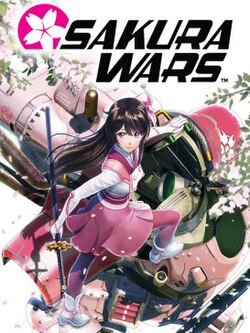












 Another SquareThought Site