

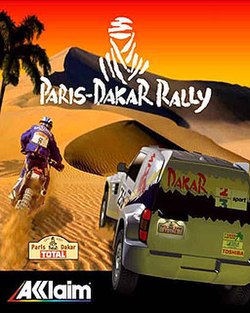

This is a review written like a drama club put the Paris-Dakar rally onstage and then let the props improvise. Paris-Dakar Rally for PS2 and PC is officially a racing game, and unofficially a soap opera about machines, sand, and broken promises. It tries to dramatize one of motorsport's most brutal endurance tests, the 2000 Paris-Dakar-Cairo event, by turning locations into acts and stages into scenes. The result is less Hollywood epic and more low-budget indie whose lead actor keeps missing lines. The cast is curious: you have the ambitious Driver, the overconfident Dev Team, the well-meaning but tone-deaf Publisher, the merciless Desert, and a chorus of Critic-Reviewers who show up to point out every moment the plot goes off a cliff. The game ships with the premise that traversing ten locations, each with four stages from Senegal to Wadi Elrayan in Egypt, will be a satisfying arc. In practice, most character arcs peak at 'stalled in a sand dune'.
If characters are what interest you, the Driver is the protagonist who never quite grows into the role. At the start, the Driver arrives eager, clutching a controller like a steering wheel and dreams of glory. He signs up for single-player and multiplayer campaigns, promises himself he'll master navigation, and then promptly learns that the Navigator is an unreliable sidekick. The in-game navigation systems and stage designs often feel like a stubborn co-driver who gives you a map folded wrong; checkpoints appear, disappear, and sometimes seem allergic to player expectations. Broadsword Interactive tried to build a long, episodic journey: ten locations each containing four stages, giving the impression of an evolving pilgrimage from Senegal to Egypt. That structure could be the spine of a proper character-driven tale, where each locale teaches the Driver something about resource management, terrain respect, or humility. Instead, the pacing feels episodic in the sense of a sitcom gone wrong: same setup, different backdrop, punchline of disappointment. Races can drag because the handling model and mission balance rarely let the Driver shine. You put in the hours, you sharpen skills, and the game responds like a skeptical mentor who says 'Nice try' and then sends you back into another hour-long grind. The Dev Team's arc is tragicomic. They are clearly ambitious - a licensed rally, multiplayer, PC and PS2 ports - but their ambitions clash with delivery. On one hand, credit must be given for attempting to recreate the real-life event and the scale of cross-country stages. On the other, player feedback from the era reads like a Greek chorus of disappointment: inconsistent controls, dull AI, and race systems that make strategy feel optional. Reviewers were unforgiving. IGN and GameSpot flayed the PS2 version with single-digit scores on a ten-point scale, and Metacritic aggregates the PS2 reception at 36/100. Consoles + and 4Players offered kinder marks, but even their praise feels like a concession that the game at least tried to be something different. The Desert is the villain everyone loves to hate. In true antagonistic fashion, it is omnipresent, shaping the stakes. Sand dunes, heat, and long, lonely stages are meant to force the Driver to adapt, to read terrain, to manage fatigue. In the game, these elements exist, but their implementation rarely rewards the player for strategic thinking. Obstacles are either too forgiving or arbitrarily punishing. The drama of a come-from-behind win against the shifting sands almost never arrives because the systems that should enable such narratives are either absent or inconsistent. Multiplayer is the comic relief, a place where the plot loosens. The mode exists, and when you and a friend manage to find a match without lag or a weird collision bug, there are flashes of fun. Two human drivers tearing across a poorly textured plain can outshine the solo experience simply because human unpredictability introduces narrative beats the game itself failed to script. It is in these ragged moments that you remember the rally's core appeal: competition, survival, and the thrill of out-driving another living person. Ultimately, story arcs here are more about potential than payoff. The Driver could have become a legend; the Dev Team could have learned from early missteps and iterated; the Desert could have humbled and then elevated the player. Instead, the ending feels abrupt. GameSpot even shortlisted the title for its 2001 'Worst Game' award, a final act critics used to underline a trajectory that began with enthusiasm and ended with 'maybe next time.'
The visual character of Paris-Dakar Rally is functional but forgettable, like a background extra who knows their lines but never steals a scene. For a game trying to sell the epic scope of traversing continents, the environments are disappointingly bland. Texture work often reads like a postcard printed at the wrong resolution: you can tell it's supposed to be sweeping desert, dunes, and distant horizons, but the engine sometimes collapses the grandeur into blocky horizons and repetitive scenery. Models for vehicles do what they need to do: they look like rally machines from a distance, but up close you notice the corners cut in polygon count and detail. Lighting and weather are present but never used to full narrative effect. A proper character study of the Desert needs light and shadow to tell mood; this game's visuals shrug and say 'same as yesterday.' On the flip side, the PS2 era had limits, and the title attempted to deliver multiple long stages across varied locations. That it managed that scope on hardware of the time is somewhat admirable, even if execution lacked polish. Graphical glitches and rough presentation contributed to the negative reception. When the aesthetic does not support the story you are trying to tell - the epic of survival against nature - the emotional beats fall flat. Players expecting a cinematic cross-country saga received instead a functional racer whose graphics neither inspired nor infuriated enough to be memorable in a good way.
If Paris-Dakar Rally were an ensemble drama, it would be an earnest production beset by costume malfunctions, awkward direction, and a sound engineer who forgot the boom mic. The game has heart: it attempts to model one of motorsport's greatest endurance tests, offers a sensible structure of ten locations and multiple stages, and includes both single-player and multiplayer modes. Those are the seeds of a meaningful arc. Unfortunately, poor controls, uneven design, and a presentation that never quite commits to the epic it hints at turn that seed into weeds. Critics noticed; the PS2 version holds a low Metacritic score and earned scathing reviews from major outlets. For collectors or die-hard rally fans curious about historical attempts to capture the Dakar on consoles, it is worth a look as a curiosity and a lesson in how ambition can outpace execution. For players seeking a satisfying character-driven journey where the Driver grows, learns, and triumphs over the Desert, this title is more of a tragicomedy than a triumph. In short: noble intentions, spotty execution, and a story arc that ends with more sand in the gearbox than applause on the podium. Score: 3.5/10.
 Dakar 18 on PS4
 ACA Neo Geo: Thrash Rally on Xbox One
 Roary the Racing Car on DS
 Team Sonic Racing on Switch
 Garfield Kart: Furious Racing on Switch
 Ben 10: Galactic Racing on PS3













 Another SquareThought Site