

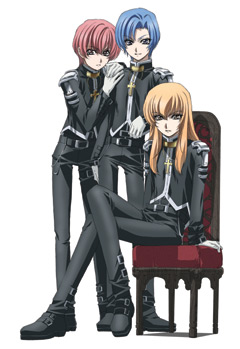

Princess Princess on PS2 is a licensed visual novel adaptation of Mikiyo Tsuda's oddball school comedy-drama: an elite all-boys academy that copes with surplus testosterone by appointing three of its prettiest first-years to dress as 'Princesses' for morale duties. On paper the premise reads like someone dared freshman-year Japan to start a cosplay club and then forgot to put the punchline in the footnotes. The game, subtitled Himetachi no Abunai Hōkago, largely leans into what the manga and anime do best: letting character quirks and interpersonal friction do the heavy lifting. If you're into character-driven slices of life with a steady undercurrent of performative identity, this PS2 visual novel is like a backstage pass to the drama club where everyone's emotions are costume changes.
The PS2 adaptation is not trying to reinvent visual novels; it takes the franchise's episodic, slice-of-school-life structure and rearranges it into interactive chapters that follow the same beats fans will recognize from the anime-introductions, festival arcs, the stalking incident, and the ultimately thornier moments about family and belonging. Gameplay boils down to reading scene text, watching sprite-based interactions and event illustrations, and occasionally making choices that branch to short scenes or slightly altered endings. The choice structure is modest, which fits the material: Princess Princess isn't a multi-route romance simulator so much as a character anthology. The game rewards attention to dialogue and small emotional cues more than stat grinding-perfect for players who prefer analysis over min-maxing. The real engine beneath the surface is character development. Toru Kouno is the player's anchor: newly transferred, orphaned, and using the Princess role as distraction and armor. In the game your 'choices' when you play Toru rarely turn him into a different person; instead they highlight shades of his coping mechanism. Early routes present Toru's willingness to throw himself into the role-treating the Princess duties as a temporary imperial throne where free lunches and adoring classmates fill the hole left by family trauma. Mid-game sequences invite you to watch that performance wobble: a tug-of-war between attention-seeking as avoidance and attention as a bridge to friendship. The game excels at making small moments-an ill-timed fan encounter, a private late-night conversation-do real narrative work. Yuujirou Shihoudani is the series' gleaming troublemaker, and in the visual novel he operates as the emotional accelerant. Yuujirou's teasing is a surface-level joke, but the game's scenes devoted to his family reveal a lonelier truth. In multiple set-pieces you see how his confident queen act dissolves when family expectations and a perfect-appearing home life are mentioned. These beats are handled with restraint: the player isn't railroaded into a melodramatic reveal, but you'll watch Yuujirou move from flippant provocateur to someone who tends to Toru in quiet, unshowy ways. The visual novel's dialogue-heavy format gives these interactions room to breathe; the payoff is that his friendship arc with Toru turns from banter into mutual reliance rather than fanservice. Mikoto Yutaka's arc is the one most likely to surprise players who expect only cheap cross-dress gags. He starts as the reluctant princess: embarrassed, resentful, the stand-in for anyone pressured into a role by external forces. Through the game's cultural festival and choir arcs, Mikoto's stubbornness gets humanized-his resistance is not mere pride but fear of losing his relationship with Megumi and of being misunderstood. The game gives him small victories that matter: a tentative acceptance of his duties, a comedic fantasy sequence that shows his deep yearning for normalcy and affection, and scenes where his girlfriend Megumi's reaction reframes his identity as continuity rather than performance. Mikoto's arc is about agency: you watch him reconcile the shame of being staged with the comfort of being loved. Secondary characters are treated like auditioning understudies who steal their scenes. Shuya Arisada, former Princess and student council president, is depicted as a quietly competent manipulator of institutions; his scheming serves as structural pressure that forces the leads to grow. Akira Sakamoto and his improbably beautiful family provide both comedic respite and a mirror for Toru's insecurity-Akira's arc explores being the "average" soft-spoken good kid in a family of dazzling specimens, and the game uses this to examine belonging without needing dramatic pivots. Natashō, the costume designer, is the one who reminds the narrative that appearances are costumes in more senses than one: his obsession with fashion becomes an oddly tender commentary on creative control and the meaning of presentation. The visual novel also doesn't shy away from the premise's problems. The Princess system is shown as both a relief valve and a structural imposition: students cannot refuse the position, and the series' comedic surface sometimes masks real questions about consent and objectification. The game includes touches that let you see how the school's rules produce both pleasure and constraint, which is why the later chapters-where a new director threatens to abolish the system-serve as legitimate moral pressure rather than mere plot contrivance. Choices rarely change the central arcs but can tilt emphasis: spend more time in Yuujirou's rooms and you'll get an expanded version of his family backstory; choose to comfort Mikoto at the right time and his relationship scenes deepen. For players after branching romances or wildly divergent endings, this is not a heavy hitter. For those who want a character study with the ability to poke a little and see different facets, it's satisfying.
Graphically, the PS2 version wears its anime lineage proudly. Character sprites and event CGs resemble the Studio Deen designs from the anime era-clean lines, soft eyes, and expressions that do most of the emotional work. The backgrounds are static but lovingly drawn: dorm corridors, the P-room, and the overblown school festival banners feel like places you could get lost in for an afternoon. The game doesn't attempt flashy 3D or animated set pieces-the occasional limited animation and portrait changes are serviceable and, more importantly, unobtrusive. The visual novel's strength is readable emotion; character poses and facial crops are timed well to emphasize confession beats or awkward comic timing. If you're playing on a CRT-era TV via original hardware, the color palette has a warm, slightly saturated charm. Modern players using upscalers will notice softness in some CGs, and the lack of high-res assets makes the game look dated compared to contemporary visual novels. That said, the PS2 aesthetic complements the content-the art reads like a comfy cardigan rather than a designer jacket, and for a story about staged appearances and private frailties, that's oddly perfect.
Princess Princess on PS2 is a curious, largely successful effort to turn a gag premise into a meditation on friendship, identity, and the complicated ways we armor ourselves with roles. It won't satisfy players who expect branching, route-heavy dating sims: the game is more of a curated anthology of character-focused scenes than a playground for alternate lives. Fans of the manga and anime will find the adaptation faithful and emotionally rewarding, particularly if they come for the slow-acting drug of watching damaged boys learn to mean something to one another beyond spectacle. The game's humor lands enough that it eases the weightier moments, and its willingness to interrogate the Princess system-without suddenly deciding that everything was a social experiment-gives it narrative integrity. Critics who find the forced cross-dressing premise uncomfortable (and there are valid critiques, as noted by commentators like Casey Brienza) will find that the game doesn't gloss over the ethical oddities; it treats them as part of the social architecture the characters must navigate. Ultimately, Princess Princess is recommended for players who care about character work, enjoy modest interactivity, and don't need their licensed adaptations to reinvent the wheel. It's a comfortable, thoughtful drop of nostalgia with a wardrobe full of emotions. Score: 7.5/10.
 Fat Princess Adventures on PS4
 Princess Natasha on DS
 Root Film on PS4
 Tokimeki Memorial Drama Series Vol. 3 Tabidachi no Uta on PlayStation
 Oshiete! Popotan on PS2
 Story of Seasons: Grand Bazaar – Nintendo Switch 2 Edition on Switch 2
 Cluster Edge on PS2












 Another SquareThought Site