

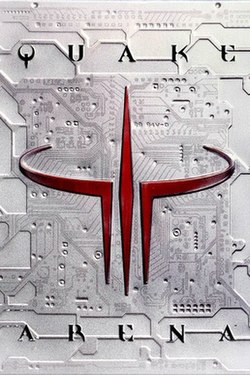

Quake III Revolution is the PS2's diplomatic attempt to translate id Software's multiplayer gladiatorial poetry into a living room party trick. The original Quake III Arena was never built around single-player drama - it was a cathedral to twitch reflexes and map knowledge - but Revolution grafted a mission-based single-player experience and local split-screen multiplayer onto that bloody altar. What remains is a game that still smells like rocket fuel and late-night LAN parties, but now it also tries (sometimes awkwardly) to hand you a map and say: "Here, play the gladiator's part and pretend it's meaningful." This review takes a deliberately odd route: instead of just counting frags and frame rates, it reads the combatants' non-existent diaries, tracks their 'story arcs' through tiers, and asks whether a game built around respawn can still deliver emotional stakes - or at least the feeling that your favorite helmet has a personality.
Quake III's official narrative is basically: the greatest warriors of all time are kidnapped by the Vadrigar and forced into arena murder for their amusement. It's so economical it could fit in a fortune cookie, but from that nugget comes surprisingly rich character work - if you accept that character work here is mostly expressed through movement, weapon choice, and canned bot chatter. The PS2 Revolution port inherits the bot-driven single-player progression: you rise through tiers, facing tougher bots from Crash at Tier 0 up to the near-mythical Xaero at Tier 7. That climb is the game's version of a hero's journey, albeit one where the hero keeps dropping their shotgun every time they die. Consider Sarge, the opening cinematic's abducted last stand. On paper he's the archetypal soldier - gruff, beleaguered, not here to philosophize. In Revolution his arc is the classical "taken from the front line and reduced to spectacle." You meet Sarge as a legend, watch him get yanked into the Arena Eternal, and then repeatedly witness his competence reduced to a series of respawns. The emotion is weirdly specific: pity for a veteran forced to play in a cosmic bar fight and a sneaking admiration every time he still nails a grenade jump. Bitterman and Ranger are legacy cameos with veteran-combatant arcs: Bitterman carries the weariness of Quake II's battlefields, Ranger is the stoic, almost mythic shooter from the original Quake, and Doomguy is the franchise's angry, silent wrecking ball. Their 'development' across Revolution's mission structure is really a lesson in how small changes - a new arena layout, one extra power-up spawn, a tilted platform - can alter the way a supposedly static character expresses agency. Doomguy doesn't get more words, but his arc is made by the way the player channels him: storming rooms with the lightning gun becomes his form of monologue. The bots deserve their own novella. Quake III gives each bot a scripted personality, and Revolution preserves that. The bots' lines (written by folks including R. A. Salvatore) are the game's attempts at Hamlet soliloquies between railgun shots. Some bots are cocky, some are philosophical (in a kind of 'I was here before you and I'll be here after you' way), and the top-tier bots - designed to feel like bosses - amount to arc climaxes. Xaero, at the apex, is less a character than a measuring stick: beating him is the final punctuation mark of the single-player climb, the "I have reached competence" moment you can humblebrag to your friends about on the PS2's split-screen. Gameplay-wise, Revolution keeps the mechanical hallmarks: rocket-jumping, strafe-jumping, map control, and balanced weapon roles. The weapons function like personality traits: the railgun is the distant, contemplative sniper; the lightning gun is the up-close rage; Quad Damage is the manic, temporary godhead that turns every character's arc into a tiny tragedy (because it ends). The PS2-specific additions borrowed from Team Arena and a mission framework try to scaffold arcs with goals, but the core emotional beats remain the rhythm of kill, die, respawn, learn. That rhythm is cathartic in its own ritualistic way, even if it isn't narrative complexity. Revolution's split-screen four-player chaos is where these 'stories' get a soap-operatic upgrade. Friends become rival archetypes: the careless grenade artist, the sneaky railgun weirdo, the quad-hogging glory hunter. Watching those play out locally - stealing someone's rocket mid-air, shouting accusations in a living room - constructs transient character arcs that mean more than any voiceover. Where the PS2 version stumbles is in technical choices: as an early PS2 title it lacks online play, sports long loading times, and was criticized for balance issues and the absence of native mouse/keyboard support. Those flaws don't kill the gladiatorial drama, but they do interrupt the pacing of the arcs when you spend thirty seconds loading into a match after finally getting momentum.
Visually, Quake III's id Tech 3 engine was a flex of technical bravado in 1999 and still holds up as a stylized, efficient package on the PS2. Revolution brings those crisp textures and shader-driven surfaces to the console, and the curved spline geometry that was new to Quake III looks surprisingly clean under the PS2's GPU. Mirrors, volumetric fog, and decal splatter make arenas feel lived-in rather than flat arenas of sport. The character models are blockier on PS2 than on high-end PCs of the era, but the art language - gothic meets tech - reads perfectly on a TV from 2001. Where evolution halts is performance and presentation. The port's longer loading times break immersion, and the lack of online play (a hardware/platform limitation more than a design sin) robs the graphics of their most meaningful purpose: showcasing chaotic multiplayer spectacles in real time over the net. Nevertheless, Revolution still nails important visual beats: explosions feel punchy, weapon effects communicate hit feedback satisfactorily, and the map designs are readable, which is the single most important graphical requirement for an arena shooter.
If you approach Quake III Revolution expecting a narrative-driven sprawl, you'll be disappointed. If you approach it as a study in gladiatorial personality - where bots, weapons, and arena geometry combine to create tiny, repeatable story beats - it's unexpectedly rich. The PS2 port adds a mission-based single-player mode and local split-screen mayhem, which gives fledgling arcs a stage, even if technical limits (loading times, balance quibbles, no mouse and keyboard out of the box) hamper the experience. For couch multiplayer with friends, Revolution is a riot: characters bloom into memorable caricatures in the span of a single match. For solo play, it's a disciplined boot camp of reflexes masquerading as plot. Ultimately, Revolution is best judged like any gladiator: measure the spectacle, praise the moments of transcendence (a perfect rocket jump, a railgun headshot across the map, an impeccably timed Quad capture), and forgive the rest. It doesn't rewrite storytelling in videogames, but it finds surprising character in the smallest things - a bot's one-liner, the way a weapon feels in your hands, the way a player chooses to die. For PS2 owners hungry for fast, brutal, and occasionally profound multiplayer, Quake III Revolution remains a worthwhile relic with more heart and theatricality than its synopsis would ever admit.
 Rock Revolution on PS3
 Quake on Switch
 Warhammer 40,000: Boltgun 2 on Xbox Series X/S
 PixelJunk Shooter 2 on PS3
 Turok: Dinosaur Hunter on Switch
 Primal Carnage: Extinction on PS4












 Another SquareThought Site