

 Aug 2025


In an era when most console releases arrive with instruction manuals thicker than the plot of a soap opera, Proteus is the sort of game that refuses to hand you a mission statement. You boot the thing up, cross an ocean, and you are deposited on a small, procedurally generated island. There are no quests to tick off, no bosses to seize the day from, no health meters to lecture you. Instead, Proteus exists as a measured, quietly stubborn experiment: an invitation to walk, listen and discover the way tiny things add up to a whole. If you remember the days when a game could seduce you simply by the way it sounded when you wandered into the next room, Proteus will feel like an old friend you've misplaced. Its creators, Ed Key and David Kanaga, set out to make a nontraditional, nonviolent experience; the PS3 edition, ported by Curve Studios, brings that vision to the living room via the PlayStation Store. Whether you call it a game, an interactive piece of sound design or a meditative toy depends on your tolerance for ambiguity. I call it an ambitious little cartridge-less oddity: earnest, beautiful and capable of frustrating purists who prefer objectives to ambience.
Proteus is minimal by design and maximal in its implications. The island you explore is rendered in a pixel-art aesthetic; it is generated anew each playthrough by procedural systems, so hills, trees, groves and the odd man-made structure will adorn each isle differently. The viewpoint is first-person and the only sustained action the system insists you perform is walking. When you arrive from the sea you are free to be curious: trees make notes, animals contribute motifs, structures thrum quietly when you approach. These elements are not merely decorative: each emits a unique musical signature and the soundtrack is an emergent layer of these signatures combined with a dynamic score by David Kanaga. As you move, the audio shifts. At the top of a hill you may be met with a sparseness of sound; as you descend the air thickens into a little arrangement that could plausibly have arisen in the game's own ecosystem. There is no tutorial. There is no HUD. There are a handful of interactions: animals will scuttle away if you get too close; you can enter a night area to advance the season. The game cycles through spring, summer, autumn and winter. When winter passes its finale the session ends. You do, however, have ways to save moments. The "save a postcard" feature lets you capture a screenshot and reload that state; it doubles as a rudimentary bookmark system for those inclined to linger over a particular landscape composition or a musical piece you'd like to hear again. On the Vita Curve Studios added a couple of platform-specific niceties - a rear touchpad that can alter world colours, and a world-generation mode that takes the real-world date and location into account. The PS3 build inherits these touches, albeit in console-appropriate form. Curve's port uses its own engine and, for the most part, preserves the core: slow walking, curious listening, seasonal progression. There is variety, but not in the conventional sense. The world's permutations are meaningful at small scales - who knew a single tree could carry a leitmotif? - yet the game has attracted criticism for its brevity and, to some, a flagging replayability. Later seasons can feel familiar; the novelty of discovery subtly fades if you expect a different kind of game arc. Proteus courts a peculiar tension. It gives you enough agency to treat the island like a toy but refuses to make the mechanisms of that toy obvious. The lack of objectives has been the most polarising point. Some journalists and players argued it stretches the definition of "video game"; the developers and some critics embraced the term "anti-game." From my old salt-of-the-magazine vantage: whether Proteus is a game depends on what you bring to it. If you bring patience, an ear for texture and a willingness to surrender to quiet, you will be rewarded. If you bring a checklist and a need for escalation, Proteus will be maddeningly, magnificently simple.
Visually, Proteus is an oddball beauty. The landscape is three-dimensional but populated with a chorus of two-dimensional sprites - trees, frogs, rabbits - rendered in impressionistic pixel art. This deliberate mismatch feels like an art-school thesis turned into a PlayStation download: blocking forms suggest rather than define, leaving generous spaces for your imagination. Colour schemes shift with the seasons; autumn dresses the island in orange and brown leaves, winter strips it to essentials. It's the kind of visual language that reads well on a living-room screen because it trusts the eye to fill in details rather than brute-force them with polygons. For a console port, the PS3 presentation is tidy. Curve Studios' engine recreates the island generator faithfully and preserves the sense that you are moving through a small, self-contained ecosystem. Performance on PS3 is largely solid; it lacks the occasional camera jitter some reviewers found on portable versions, though the game's minimalist ambitions mean it never attempts high-fidelity spectacle. That is deliberate. Proteus isn't trying to flex the hardware; it is, instead, an argument for restraint. Sprites bloom into sound when you approach. Hills are models that frame the play area rather than arenas for combat. This is a title that rewards slow observation: the bloom of sun over a ridge, the tiny way a frog's motif layers with a nearby wind chime - these visual and sonic coincidences are the principal attractions. The trade-off, of course, is that the visuals can feel sparse to those expecting the visual density of a traditional adventure or platformer. Elements repeat; animal life can be thin in later stages. But for the patient viewer Proteus offers compositions as quietly satisfying as a record you discover at 2 a.m.
Proteus on PS3 is a strange, deliberate entry in the catalogue of ambient, exploratory software that surfaced in the indie boom. It won Best Audio at IndieCade in 2011 and found itself inside museum exhibits - accolades that speak to its strength: a dynamic soundtrack that does most of the heavy lifting and an island that rewards curiosity. This is not a game to be conquered. It is a place to sit in for a while, to let procedural systems conspire to make music around your footsteps. Viewed as such, it succeeds admirably. It can feel like an elegant little experiment translated to the living room, and Curve Studios' port keeps the essentials intact. Measured as a conventional PlayStation purchase it will divide buyers. Some will hail its restraint and craftsmanship; others will call it too brief and insufficiently gamified. In score form I give it a 7.2 out of 10: a high mark for ambition and audio design, tempered by a brevity and replayability ceiling that will put off those who measure value in hours of escalating challenge. If you grew up in the '90s with a penchant for ambient CDs, rainy-day exploration and magazines that reviewed games with both a scalpel and a wink, you'll find a lot to admire here. If you crave objectives, trophies and a clear reason to return, Proteus will test your philosophical patience. Either way, it is brave in the way only small teams can be: unafraid to make a video game that sounds like itself and asks in return only that you listen.
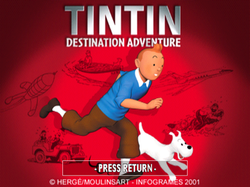
 Tintin: Destination Adventure on PlayStation
 One Piece Grand Adventure on PS2
 Taiko no Tatsujin: Don to Katsu no Jikū Daibōken on Switch
 Taiko no Tatsujin: Dokodon! Mystery Adventure on Switch










 Another SquareThought Site