

 Aug 2025
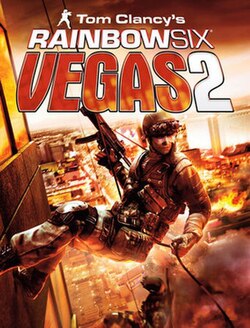

There are sequels and there are continuations; Tom Clancy's Rainbow Six: Vegas 2 is the latter - a careful, unmistakably commercial extension of a well-tuned concept. Ubisoft Montreal returns to Sin City with a follow-up that wears its intentions on its sleeve: refine what worked in the original, add a portable set of improvements, and give players the choice to inhabit the protagonist rather than follow a pre-written lead. For PlayStation 3 owners in 2008, this meant a tactical shooter that aimed to keep the grim satisfaction of methodical entry and precision shooting alive at a time when shooters were leaning ever more heavily on spectacle. The title bills itself as part sequel, part prequel, and that duality is evident in the campaign: players take on the role of Bishop, a seasoned Rainbow operative whose story threads through and around the events of the first Vegas. Character creation makes an entrance here; rather than assuming the familiar face of Logan Keller, PS3 players can craft Bishop's appearance and gender, and in cooperative play that customization extends to Knight, Bishop's in-mission partner. On paper the changes are modest, but in practice they yield a game that feels like a considered update: new maps, more multiplayer modes, extended advancement systems, and handier AI commands. The intent is plain - keep the formula intact while smoothing its rough edges and widening the playground for squads and friends.
Rainbow Six: Vegas 2 splits its time between measured single-player scenarios, a cooperative story mode, and a rejigged multiplayer suite. The campaign preserves the deliberate pacing of the series: reconnaissance, breach, and controlled eliminations rather than run-and-gun improvisation. The game swaps the solitary mantle of the previous lead for Bishop, a role whose narrative weight is shared with computer teammates or a human co-op partner. Ubisoft Montreal insists the companion AI has been improved and, for the most part, this is true: teammates will cover each other as they advance and can be issued environment-based contextual orders - shove a flashbang here, breach that door, or pin an enemy at that window. The functionality is not always flawless, but it elevates the missions above the twitchy chaos of lesser shooters. Cover mechanics are central. When you press yourself against a wall the camera snaps to third-person, an elegant design choice that presents the battlefield as if through the lens of squad tactics rather than solo heroics. While in cover you can blind-fire or line up a precise shot using the reticle; you cannot, however, peer down iron sights unless you attach a scope. This trade-off encourages planning - you will switch into first person to make the careful headshot and slip back to cover when the room turns hostile. Grenade commands and more direct orders to squadmates inject a small but meaningful tactical palette into encounters. Terrorist Hunt returns, preserving the arcade-like pleasure of repeated enemy encounters on semi-open maps. It supports up to four human players online on the Xbox and PC versions, but on the PS3 the co-op campaign itself is limited to two players where a second player assumes Knight's position. This decision tightens the narrative focus but slightly reduces the larger-party mayhem some players enjoy. Multiplayer, meanwhile, is deeper than the average quick-match roster of its era: more than ten new close-quarters maps, two fresh adversarial modes, and a redesigned rewards system give veterans reasons to return. Ubisoft experimented with player-face mapping via the PlayStation Eye, a novelty that marked the era and offered a laugh at parties - implementation was clever, if inconsequential to the shooting itself. The advancement model is one of Vegas 2's most important additions. An experience point (XP) system means every killed enemy contributes to your promotion, and promotions unlock equipment such as body armour. Sitting beside the XP ladder is the ACES combat system, a separate progression that rewards particular playstyles - stealth, explosives, precision shooting - with distinct weapon unlocks. The result is a multi-dimensional progression that respects both the methodical Rainbow player and the impatient multiplayer skirmisher. Perhaps most importantly, progression is shared across modes: XP earned in a quick Terrorist Hunt skirmish boosts your single-player loadout, and vice versa. That cross-pollination keeps the game feeling coherent; your online hours are not squandered if you return to the solo campaign. Voice command support and headset integration were touted at launch. The idea of barking orders into a mic and watching virtual teammates respond fit the Tom Clancy fantasy of a modern squad commander. In practice, players on the PS3 saw mixed returns; the functionality was less of a revolution and more of a novelty. Nevertheless, when it works the immersion it supplies is tangible. The game's co-op and multiplayer flourished in the hands of social players: tactical coordination is rewarded far more than in shooters that rely on run-and-gun reflexes. The campaign's structure is proficiently plotted for a shooter: pockets of intense firefights are interleaved with moments of infiltration, interrogation, and chases. The narrative is competent, if unsurprising, turning on betrayal and a familiar cast of operatives. Nowak's treachery reads as serviceable antagonist work: the game stages his reveal with enough flourish that the mission beats feel cinematic without losing the restraint that defines the series. Fans of tight mission design will find comfort here; those seeking radical reinvention will not. There are rough edges. The PS3 build, as contemporaneous critics noted, exhibits occasional frame-rate hiccups in the more demanding scenes. Such stumbles rarely cripple gameplay, but they are noticeable in a title that prizes precise timing and clean animations. Additionally, the artificial intelligence, while improved, can still be brittle; teammates sometimes take time to process commands in cluttered environments, and enemy awareness can swing between competent and frustratingly obtuse. These are not fatal flaws; they are the small, human failings of a production that prioritizes systems over showiness. Finally, the game's downloadable content offerings and a fan-pack DLC that imported classic maps from the first Vegas added reasonable value for multiplayer communities. The game also landed in the centre of an awkward development footnote when a post-launch patch for PC briefly carried an anti-piracy measure that misfired on legitimate digital sales. That controversy was not a PS3 problem, but it coloured the release's public perception and is worth mentioning to readers who pay attention to the business side of gaming.
Visually, Vegas 2 is a study in contrasts. Running on Unreal Engine 3, the title aims for realism and occasional spectacle, and within most contexts it achieves both. Las Vegas as presented here is less a neon postcard and more a series of believable, physically realized set pieces - the Neon Boneyard, casino floors, convention halls, and a penthouse with its glassy, vertiginous edges. Lighting is used well: when you move from a casino's garish interior to a shadowed service corridor the game sells the transition with convincing bloom and contrast. Character models and weapon textures are competent for the generation. Animations are serviceable and the cover-to-cover transitions are handled with cinematic clarity. Where the title shines, particularly on the PS3, is in the clarity of its tactical spaces - rooms feel like rooms, levels feel coherent, and sight-lines are constructed to encourage tactical thinking rather than arbitrary flank-and-spawn chaos. Map design favors choke points and purposeful entry choices, which rewards the patient player. That said, the PS3's technical limitations show themselves in moments of dense action. Frame-rate dips were noted in several reviews and are visible in practice: explosions, lots of enemy AI, and dynamic lighting can strain the hardware. These slowdowns rarely make the game unplayable, but when split-second reactions matter they are an annoyance. Texture pop-in is rare but present, and environmental destructibility is limited compared to newer titles; this is not an immersive-sim where the world rearranges itself under your bullets. Instead, Vegas 2 is content to get the basics right - readable environments, dependable enemy models, and lighting that underscores mood. Sound design complements the visuals. Weapon fire has weight, dialogue is crisply recorded, and the score by Paul Haslinger underlines tense moments without dominating them. Foley work - boots on tile, the metallic clink of magazines, the distant thud of helicopter rotors - supports the illusion of a military operation without calling attention to itself. All told, the audiovisual package is less about showy set pieces and more about making a convincing tactical sandbox.
Tom Clancy's Rainbow Six: Vegas 2 on PlayStation 3 is not a revolution; it is a refinement. It polishes the tactical mechanics of its predecessor, deepens progression with a sensible XP and ACES system, and provides a multiplayer suite that rewards coordination and patience. The campaign is well constructed, the co-op functionality is useful and often rewarding, and the addition of character customization gives players a gentler way to identify with Bishop. Critics of the day were broadly positive, and aggregate scores in the low eightes attest to a title that pleased its audience even if it did not astonish them. For PS3 owners the caveats are specific and practical: occasional frame-rate instability in hectic scenes, the sometimes-uneven AI responses, and a multiplayer mode that trims story co-op to two players rather than four. These are blemishes rather than defects. Where Vegas 2 succeeds is in doing what it promises - thoughtful tactical design, meaningful progression, and solid multiplayer - better than most of its contemporaries. If you remember the 1990s as a period when shooters were finding their feet and voice, you will appreciate the seriousness of Vegas 2's approach. It asks the player to plan and coordinate instead of franticly mashing triggers; it rewards restraint, and it makes multiplayer feel like an exercise in teamwork rather than a sprint for kill counts. In short, it is the kind of sequel that understands the value of incremental, measured improvement. Score: 8.2/10 - A confident and competent sequel that refines the formula, recommended for players who prefer their shooters with tactics and teamwork rather than nonstop spectacle.
 Tom Clancy's Rainbow Six: Vegas on PS3
 Tom Clancy's Rainbow Six Extraction on Xbox Series X/S
 PixelJunk Shooter 2 on PS3
 Commandos: Strike Force on PS2
 Assassin's Creed II on PS3
 Tom Clancy's Rainbow Six Siege on PS5
 Far Cry 3 Classic on PS4
 Assassin's Creed: Origins on PS4










 Another SquareThought Site