

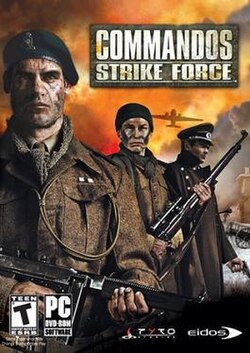

Commandos: Strike Force was Pyro Studios' bold, borderline heretical leap from the bird's-eye, puzzle-like stealth of the original Commandos games into the sweaty palms and tunnel-vision of a first-person shooter. Released on consoles like the PlayStation 2 in spring 2006, the game trades top-down patience for headshots and cinematic trenches, and ships three personalities into that conveyor belt of WWII action: Lieutenant William Hawkins, Captain Francis O'Brien and Colonel George Brown. On paper it's a classic odd-couple wartime drama - a stoic British sniper, a brawny London beret, and a German-born spy who is emphatically 'not a Nazi' - tossed through France, Norway and the ruins of Stalingrad. The tonal collision between the franchise's tactical roots and its newfound FPS identity produces a game that is interesting to study, if not always satisfying to play. This review will obsess over what the game does with its characters and their arcs - because the missions are short, the plot is blunt, and the best way to find nuance here is by paying attention to how Hawkins, O'Brien and Brown are written and used. Expect a handful of gameplay notes, a few eyebrow-raising development observations, and some dry humor about how second World War espionage sometimes feels like three guys improvising because the script lost the map.
Strike Force plays out like three little novella chapters punctuated by gunfights and stealth windows. Mechanically, you switch between one or two of the trio depending on the mission, and each man brings a tiny toolkit that defines both playstyle and character. The Green Beret, Captain Francis O'Brien, is the game's battering ram: pistols akimbo, heavy weapons, up-close and messy. If O'Brien were the kind of bloke who wears his heart on his sleeve, he'd also be the type to fire it. Lieutenant William Hawkins is the classic sniper archetype - scoped rifles, throwing knives and a coolness that the game communicates more through mechanics than dialogue. Hawkins' one oddball ability, that only he can swim in freezing water, is a neat mission-gating quirk that also acts as a metaphor: he's built for patience and solitary danger. Colonel George Brown, the German-born (but not Nazi) spy and leader, gets the uniforms, the silenced pistol and gas grenades - he is the actor, the social chameleon, and also the game's most morally ambivalent figure. The first campaign, set in occupied France (1942), reads like a short story about trust and suspicion. The trio help the French Resistance, but their cover is blown thanks to a double agent. O'Brien suspects Brown. That suspicion isn't just an arbitrary drama beat; it colors every play decision the player makes when controlling Brown: should you wear a uniform and bluff? Should you go loud and hope O'Brien's instincts are wrong? Brown is both leader and suspect, which the game uses to create small ethical quandaries. His arc in France is about proving leadership under doubt: he aids the Resistance and liberates a doctor, showing he is capable of selfless acts even as his comrades eye him sideways. It's an arc about credibility rather than conversion - Brown doesn't suddenly confess to anything, but he accrues small credits for action over accusation. Norway serves as the game's action-heavy midsection and functions like a thriller about resource denial. The Nazi attempt to win the race for nuclear fission gives the missions a clear, kinetic purpose: move explosives, sabotage facilities, fight off waves. It also spotlights the team's tactical diversity. O'Brien is grinding through guard posts and moving heavy charges, Hawkins picks off overwatch targets to keep the truck safe, and Brown slips into uniforms to misdirect patrols. The arc here is procedural: the men become a functioning unit by necessity. The story doesn't give them deep internal changes, but the missions themselves teach the player how each character's toolkit complements the others. If France was about trust, Norway is about competence: are these three capable of working in concert when stakes are technical and immediate? Mostly yes, and the gameplay rewards that cooperation with smoother mission flow. The Soviet campaign - Stalingrad - is where the script tries to wring a proper climax from its trio. They are tasked with retrieving a seized Russian relic and collaborate with Commissar Salenkov. The sewers sequence pins the players into a trap and forces a fascinating authorial decision: Brown deliberately has Hawkins and O'Brien captured to let himself slip around and infiltrate the garrison. That move reads like the cold calculus of a spy who values mission success and has internalized sacrifice. When he rescues them and retrieves the relic, it looks like redemption; then the final twist arrives - Salenkov is the real double agent. Brown kills Salenkov and leads the exfil, and the team fights through waves of Nazi invaders before celebrating. Brown's arc ends in triumph and vindication, O'Brien and Hawkins reassert their competence, and the team bundles into a cathartic victory lap. The narrative implication is that Brown's morally grey gambit worked, and the suspicion from France is retroactively, if not cleanly, resolved. Across all missions, the game tries to translate character into mechanics. The choices it offers - stealth with Brown in disguise, patient overwatch with Hawkins, frontal assault with O'Brien - inform how you read them as people. Where the original Commandos games made strategy feel like personality (the diver could be patient, the chauffeur practical), Strike Force tries to keep that DNA while adopting FPS tropes. That hybrid promises a more thoughtful action game but delivers something leaner: the strategy is hinted at but often smoothed out by conventional shooter pacing. Fans of the older titles expected the cruel, elegant puzzle of the originals; instead they got a game more inclined to nod at strategy than to require it. On the PS2, control fidelity and AI quirks sometimes get in the way of the character-driven moments. Enemies occasionally act like background props, and the stealth options aren't always tight enough to make Brown's impersonations feel reliably cinematic. When it works - a quiet infiltration in which Hawkins' shot clears a path for O'Brien's charge - the game flashes the tactical brilliance the series used to own. When it falters, it feels like characters are playing their roles for the sake of convenience rather than destiny. That tension is the heart of Strike Force's paradox: compelling character beats constrained by middling systems.
Visually, Strike Force on PS2 looks like a mid-2000s attempt to be atmospheric on a budget. The RenderWare engine supplies blockier soldiers, muted palettes and an emphasis on set dressing over fine facial animation. The environments - a French village, icy Norwegian harbors, Stalingrad ruins - are evocative in broad strokes, and the game uses lighting and weather well enough to sell moments of loneliness (a sniper in freezing dark) or chaos (ruined cityscapes with tracer fire). Character models are serviceable and expressive enough to read in cutscenes, but they rarely convey deep interiority; you infer personality from posture, voice cues and the missions they are given. From the perspective of story, the graphics do what matters: they make you feel the difference between a quiet, morally suspicious infiltration and an explosive sabotage. Brown's disguises look plausible in context, Hawkins' scope sequences feel tense, and O'Brien's heavy-weapons sequences are satisfyingly blunt. However, the PS2's limitations mean faces don't sell subtext the way modern games do - so a lot of the 'character' is carried by mission structure, voice lines and our own imagination. For a reviewer interested in arcs and personality, that's both frustrating and oddly charming: you're forced to become a tiny director, reading beats between textures and shotgun blasts.
Commandos: Strike Force is an awkward but earnest experiment - part character study, part shooter, and part marketing pivot. For anyone who loved the original Commandos for its punishing puzzles, the switch to first-person may feel like betrayal; for those willing to meet it halfway, the game offers compact narratives and a trio of workable, distinct personalities. Lieutenant William Hawkins remains the cool, solitary professional whose abilities underline his arc of isolation and precision. Captain Francis O'Brien is the blunt instrument, the muscle with a surprisingly noble streak. Colonel George Brown is the most interesting piece: a leader whose 'not a Nazi' label is almost a punchline and whose moral flexibility gives the plot its twists. His gambit in Stalingrad - letting teammates be captured to achieve a larger end - is the kind of morally ambiguous spy moment that the game occasionally pulls off with real narrative payback. Critically, Strike Force suffered for its compromises. Reviewers gave mixed scores (the PlayStation 2 aggregate sits around the high 50s out of 100), and fans grumbled that the franchise's trademark difficulty and tactical purity were watered down. Sales were underwhelming, though the game did earn a domestic sales award in Spain for moving at least 40,000 units. As a study in characters and short wartime arcs, it's worth a playthrough: the missions are short, the roles are clear, and the betrayals land with genuine (if modest) punch. As a modern shooter or a faithful Commandos sequel, it is middling. If you boot it up on PS2 today, do it expecting a small, imperfect wartime novella rather than an epic. Let Hawkins' silence, O'Brien's bravado and Brown's ambiguity tell you the story between the bullets. You'll leave the trenches with a handful of memorable scenes, some tactical envy for the old games, and the comforting thought that sometimes a character arc is simply a good plan executed under bad lighting. Not a classic, not a disaster - just an interesting footnote where a beloved strategy series tried to wear a shooter suit and, for better or worse, made it to the dance.
 Fighting Force 2 on PlayStation
 Power Rangers Time Force on PlayStation
 Tom Clancy's Rainbow Six: Vegas 2 on PS3
 Tom Clancy's Rainbow Six: Vegas on PS3
 PixelJunk Shooter 2 on PS3
 Planet 51 on PS3
 Commandos 2: Men of Courage on PS2












 Another SquareThought Site