

 Feb 2011
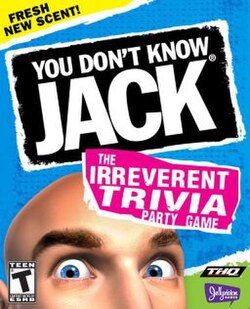

There is a peculiar comfort in seeing an old friend stagger back into the room wearing a new haircut and the same tired grin. You Don't Know Jack, revived by Jellyvision Games after an eight-year hiatus, arrives on the PlayStation 3 not as a bold reinvention but as a carefully dusted relic: still mercilessly funny, still delightfully snide, and still utterly uninterested in pretending it isn't a game show with attitude. Where its late-90s ancestors traded on clever CD-ROM packaging and laughably over-earnest FMV, the 2011 edition trades on a sharp script, the return of Cookie Masterson's belligerent charm, and modern console conveniences like online multiplayer and DLC. For fans of the original series, this is a sentimental homecoming. For newcomers, it's a tidy, mean-spirited crash course in how trivia can be funny again.
The structure will be familiar to anyone who once argued with a roommate over whether "Groucho" is a suitable answer to a question about composers: ten-question episodes culminating in the frenzied "Jack Attack." Each episode is framed as a fake TV sponsor's brainchild (the sponsor jokes are part of the fun) and is played by up to four contestants on the PS3. Questions are mostly multiple-choice, with a 20-second clock that chases you like a tiny, passive-aggressive hourglass. Correct answers net you money; wrong answers cost you money; letting the timer run out is the least aggressive thing you can do to your score. Multiplayer gets the good treatment here. Local and online play (absent only on the Wii version) let up to four players bicker in real time, and the classic "screw" mechanic returns - you can force an opponent into an accelerated answering window, gambling on their panic. The gamble is deliciously binary: if they miss, you feast; if they get it, they steal your lunch. It is pure petty human interaction, packaged with a controller rumble to emphasize your cruelty. Beyond the straightforward multiple-choice fare, the game preserves signature rounds such as DisOrDat, the "Wrong Answer of the Game" gimmick, and the Jack Attack that often turns the whole match on its head. The Wrong Answer feature is a neat console-friendly innovation that preserves the series' taste for lateral mischief: select it and you sometimes receive a bonus and a collectible rather than punishment. DisOrDat forces players to classify a list into two possible bins and is a welcome brain-teaser. Jack Attack itself is a speed-and-pattern-matching finale: a clue defines a relationship and you buzz in when a cycling answer matches. It still has the power to make earlier performance moot, and critics have pointed out that the final round often decides the match; this is both a flaw and a feature, depending on how you feel about comeback narratives. Content-wise the base PS3 release offers 73 episodes, a generous stockpile of scripted mayhem that keeps the game from becoming stale quickly. DLC packs - purchasable only on the PS3 and Xbox 360 - extend the life further, although the decision to gate expansions behind console stores is frustrating for those on other systems. The DS and Windows versions are notably neutered: two-player limits, no online play, and the absence of DLC make them pale cousins of the PS3 experience. The iOS release was briefly available as a single-player tease before being pulled for a broader cross-platform strategy; mobile fans should take note that this is fundamentally a console party experience in spirit and design.
If you come expecting a visual tour de force, you're in the wrong decade - deliberately. The PS3 presentation is clean, unfussy, and very much in the tradition of game-show scaffolding: animated numbers, bright interstitials, and stylized backgrounds that keep eyes on the questions and ears on Cookie. The artwork is serviceable and occasionally clever, with the short musical and animation stings before each question designed to be annoyingly catchy - mission accomplished. Fake commercials and jingles pepper matches and provide pleasant palate cleansers between rounds. Visually, the game doesn't compete with cinematic blockbusters or even the flashiest party titles of its era, but it doesn't need to. The animation and interface are designed to be transparent so the writing and timing can carry the load; they do. Voice work is where the game makes its visual limitations irrelevant. Tom Gottlieb returns as Cookie Masterson, and his delivery is the reason most players will keep coming back. Recorded in what the developers cheerfully admit was a makeshift soundproofed closet, the voice acting nonetheless sounds polished, human, and richly textured. The comedic timing between the narrator's snark and the game's visual cues sells lines that would fall flat with a lesser cast. Design-wise, the PS3 benefits from controller rumble to underline certain moments, which is an old-school but effective touch that makes the act of "screwing" someone feel satisfyingly physical.
You Don't Know Jack for PS3 is a rare modern sequel that remembers what made the original great and refuses to apologize for it. The writing is the star attraction: witty, sharply timed, and confident in its ability to make pop culture and deadpan trivia collide. The return of Cookie Masterson is a masterstroke, and the core gameplay - from DisOrDat to Jack Attack - has been updated just enough to fit on modern consoles without losing its soul. There are flaws. The structure can feel repetitive; Jack Attack often determines the winner, which undercuts earlier rounds' stakes. The decision to sequester DLC to certain consoles and hamstring other ports with reduced features is annoying and feels like an old-fashioned publisher's compromise. The DS and Windows versions are notably inferior, and mobile customers got only a temporary taste before the app was pulled. Despite these gripes, the PS3 edition is the definitive way to play this revival: it supports full multiplayer, offers the most content, and takes advantage of consoles' social features. In a marketplace that often equates novelty with quality, You Don't Know Jack reminds us that a razor-sharp script and a reliable host can still outclass flashy bells and whistles. It's a party game that rewards a quick mind and an ugly sense of humor. Bring friends, bring a willingness to be roasted, and bring change for the DLC if you get hooked. For a comeback that could have been a nostalgia-kitsch cash-in, Jellyvision delivered something closer to the original's mischief and wit. Score: 8.5/10 - a smart, snide revival that mostly hits the mark and will ruin friendships in the best possible way.
 Professional Baseball Spirits 4 on PS3
 Monster Rancher on Switch
 The TakeOver on Switch
 Lego Party on PS4
 Quiplash 2 on PS4
 Super Mario Party Jamboree – Nintendo Switch 2 Edition + Jamboree TV on Switch 2
 We Dare on PS3










 Another SquareThought Site