


 Nov 1999
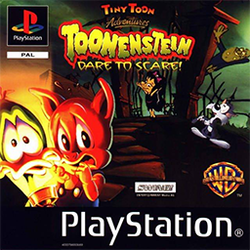

Tiny Toon Adventures: Toonenstein - Dare to Scare! drops you into a spooky mansion with Furrball, Plucky Duck and Hamton J. Pig, and expects you to survive Elmyra/Baroness Toonenstein's brain-swapping shenanigans using equal parts speed, memory and mild panic-management. Released in late 1999 on the PlayStation, it bills itself as an Action Interactive Movie - which is developer-speak for "you'll be glued to scripted encounters while the game tests whether your reflexes and noggin are up to the task." If you're looking for a licensed Tiny Toons nostalgia trip that actually asks you to earn your victory, this one delivers challenge in little, unpredictable bursts. If you're looking for a pure platformer, you're in for a weird, slightly twitchy experiment.
The first thing you notice when you pick up the controller is the simplicity of the core inputs and the complexity of what those inputs demand from you. Movement is left and right for area-to-area within a room; up moves you between rooms and lets you use Acme emergency exits. The square button is your bureaucrat - it activates control switches to siphon power. Circle runs the elevator, but only if you've assembled enough of the mansion's electrical mojo. X is your active defense - it toggles and fires bomb bat disablers - and triangle stops that action. On paper this is wonderfully neat. In practice it means the game is a compact test of a handful of mechanical skills and a handful of decision-making skills, and it mixes them together in ways that can either make you feel clever or make you throw the controller at a particularly smug room. You can boil the game's challenge down to five overlapping skill tests: timing, spatial navigation, risk assessment, short-term memory, and resource (power) management. Each switch you hit is effectively a little mini-game with randomness baked in. When a control switch is activated, an icon appears and whatever it flips to determines the immediate task. A clover? You're golden - no drama. A money bag? Congratulations, you just earned a piece of the generator code: slow, steady, and methodical play is rewarded. Hamton's face? That turns the game into a search-and-rescue puzzle: Hamton gets spooked and the elevator won't run until you find and calm him. A bomb bat icon? That triggers an urgent reflex challenge: you must sprint to a disabler and use X before the bomb bats chew through your control panel. The Baroness' face? Suddenly you are playing a sneaky escape game - dash to an Acme exit before she scoops you back to the starting room and eats your time. This randomness is the heart of Toonenstein's difficulty curve. It's not a precise, repeatable obstacle course; it's an environment that throws a little roulette wheel at you every time you flip a switch. That means the game rewards adaptability and good prioritization - two skills people often forget are different from raw reaction time. If you get a bomb bat icon but the money bag is one switch away, you need to decide: risk the timer on the disabler or go for the generator code piece and hope you can repair the switch if the bats wreck it. This is where the game's punishing but fair design shines: mistakes are frequently recoverable, but they cost time and force you to re-evaluate. The repair mechanics also add an extra cognitive layer. Destroyed control switches can be repaired by an angel bomb bat, so the game never quietly punishes you with permanent dead-ends. It nudges you to plan for contingencies - think three steps ahead and remember where emergency exits and disablers exist in the mansion. Mapping the mansion in your head or on paper becomes an actual skill you cultivate. The rooms are not endless; they are small arenas with clearly defined choke points. Mastery comes from knowing the quickest path from any given switch to the nearest safety or utility: disabler, exit, or elevator. The elevator mechanic is another delightful little resource-management headache. To run it you need full power, which means you can't simply spam it and win. Collecting parts of the generator code via money-bag outcomes is therefore a priority in many runs. This forces the player into repeated cost-benefit calculations: do you chase codes or chase survival? Sometimes the smartest option is to accept a slower run that garners pieces of the generator and aims for long-term progress; other times you have to play short-term cat-and-mouse to avoid the Baroness or fend off bomb bats. That variety is what keeps the challenge fresh even when the mansion's rooms become familiar. Reaction time matters - if a bomb bat event occurs and you're not on the ball, you're visually punished by a destroyed switch and dragged into a backtrack. But reaction time is not the only measure of skill here. Memory and situational awareness are equally important. The Hamton events present a nice twist: the elevator becomes unusable until you locate him, which turns an otherwise direct traversal tool into a scavenger hunt. It encourages players to remember where Hamton likes to hide and to keep alternate routes in mind. The game therefore rewards the kind of spatial memory that real-life sneaking toddlers and raccoons probably have. There is also a psychological component to the gameplay: stress management. The game manufactures tension through sudden threats (Baroness capture, bomb bats) and by resetting players to the starting room if the Baroness gets her mitts on you. Those resets sting, and how you respond - whether you panic and rush into mistakes or slow down and plot the safe path - will determine how quickly you improve. In that sense Toonenstein acts like a tiny, cartoonish boot camp for learning to stay calm under pressure. Because so much depends on the unpredictable icon outcomes, the game tips toward adaptive playstyles. You need a toolbox of micro-skills: the sprint-to-disabler reflex, the patient hunt-for-Hamton method, the measured generator-code grind, and an instinct for repairing systems. Players who lean too heavily on one approach (pure speed or pure exploration) will find themselves outmatched by the game's variety. Worse, repetition is real here: the game's reward loop is built around doing the same kinds of tasks repeatedly with random permutations. If you have the patience and the ability to learn the mansion's geography, it becomes a delightful puzzle of optimization; if you lack patience, the randomness will feel like cheap punishment. A final point about control ergonomics: the mapping is simple but meaningful. The X button's role as both activation and fire for disablers makes it the action-button-of-high-stakes; triangle as a canceler is a small mercy when you misfire. Getting comfortable with toggling the disabler on and off while babysitting your path to safety becomes second nature after a handful of failures. The user interface and inputs are minimal by modern standards, and the game leverages that minimalism to focus entirely on the interplay between a few mechanical systems. If you like games that demand you squeeze maximum play out of a small set of tools, this design will click. If there's a rub, it is that the game's difficulty can sometimes feel dictated by luck. The good news is luck and skill are intertwined: the better you get at reading the mansion and making fast choices, the less the RNG can ruin you. But players should come in knowing that Toonenstein is not a consistent road of difficulty escalation - it's a house of mood swings, and you'll learn to handle its tantrums.
The source material doesn't dig deep into polygons or frame-rates, but the game's identity is unmistakably cartoon-first. Character names and personalities - Furrball, Plucky Duck, Hamton - anchor the experience to the Tiny Toons property, and the presentation serves the gameplay's purpose: clear, readable rooms where you can immediately spot a switch, a disabler or an Acme exit. Visual clarity is the priority here; when bomb bats are on the menu the game needs to communicate danger instantly, and it does. If you're expecting bleeding-edge visual spectacle, this late-90s PlayStation outing won't impress modern eyes. If you want faithful Tiny Toons ambiance and readable level architecture that supports split-second decisions, the visuals do their job. In short: the graphics aren't the star, but they don't need to be - they exist to keep the challenge honest and visible.
Tiny Toon Adventures: Toonenstein - Dare to Scare! is less about platforming finesse and more about developing a handful of survival skills inside a mischievous, random-friendly mansion. It asks you to be quick when you need to be, patient when it's time to collect parts of the generator, and clever enough to map the place in your head. The game's charm comes from that mix: the unpredictability keeps runs tense, and the repair/escape mechanics mean most setbacks are recoverable if you're smart about priorities. Fans of Tiny Toons will appreciate the characters and scenarios, but the real audience is players who enjoy short, high-stakes decision cycles - the sort of person who likes making split-second calls under pressure while keeping one eye on the long-term objective. It's not flawless - randomness can infuriate, and visual ambition is modest - but the design teaches you to play better instead of simply beating you down. For a licensed, late-90s PlayStation experiment that blends reflexes, memory and resource management into something oddly satisfying, I give it a 6.5 out of 10. Bring patience, keep your map handy, and don't let the Baroness catch you - she has zero chill.
 Tiny Toon Adventures: Plucky's Big Adventure on PlayStation
 Tiny Tank on PlayStation
 Onimusha: Dawn of Dreams on PS2
 Action Man: Operation Extreme on PlayStation
 Combat Elite: WWII Paratroopers on PS2
 Door Kickers: Action Squad on Switch










 Another SquareThought Site