

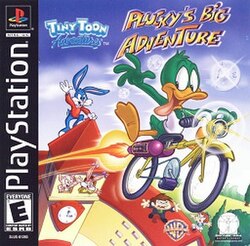

Tiny Toon Adventures: Plucky's Big Adventure is the kind of licensed game that seems to have been designed in the time between 'We should make a Tiny Toons game' and 'Why are we still making this?'. Developed by Warthog and released for the PlayStation in late 2001, it adapts the 'A Ditch in Time' episode with the subtlety of a rubber mallet. The premise is charming in a Saturday-morning-toon way: Plucky Duck forgot his homework, builds a time machine to go fix his past, and then promptly needs everyone in Acme Looniversity to run around looking for machine parts. The result is a single-player scavenger hunt dressed up as a platformer, starring Plucky, Hamton, Babs, and Buster in alternating chapters. The game's writing and setup are faithful enough to the show to make a fan smile for roughly the first five minutes, which is the grace period you get before the gameplay mechanics remind you that cartoons and game design are separate crafts. If you're nostalgic for Tiny Toons, the cast is present (and occasionally helpful), and the story ends the way many misguided inventions do: with parts flying and dignity lost. Critics weren't gentle: IGN called it 'an abomination of a game' and handed a 2.3/10, while Official U.S. PlayStation Magazine kept things short and blunt with 1.5/5. Those responses capture the mood fairly well, but let's take a more measured, deadpan look at what you actually do inside this time-brittle rubber duck's world.
Gameplay centers around four chapters, each putting you in control of one Tiny Toons character. Each character has their own chapter but not necessarily their own discipline in design: Plucky, Hamton J. Pig, Babs Bunny, and Buster Bunny all march through Acme Looniversity collecting items, following clues, and making trades until the right combination of found objects yields the piece of time-bending hardware you need. If that sounds like scavenger-hunt design, it's because it is. If that sounds like a delightful romp of exchange economy and puzzle logic, the game will gently inform you that it is not. Each chapter feels like a small network of rooms and corridors - campus buildings, backlots, and vaguely educational-looking areas that call themselves levels. The levels are populated by series characters who either help, ignore, or try to capture you. Montana Max and Elmyra show up and capture the player on occasion, which is the game's primary method of adding failure states. These captures are less about tension and more about the mild inconvenience of losing a few seconds while a cartoon villain holds you against your will. The rest of the time you poke around, read clue text, pick up items, and occasionally perform platforming jumps that are neither precise nor particularly exciting. There's a trading mechanic that could have been charming in the right hands: you find an item that is useful to someone else, they give you something you don't need, and so on, until eventually you possess the component you need. The concept is social and comedic by nature, like a flea market where everything is necessary and nothing is manufactured with logic. In execution it becomes tedious because the inventory management and clue system lack clarity. Frequently you'll hold an item and stare at the sprite because the game expects you to remember where to go with it rather than giving you any reasonable breadcrumb trail. Controls are functional, which is to say they work enough to get you from point A to point B and occasionally back again. Platforming physics are forgiving, but that forgiveness is not always a virtue; it often feels like the game replaces skill-based challenges with gentle, aimless wandering. Combat is almost non-existent - encounters are usually scripted or resolved by being in the right place with the right object rather than by any tactical input. Enemy variety is limited, and progression mostly comes from the checklist of items rather than learning new abilities or facing increasingly complex obstacles. The chapter structure is the game's attempt to create variety, and in a different reality it might have worked: four perspectives, a different slice of campus for each character, and slight changes in objectives promise replayability. In this reality, repetition sets in quickly. Rooms get reused. NPCs hand out the same kind of hints. The puzzles rarely escalate beyond simple fetch quests and trading loops. The whole is held together by the franchise's voice and character cameos, which do more heavy lifting than the design itself. If you're playing for the Tiny Toons Easter eggs, you'll find them. If you're playing for the gameplay, you'll find plenty of reasons to look at the PlayStation logo and reflect on life choices. There is a certain melancholic charm to watching Babs or Buster wander through a campus that looks like it was designed during a caffeine deficit, but charm is not a substitute for depth. Completion feels like finishing a crossword where half the answers were given to you in advance and the rest were guessed by flipping pages. Save points and checkpoints exist, so you won't be punished by brutal restarts - the game is intent on being accessible, which is another way of saying it's gently, persistently forgettable. For younger players or absolute Tiny Toons completists, the simplicity might be a selling point. For anyone looking for a robust platformer experience on a system that had already seen classics like Crash Bandicoot and Spyro, Plucky's Big Adventure reads like a budget exercise wearing a cartoon mask.
Graphically, Plucky's Big Adventure looks and behaves like a late-era PlayStation title that didn't quite get the memo about ambition. Character models are recognizably Tiny Toons but lack the squash-and-stretch animation that made the cartoon so lively. Faces are serviceable; limbs do what they have to do; textures are flat in a tasteful, time-efficient way. The environments are populated with props and posters that try to make the university feel lived-in, but the whole thing has the color vibrancy of laundry left in the sun for three hours too long. The game's art direction clearly aims for the show's cartoony energy, but the hardware and budget restrain it. Expect blocky geometry, pop-in, and an overall visual polish that suggests the developers did their best with fewer polygons than the problem demanded. Lighting is simple, shadowing is sparse, and animation loops are short. The result is not ugly; it's adequate. It won't make you nostalgic for the original PlayStation's best moments, but it does get the job done without audible complaints from the GPU. Sound design follows a similar 'do the minimum, then add a jingle' philosophy. Music cues are jaunty and serviceable, and many lines from the cast are delivered in a way that reminds you the game is based on a cartoon. Voice work is present but limited; it's enough to give the characters personality but not enough to elevate the narrative. If the visuals are a pair of acceptable shoes, the audio is the shoelaces: present, necessary, and not particularly exciting.
Tiny Toon Adventures: Plucky's Big Adventure is best described as an earnest attempt that got lost somewhere between 'we have a license' and 'we have a game'. It captures the framework of the show - the characters, the premise, the slapstick ending where the time machine breaks and Plucky is hurled like a well-seasoned rubber duck - but it struggles with the fundamentals of fun. The scavenger hunt mechanics, trading loops, and forgiving platforming make the game approachable for younger players, which might have been the point. For everyone else, especially those who owned a PlayStation during its prime, the title feels like an odd footnote: familiar faces in an undercooked package. Critical reception reflected these shortcomings. IGN's blistering 2.3/10 and Official U.S. PlayStation Magazine's low score are not subtle: reviewers expected more from a Tiny Toons outing, and the game offered less. The small audience who will enjoy this game are the ones who adore the franchise enough to overlook mechanical laziness and savor cameo appearances. For everyone else, it is a reminder that a good license doesn't automatically translate into a good game. If you're curious and have an afternoon free and a forgiving nostalgia budget, it is possible to enjoy Plucky's Big Adventure as a short, silly detour through Acme Looniversity. Treat it like a novelty item: interesting to own, amusing to open, and then pleasantly forgettable. If you're seeking quality platforming or anything resembling modern game design standards, keep walking - the time machine to better platformers is just next door, and Plucky is not reliable with directions.
 One Piece Grand Adventure on PS2
 Tiny Toon Adventures: The Great Beanstalk on PlayStation
 The Wacky History of Platform Games
 PlayStation Home on PS3
 Obscure: The Aftermath on PS2
 Cocoto Platform Jumper on PS2
 Mace Griffin: Bounty Hunter on PS2
 Looney Tunes: Back in Action on PS2












 Another SquareThought Site