

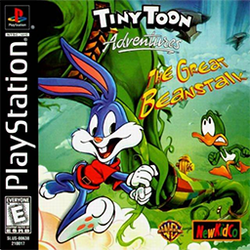

Tiny Toon Adventures: The Great Beanstalk is a PlayStation adventure title built on the charming (and slightly chaotic) Tiny Toon world. You take control of Plucky Duck as he shadows Buster Bunny up the titular beanstalk into a cartoonish cloud kingdom. The premise borrows liberally from Jack and the Beanstalk: big plant, bigger heights, and presumably a giant with questionable rent payments. The game was developed by Terraglyph Interactive Studios and published by NewKidCo in North America (with Sony handling Europe). Announced at E3 1998, it arrived late in the '90s PlayStation cycle and fits squarely into the era's licensed-kid-game mould: colorful, kid-friendly, and designed to feel accessible to younger players. That said, beneath the candy-coated surface there are actual challenge elements - if you pick the right perspective, this game demands timing, observation, trial-and-error persistence, and a surprisingly patient approach to platforming and exploration. This review zeroes in on difficulty and the player skills the game expects you to bring to the climb.
The game's bones are simple: it's an adventure where you control Plucky Duck while following Buster Bunny up and through areas that sit atop a very ambitious vine. The narrative is minimal - the beanstalk is the MacGuffin and Buster is the goal - but the structure is enough to frame a string of bite-sized challenges. If you grew up thinking 'adventure' meant wandering until something sparkles, this one gives you more purposeful micro-challenges: platforming sections, basic puzzles, and situational obstacles that test reflexes and observation more than complex systems. If you want to win here, start by tuning up your timing. Platforming in The Great Beanstalk is not 'Dark Souls of precision' by any means, but it rewards clean inputs and predictable movement. The levels toss you onto moving platforms, narrow ledges, and springy surfaces that make holding a position a temporary luxury. The margins for error are generous enough for kids, but they still exist: missed jumps often send you back a small section, forcing you to re-execute a short sequence of moves. The game therefore teaches - politely, like a teacher who hides a whoopee cushion under your chair - the fundamentals of jump timing, momentum management, and how to read platform telegraphs. Observation skills are the second currency. The designers lean on visual hints; breakable items, subtly different textures, and NPC dialogue give clues to what you should interact with. The challenge ramps not by introducing complex systems, but by burying required items behind environmental puzzles that demand you to spot a pattern or an out-of-place prop. That makes backtracking and exploration part of the rhythm. If you hate looking around and poking everything with an invisible stick, this game will test your patience. If, however, your inner completionist enjoys opening every suspicious-looking chest, you'll find the reward loop pleasing. Pattern recognition and memory come into play during sequences with moving hazards or timed gates. These sections ask you to learn rather than brute-force: observe an obstacle's cadence, then jump in when it offers a safe window. You'll probably fail your first few attempts, laugh about the cartoonish death animation, and then gradually shave seconds off your run as the pattern becomes muscle memory. This is where the game quietly trains rhythm skills - very useful for older platformers and, weirdly, for real-world tasks like making a decent pancake without flipping it into the sink. Puzzles are not brain-melters; they're serviceable, logic-lite affairs that favor lateral thinking over deep deduction. Expect switches that change platform orientations, items that need to be carried to a specific NPC or location, and simple light puzzles where activating things in the right order opens doors. Inventory management exists but is mercifully limited: you aren't juggling a dozen icons, just a couple of tools that must be used in the correct context. That means the real puzzle challenge is recognizing when to use what - a neat way of leaning on situational awareness. Enemy encounters are more about timing than combat depth. You won't be doing complex combos; instead, foes behave predictably and act as moving obstacles. Learning enemy patrol patterns and knowing whether it's safer to dodge or to bait their movement are recurring decisions. Boss fights tend to be set-piece pattern-learning encounters where hitting the attack window or exploiting a temporarily exposed weak point wins the day. They might sting the first time around, but they play fair: once you've learned the boss's rhythm, victory feels earned and cartoonishly satisfying. A large part of the game's difficulty profile depends on patience. Younger players will breeze through some sections thanks to forgiving checkpoints and slow enemy aggression, but the game purposely throws in sequences that require repeated attempts. The goal seems to be teaching persistence: it's okay to fail several times; what matters is learning from each failed attempt. That can be charming or tedious depending on your tolerance for repetition. Personally, I found that the small, frequent checkpoints soften the sting, letting you focus on skill refinement (timing, memorization, observation) rather than punishment. The Great Beanstalk is also an exercise in platform awareness: camera angles are fixed-ish in many spots, so you must rely on parallax and level geometry to gauge depth and spacing. That adds a mild layer of challenge because you occasionally have to estimate jumps without the luxury of freely rotating a camera. It's vintage late-90s console design: clever use of sprited or early-3D backgrounds that sometimes hide the exact landing spot. If you're used to modern, always-perfect camera work, adjust your expectations and sharpen your spatial estimation. If I were to prescribe a skill-building regimen for potential players, it would look like this: practice short burst platforming to improve jump timing; train observational scanning by thoroughly inspecting each new room before leaping; build pattern-memory by intentionally timing out hazards rather than spamming the jump button; and resist the urge to rush - the game rewards deliberate play. For an 18-year-old who still thinks they're invincible, this game is a calming reminder that being quick is good, but being precise and patient is sometimes better.
Graphically, The Great Beanstalk wears its Tiny Toon roots on its sleeve. The character sprites and backgrounds are colorful and cartoony - exactly what the license promises - and the visual language is clear, which is important when the player must rely on visual cues to solve puzzles. The PlayStation hardware wasn't pushed to its limits here, and the result is a pleasant mid-90s aesthetic rather than cutting-edge polish. That is not a complaint so much as an observation: the visuals serve the gameplay. Platforms, hazards, and interactive props are distinct enough that you don't spend time guessing what's solid and what's background scenery. Where the visuals create challenge is in the occasional camera constraint and depth ambiguity. Because the game uses fixed camera angles in places and mixes sprite-based characters with layered backgrounds, judging a landing sometimes feels like estimating from a postcard. It's part visual charm, part retro irritation: you learn to interpret visual clues - shadows, relative size, and railings - to commit to a jump. Lighting and color palettes are bright and kid-friendly, which keeps the mood light even when the game's timing sequences force you into repeat attempts. Overall, the graphics are functional with character - they don't earn any awards for technical bravado, but they translate level information clearly enough to keep the challenge fair.
Tiny Toon Adventures: The Great Beanstalk isn't a masterclass in design, but it's a focused little adventure that asks the player to bring a handful of real skills: timing, pattern recognition, observation, spatial estimation, and a pinch of patience. If you approach it like a training ground for those skills, it's pleasantly rewarding. The game's challenges never turn malicious; instead they are gently educational, teaching you how to read levels, learn enemy rhythms, and execute platforming sequences cleanly. For an older player looking for deep systems or high difficulty, the game will feel light. For a young player or someone who enjoys retro, measured platforming and puzzle-lite design, there's a comforting charm here. The Great Beanstalk is at its best when you accept it as a cozy, occasionally tricky climb rather than a toxic gauntlet. It's an approachable title that quietly nudges you to improve without slapping you with unfair penalties. That earns it a respectable score: not a classic, but a competent licensed adventure that provides fair challenges and useful skill tests - all wrapped in Tiny Toon cuteness. If your taste in games includes patient platforming, mild puzzles, and the will to learn from repeated attempts, Plucky Duck's beanstalk is worth the climb.
 The Land Before Time: Return to the Great Valley on PlayStation
 Tiny Toon Adventures: Toonenstein -- Dare to Scare on PlayStation
 Tintin: Destination Adventure on PlayStation
 One Piece Grand Adventure on PS2
 Taiko no Tatsujin: Dokodon! Mystery Adventure on Switch
 Taiko no Tatsujin: Don to Katsu no Jikū Daibōken on Switch












 Another SquareThought Site