

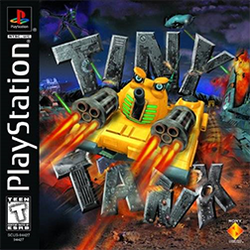

Tiny Tank: Up Your Arsenal arrived late in the PlayStation lifecycle as a curious hybrid: a cute orange avatar with an appetite for robot guts, wrapped in platforming levels and third-person shooting loops. On paper the idea is arresting for anyone who has ever wanted to drive something adorable toward orbital salvation, collect spare robot bits, and micro-manage a swarm of tiny drones. Under the hood this is a PS1-era action title that trades glossy ambition for clear technical decisions - some of which work very well within the console's limitations, and some of which reveal the era's constraints in painfully honest ways. This review focuses on the nuts and bolts: systems, HUD, controls, rendering, playback stability, and how Tiny Tank translates design intent into PlayStation-era reality while maintaining a playful sense of humor.
Tiny Tank's gameplay loop is concise and mechanically explicit: navigate levels, eliminate SenTrax forces, scavenge components, and use those components to keep your tiny chassis alive and better armed. The HUD is minimal but informative: two bars across the top of the screen indicate health and nanometal, and a smaller minimap in the upper-right displays geometry, enemy icons, and objectives. From a systems perspective, the nanometal mechanic is the game's most interesting engineering choice. Nanometal is both a resource and a gating mechanism for survivability. The Fix-It Crabs onboard require nanometal to auto-repair Tiny; if the nanometal bar is empty you lose passive heal, so the resource functions like both ammo for self-repair and a risk buffer. That dual-use design forces the player into frequent decision points: attack aggressively to harvest debris, or hang back to avoid needing the crabs in the first place. It also neatly sidesteps the need for complex inventory UIs by making a single scalar resource do double duty, which is elegant for a system constrained to the PlayStation controller and memory budgets. Weapon and upgrade systems are similarly pragmatic. Enemies drop positronic brains, weapons, and debris. P-Brains are explicit upgrade tokens: they improve the AI-backed attributes of weapons rather than acting as vague experience points, which makes each P-Brain pickup feel telegraphed and meaningful. Weapons can be attached to Tiny's four hardpoints, and there is a clear mechanical interplay between hardpoint loadout and battlefield role. The game encourages experimentation without deep menus by allowing players to visually swap attachments in the field, which reduces cognitive overload and suits short-session play. One of the more interesting mechanical affordances is the Teeny Weeny Tanks mechanic. These little deployables can be manually controlled or set to autonomous behaviors such as hunting, gathering, or protecting. From a technical angle this choice is smart because it offloads some of the enemy-handling logic to small AI agents that are intentionally limited in scope. The autonomous behaviors are simple finite-state machines: pursue, collect, and guard. This keeps CPU costs down while still giving players a feeling of strategic leverage. When you micro-control a Teeny Weeny Tank the game temporarily reroutes player input to that unit, which is handled smoothly thanks to the PS1's low-latency input loop; swapping control contexts is seamless and avoids long state transitions. Camera and control mapping are where the design shows both maturity and age. The PlayStation's single analog stick era was still fresh in 1999, and Tiny Tank uses a classic third-person camera that tries to balance fixed angles with player-driven rotation. The camera will auto-center behind Tiny and offers manual rotation, but the collision handling and occlusion prevention are rudimentary: complex geometry occasionally produces frustrating line-of-sight issues. In cramped platforming sections the camera sometimes snaps to odd angles, which can lead to input dissonance when trying to aim or platform precisely. A modernized camera system could have remedied this, but given the hardware and production schedule, the implemented approach is understandable. Enemy variety and progression are delivered via sentinel classes with predictable attack telegraphs. The combat is less about twitch precision and more about pattern recognition and resource economy. That matches the leveled collection design where fallen enemies become upgrade sources: players who focus on dismantling high-value targets and managing nanometal stocks will have an easier mid-to-late-game curve. Difficulty tuning is uneven in places; the early game is forgiving to let you learn the hardpoint and Teeny Weeny systems, but later levels spike because enemy density, combined with limited nanometal spawn points, forces longer backtracking sessions. From a level design logic standpoint, it would have benefited from more distributed nanometal nodes or scalable enemy death returns to avoid downtime. Multiplayer and single-player modes follow a classic split: single-player is campaign focused with narrative beats delivered between levels, while the multiplayer is an arcade-style diversion. For players looking for tightly tuned competitive hardware utilization, the local multiplayer demonstrates the PlayStation's ability to keep multiple agents and collision sets active simultaneously without catastrophic slowdown, even if the feature is clearly more of a party add-on than a core design focus.
Technically, Tiny Tank operates within the expected PlayStation 1 rendering budget: low-polygon models with pre-baked textures and moderate use of Gouraud shading. The game's art direction favors brightly colored, comic-machine aesthetics which masks some of the texture resolution constraints - an intended trade that keeps silhouette readability high and shader gymnastics unnecessary. Environments use tiled textures and flat lightmaps, which allows reasonably large levels while managing VRAM usage and texture cache thrashing. This approach also keeps load times reasonable because the engine streams smaller texture chunks on demand rather than attempting massive contiguous uploads. Draw distance and fog are used both stylistically and as a performance tool. Shorter draw distances limit polygon throughput and reduce the number of active actors rendered per frame. Fog and depth cueing are employed to hide LOD transitions, but pop-in remains visible when new geometry is streamed in or when camera rotation suddenly exposes more of a level. These artifacts are common on the hardware and not unique to Tiny Tank, but the title occasionally leans on them more than strictly necessary; certain vistas can feel artificially constrained by the fog plane. Animation pipelines rely on classical keyframe rigs. Robot enemies have mechanical, looped motions which are cheap to evaluate and require few bones, minimizing CPU inverse kinematics. Tiny himself benefits from snappier animation blending, with distinct states for driving, firing, damaged, and deploying Teeny Weeny Tanks. Particle effects and explosions are sprite-based with additive blending, which is efficient on the PS1 GPU and still visually satisfying when several happen simultaneously. Sound design is compact and functional: weapon SFX and mechanical clanks are mixed to prioritize gameplay-readiness over ambient fidelity, which means audio cues reliably telegraph enemy states in combat. Performance-wise, Tiny Tank mostly sustains acceptable framerates for the platform. Heavy fights with multiple effects and several Teeny Weeny Tanks can cause dips, but the engine's culling and actor prioritization strategies keep the experience intact. The minimap is integrated into the HUD and is updated at a rate that balances CPU overhead and player information needs; it's a small but technically savvy inclusion that helps mitigate the camera's occasional unfriendliness. Overall, the rendering decisions show an awareness of PS1 bottlenecks and pick practical solutions instead of aspirational ones that would have broken runtime stability.
Tiny Tank is an instructive case study in pragmatic engineering meeting quirky design. Its systems are tightly coupled: nanometal doubles as a healing resource and an economy lever, P-Brains are concrete upgrade tokens rather than abstract XP, and Teeny Weeny Tanks let simple AI behaviors extend tactical depth without a massive CPU hit. These are thoughtful technical choices that keep the game playable and often fun within the PS1's limitations. Where the game falters is in camera evolution and pacing. The camera's occasional hostility to precision platforming and some uneven difficulty spikes reveal production compromises. Graphically the game doesn't try to reinvent the PlayStation pipeline; it embraces the system's strengths and hides its weaknesses with bright design and audio priorities aimed at clarity. The mixture produced mixed critical reception, and that's fair: Tiny Tank is not a technical showcase, but it is a cohesive design that respects the hardware. For players curious about how to make a mechanically honest action-platformer on a constrained console, Tiny Tank remains a small, charming blueprint with enough tactical toys to justify a playthrough. The 6.8 score reflects a title that is competent, occasionally clever, and ultimately a bit held back by era-typical limitations, but still capable of delivering genuine, if short-lived, joy when you let an orange tank and a swarm of tiny drones do all the talking.
 Tiny Toon Adventures: Plucky's Big Adventure on PlayStation
 Minit Fun Racer on Switch
 PixelJunk Shooter 2 on PS3
 Tom Clancy's Rainbow Six: Vegas on PS3
 Crimson Sea 2 on PS2
 Tower of Guns on PS3












 Another SquareThought Site