

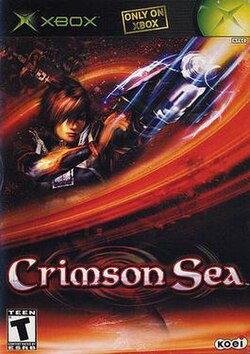

Koei's Crimson Sea 2 arrives on the PlayStation 2 like a letter from the future written on paper stock from a more conservative age: precise, slightly ornate and determined to be taken seriously. The sequel trades some of the Xbox original's sprawling genre-collage-where hack-and-slash rubbed shoulders with RPG trinkets and third-person shooting-toward a leaner, bristling third-person shooter. Fans of the first game will find familiar creaks in the machinery: Sho and his G-Squad politics, a solar system called Theophilus that sounds like it belongs on a folded map in a sci-fi serial, and the Mutons, whom you will repeatedly remind yourself are bad and must be removed. This review approaches Crimson Sea 2 with the blunt instrument of a serious 1990s games journalist: there will be comparisons, measured scorn, and the occasional compliment offered in the form of caps lock withheld. The sequel does not attempt to reinvent space opera; instead it polishes the chrome where it can and leaves some rust where your patience will notice it. For those keeping score in the margins of glossy magazines, the consensus parked comfortably in the mid-to-high 70s on aggregator boards; from the vantage point of the dual shock of nostalgia and critical appetite, the title is worthwhile, flawed and oddly satisfying.
Crimson Sea 2 is fundamentally a third-person shooter, but do not mistake that label for a straight corridor blaster. The game preserves enough of the original's hybrid DNA to remind you that Koei once dabbled in mixing systems like a chef who could not decide between soup and a sandwich. The player again occupies the world as Sho, drafted into the IAG and leading G-Squad; if the plot reads like a detectives' club lost in a space opera, that is because it is meant to feel both intimate and galaxy-sized: you fetch items, you interrogate, you battle Mutons and you occasionally attend to squad banter on the IAG ship. Combat is where Crimson Sea 2 wants to be listened to. Shooting is the spine: lock-on functions are serviceable, the camera hugs the action without strangling it, and the dash is a short, sharp burst of defensive mobility. The blade-and-gun combo remains a joy when it hits-meaty melee strikes followed by a satisfying volley of gunfire-and the rhythm of switching between the two forms the backbone of high-level play. Those who remember the first game will be pleased to see Neo-Psionics make a return in spirit, though the sequel favors immediate, flashy shooter outcomes over the more contemplative RPG tinkering of its predecessor. One of the more interesting systems carried forward is weapon modularity. Weapons are composed of three interchangeable parts; swapping components changes stats and grants special functions. This modular approach gives the loadout screen a little pocket of strategy: you will find yourself optimizing for rate-of-fire, overkill or one of the game's more eccentric field effects. The idea that a single gun can be subtly reworked to suit a planetary condition or a personal preference is a welcome touch and gives a feeling of ownership over your tools. The missions are serviceable set pieces with occasional ambition. You will tread across planets named with the kind of melodrama 1990s writers loved-Grarve, Agitato, Semplice-and each locale presents its own turf of Mutons and environmental hazards. Much of the game follows the Warriors-like tempo of large-scale skirmishes, except that you're often expected to approach objectives as tactical sprints rather than endurance runs. The ranking system remains: achieve a high rank-S if you are pristine-and the world rewards you. The S-rank unlocks are less a cash cow and more a siren: play better and the shop opens a secret drawer with improved weaponry. Koei's decision to keep a degree of the original's RPG scaffolding-shops, training sessions, and crew conversations on the IAG ship-helps to break up otherwise repeated combat loops. The ship acts as a hub where you can buy parts, learn new techniques and indulge in character chatter. It is a small but effective balm for the constant barrage of missions, and it lends the cast a little life beyond the 'enemy of the week' template. Balance is uneven. Enemy AI will occasionally act with the cunning of an embossed stamp or the thoughtfulness of a toaster. Large groups of Mutons provide spectacle, but can sometimes dissolve into repetitive slog. Conversely, some boss encounters are genuinely inventive, forcing you to use weapon parts and Neo-Psionic effects in ways that feel purposeful. The learning curve is shallow in the beginning and spikes unpredictably, which will delight players who enjoy sudden tests and frustrate those who prefer a well-graded climb. Crimson Sea 2 is not subtle; it is emphatic. It wants you to feel like a competent soldier and to enjoy shooting things until you do. The systems are competent and occasionally clever, and while they do not cohere into the perfectly balanced machine that more ambitious titles strive for, they make for a satisfying, if messy, campaign.
On PlayStation 2 hardware, Crimson Sea 2 presents a display that is arguably the visual middle class of its generation: respectable, occasionally striking, but not prone to transcendence. Environments are varied-deserts that taste of pixelated grit, jungles with verdant but blocky foliage, and metropolitan scapes that gleam with just enough detail to sell the illusion. The planetary diversity is one of the game's selling points; each world possesses a ringtone of visual cues that helps keep missions feeling distinct. Character models are solidly constructed, though they sometimes suffer from the era's common maladies: polygonal hair, faces that resolve into expressionless plates during low angles, and texture pop-in at awkward moments. When camera and action align, animations can be impressively kinetic; rush in rhythm, and Sho's melee-slash-into-gunflow looks sharp. Particle effects from Neo-Psionics and explosions are serviceable; the PS2 hardware limits the spectacle but the art direction uses the medium well enough that effects rarely now devolve into garish noise. Frame rate generally holds steady in smaller skirmishes, but when the screen embraces a multitude of foes, debris and big special attacks, the engine can falter. These dips are not catastrophic, but they puncture the illusion and occasionally force the player into a tactical conservatism that the game would prefer to avoid. Lighting is unambitious yet competent; it gives scenes weight without indulging in post-processing tricks the hardware cannot sustain. The UI and HUD are clear and functional. Menus are utilitarian and carry a practical charm, the kind that reviews in the 1990s would describe as 'workmanlike'-a compliment in the context of a game that prefers to spend its budget on levels and enemy variety rather than gaudy menus. In short, Crimson Sea 2 looks the part of a mid-2000s PS2 action title: occasionally arresting, mostly dependable, and always polite about the hardware's limits.
Crimson Sea 2 is a competent space-bound sequel that understands its strengths and pursues them with the single-mindedness of a starfighter pilot who drank his coffee too strong. Koei trims some of the original's more indulgent RPG flourishes and steers the series toward a tighter third-person shooter identity. In doing so the team delivers a game that is often satisfying in combat, occasionally inventive in its weapon and Neo-Psionic systems, and reliably atmospheric when it wants to be. The flaws are not insignificant: uneven difficulty spikes, momentary AI lapses and the occasional frame-rate hiccup prevent Crimson Sea 2 from joining the upper echelon of the PS2's action catalogue. Yet the game's virtues-its stubborn commitment to set-piece battles, the modular weaponry and the hub-based moments of respite-offer a coherent, enjoyable package. For players who remember the polished earnestness of late-90s and early-2000s action games, Crimson Sea 2 delivers the kind of experience that reads well in print: assured, occasionally theatrical and fundamentally honest about what it is trying to be. If you are looking for a cerebral treatise on interstellar politics, look elsewhere. If, however, you want to pilot a confident soldier through a handful of memorable planetary brawls, tinker with weapon parts and watch Neo-Psionics make the sky bloom into trouble for your enemies, then Crimson Sea 2 is worth the investment. Consider it a respectable mid-tier shooter with enough charm and substance to keep you playing until the credits roll and, if the ranking system catches your eye, long after.
 Crimson Tears on PS2
 Sea Monsters: A Prehistoric Adventure on DS
 PlayStation Home on PS3
 Ōkami on PS2
 Crash Bandicoot: The Wrath of Cortex on PS2
 Persona 5 on PS3
 Hyrule Warriors: Age of Imprisonment on Switch 2
 Aoki Ookami to Shiroki Mejika: Genchou Hishi on PlayStation
 Daikoukai Jidai II on PlayStation
 Nobunaga's Ambition: Awakening Complete Edition on Switch 2
 Wild Hearts S on Switch 2












 Another SquareThought Site