

 Aug 2025


There is a certain breed of puzzle that feels less like a game and more like a cold, satisfying puzzle cut from the same granite as crosswords and KenKen. Hashiwokakero - literally "build bridges" - sits firmly in that lineage. Its PS4 incarnation is not an attempt to dress the puzzle in neon or to pretend it's an action title; instead it is a careful digital translation of a pencil-and-paper logic exercise first printed by Nikoli in 1990. For players raised on the magazine-and-pencil ritual, the console port offers the curious sensation of solving in front of a big-screen television with a DualShock in hand. For that reason alone it will please a certain crowd: those who prefer patient deduction to reflex, and whose idea of relaxation leans towards quiet, strict rules rather than exploding sentient polygons. What Hashiwokakero asks of you is unglamorous but exacting. On an unmarked rectangular grid you are presented with "islands" - cells marked with numbers between 1 and 8 - and you must connect them with a set of orthogonal bridges so that the number on each island equals the number of bridges attached to it, no bridges cross islands or each other, no more than two bridges join the same pair of islands, and all islands become part of one single connected network. The PS4 version keeps these rules gospel and wraps them in a courteous interface. If you came expecting bells and whistles, the port will disappoint. If you came for a game that rewards methodical thought and the slow satisfaction of a network snapping into place, it will probably earn you a quiet, stubborn grin.
Hashiwokakero's gameplay is best described as a sequence of small certainties that, when chained together, produce a solution. The rules are plain and unforgiving: bridges run only orthogonally; they begin and end at distinct islands; there can be at most two bridges between any pair; bridges cannot cross; and finally the entire set of islands must be joined in a single connected graph. The PS4 port presents these constraints cleanly and then lets you get on with the real work: deduction. The developer's interface choices make the act of deduction smoother than pencil work without removing the puzzle's intellectual demands. A controller cursor snaps to islands, you tap to initiate a proposed bridge, and a second tap completes or doubles a crossing. There are sensible conveniences: an undo stack for recent moves, a toggleable overlay showing potential straight-line connections, and an option to mark islands whose quotas are complete. These niceties are not superfluous; in Hashiwokakero, being able to cross off a fulfilled island at a glance is a frequent step in the chain of deductions that finishes a puzzle. Typical problem-solving follows established Hashi techniques: islands with high numbers in corners or on edges force bridges in every available direction; a '3' trapped with only two feasible directions implies one must be doubled elsewhere; two aligned islands each with '1' forbid them from connecting if doing so would create an isolated subnetwork. The PS4 adaptation preserves this textbook feeling. It also supplies a hint system that is useful for newcomers: the hint highlights a bridge that is logically forced given the current state. Experienced players will find hints unnecessary and, if used too often, slightly insulting to the calculus of deduction; newcomers will appreciate them as a learning scaffold. There is also a puzzle library: the difficulty ladder ranges from the mildly soothing to puzzles engineered to choke a patience you did not know you possessed. Academic notes in the game's manual - lifted from Nikoli's pedigree - quietly remind the solver that verifying solvability in the general case is NP-complete. The port's generator therefore chooses puzzles from curated banks rather than attempting to synthesize arbitrarily complex instances on the fly, which is sensible if you value a fair test over computational showmanship. Gameplay sessions are typically long and episodic. One puzzle can take minutes; harder puzzles can stretch into hours. This is not a fault but a feature. Play is procedural: placing a bridge often removes multiple hypothetical options, which in turn forces another placement, and so on. That chain-reaction mechanic is the game's pleasure. There are, inevitably, moments of frustration - when a single misplaced bridge collapses your elegant scaffolding - but the undo and checkpointing system softens the blow. The PS4's save system stores progress per puzzle, allowing you to walk away and return to the exact mental state. For those who enjoy sharing, the game offers a modest social overlay: you can show off completion times and stars, but the port sensibly resists turning Hashiwokakero into a leaderboard-driven sprint. This is a game that wears patience with dignity rather than trophy-chasing bravado. If one has a criticism of the gameplay it is that the port sometimes over-tidies the messy charm of pencil-and-paper solving. The ability to temporarily visualize all possible lines is instructive, but it can lull players into skimming solutions rather than wrestling with inference. Conversely, the game does not attempt to obfuscate difficulty: some puzzles read like little theorems that require a sequence of non-local deductions (bridges whose legitimacy depends on preventing isolated subnetworks), and a hint economy that is too generous can rob those moments of triumph. The sweet spot is modest: learn the rules via the gentle puzzles, then shut off hints and enjoy the slow, old-fashioned work of proving a solution step by step.
Graphically the PS4 Hashiwokakero sticks to a minimalist script. Islands are typographic circles containing their numerical quota, bridges are clean vector strokes, and the grid itself is often left implicit, which is consistent with the puzzle's paper origins. The aesthetic reads like a late-1990s magazine column rendered in HD: restrained, legible, and unflashy. There are a handful of themes - sober daytime palette, muted night mode, and a slightly more playful pastel set - but none of them attempt to paper over the game's central austerity with animation or cinematic camera tricks. That restraint is the point: the visuals are there to communicate state and reduce cognitive load, not to entertain between moves. The UI is thoughtfully laid out for a controller. Selection and bridge placement are precise (no muscle memory gymnastics required), and the zoom controls work well for larger puzzles where the islands can stretch across many cells. A small HUD shows remaining bridges per island when selected, and an optional tracker lists islands with unmet quotas. Ambient sound is minimal - a discreet plink when bridges are added and a soft, unobtrusive soundtrack if you choose to enable it - which is a mercy. This is not a game that benefits from bombast; a restful audio bed complements the cerebral work. Those who expect a gaudy showcase of next-gen polish will be disappointed. The PS4 port's unadorned presentation will strike some as elegant and others as austere. In practice, the visuals do the job: islands are readable at a glance, lines never blur, and the color choices keep the important logical information prominent.
Hashiwokakero on PS4 is an accomplished translation of a pure, rule-bound logic puzzle to a living room-friendly form. It neither reinvents the wheel nor apologizes for its lack of fireworks. If you grew up in the era of puzzle magazines - or you simply appreciate games that treat your brain as the principal entertainment - this port is a small triumph. It honors the Nikoli original: rules are preserved, standard solving techniques are useful, and the puzzles range from gently educational to memorably fiendish. The port's conveniences (undo, hints, tidy UI) are well judged though on occasion they dilute the ragged satisfaction of raw deduction. Score explanation: 7.5/10. Hashiwokakero earns credit for faithfulness, clarity, and quiet rigor. It loses a few points for not doing more with the possibilities of the platform (more social features or a better-curated difficulty ramp would have helped), and for occasionally smoothing over the friction that makes the puzzle so rewarding on paper. In short, this is a game for people who buy puzzles for the thrill of an argument won by logic, not for those who want extravagant audiovisual rewards. Slot this one into your library if you like your challenges slow-burning and honest; it will repay the time with a rarest of console treats: genuine, solitary mental victory.
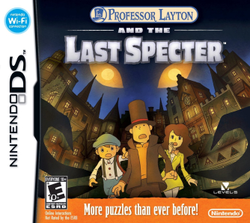
 Professor Layton and the Last Specter on DS
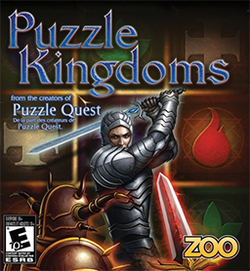
 Puzzle Kingdoms on DS
 Puzzle de Harvest Moon on DS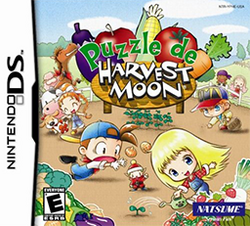










 Another SquareThought Site