

 Aug 2019
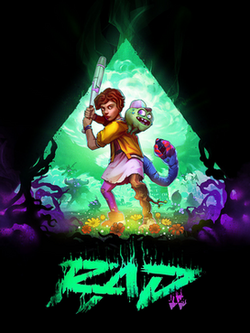

Rad on PS4 is Double Fine's neon-splattered attempt to marry arcade-ish action with roguelike randomness, wrapped in an 80s-inspired post-apocalyptic aesthetic. You control a teenager tasked with pilfering respirator effigies across a procedurally generated wasteland while accruing gene mutations that change how you move, hit, dodge and generally make a mess of whatever biome you're in. Underneath the playful tone and retro soundtrack is a tightly designed core loop - run, fight, collect mutations, die, rinse and repeat - that rewards both mechanical skill and the courage to embrace absurd synergies. That loop is interesting because it's implemented as a constrained mutation system (unlimited passives, up to three active mutations), built on Unreal Engine 4, and paired with procedural encounter design intended to keep challenge and variety high. On PS4, Rad feels mostly good, but you'll notice performance creaks and design choices that sometimes make the roguelike feel more like a fickle roommate than a reliable ally.
Rad's mechanical identity is straightforward on paper and surprisingly deep in execution. The camera sits in an isometric plane, giving you broad situational awareness, and the game's core systems are mutation-driven: as your character explores each procedurally generated sector, genes mutate and grant bonuses. Mutations are bifurcated into two classes: passive bonuses (of which a single character can have an unlimited number) and active mutations (a limit of three at any time). This design forces a regular decision-making cadence. You don't just pick the most powerful mutation offered; you consider how it complements existing passives and the active trio you already carry. That triad limit, technically, is an elegant constraint - it reduces cognitive overload, encourages trade-offs, and makes every pick feel consequential. The procedural generation in Rad is region-based: biomes and rooms are instantiated by a run generator that places encounters, hazards, and loot around connective corridors. From a technical perspective, this generator balances modular room templates with encounter scripts that scale with run progress. Encounter design has been widely praised as "pitch perfect" for early and mid-game, and that's not surprising when you watch how templates are reused: enemy placements and patrol paths are distributed across nodes in a way that creates emergent combos without needing bespoke content for every scenario. The RNG layer sits over top of this: mutation drops, effigy placement (respirators), and enemy variants are randomized, which keeps runs feeling fresh but also introduces variance spikes. When RNG cooperates, you get elegant synergies and satisfying power fantasy runs. When it doesn't, Rad's difficulty can spike suddenly - something reviewers flagged as later levels feeling "brutally unfair." Combat is action-forward with an emphasis on mobility and position. The engine allows fast dash inputs, basic melee and ranged options, and the active mutations often augment or replace those core moves. Because you can only hold three active mutations, the tactical depth comes from combining them with passives and environmental pickups. That interplay is where Double Fine's design goals become clear: they're not trying to make a pure skill-based twitch shooter; they're designing a systemic toybox where tools interact. However, that system-level depth reveals a UX problem: Rad assumes players will discover mechanics through experimentation, but it doesn't always teach the edge cases. The inability to fully convey deeper systems can make certain mutations feel opaque until you test them in the heat of combat. Progression is strictly run-based in the sense that death replaces your character with a new teenager and resets active mutations. This decision aligns with classic roguelike design: death = loss of the current build but not necessarily loss of knowledge. The mutant-per-run approach emphasizes short bursts of progression, and early runs feel rewarding because of the novelty in mutation combinations. The downside is reliance on RNG to supply a satisfying build; players can spend substantial time grinding early-game encounters to reach critical mutation combinations, and some critics suggested that Double Fine could 'crunch the numbers' to smooth the early grind without flattening the system. From a balance perspective, the challenge is to keep early runs approachable while preserving later-game spike difficulty. Rad errs on interesting complexity rather than safe predictability, which will delight some and frustrate others. On PS4 specifically, input mapping and controller feel are competent. The isometric camera and lock-free targeting mean movement and facing matter, so the pad's analog sticks and button layout get a lot of mileage. Frame rate and loading behavior factor into perceived responsiveness. Multiple outlets reported sluggish frame pacing and long load times on console versions; in practice you'll notice momentary hitches during enemy-heavy scenes and when streaming new rooms in. Those hitches don't break the combat, but they puncture momentum in a game where feel and timing are central. Enemy design is serviceable and geared toward encounter variety rather than deep archetypes. Individual enemies aren't always memorable, but the way they combine across room templates is where Rad's encounter engine shines. Multiplayer is absent - a curious omission for an action game built on systemic interactions - and that affects replayability for some players who would prefer co-operative chaos. Overall, the gameplay is a technically ambitious attempt at a systems-first roguelike action game: it nails procedural encounters, offers meaningful mutation constraints, and stirs in complexity with minimal UI bloat. It just expects you to enjoy the math and the randomness as much as the stabbing and kiting.
Rad wears its technical decisions on its sleeve. The isometric viewpoint supports a dense visual hierarchy: foreground props, mid-ground enemies, and background parallax all convey layered depth. This is aided by the use of Unreal Engine 4, which provides robust material systems, particle effects, and lighting tools that Double Fine leverages for a stylized, neon-tinted palette. The game's 1980s inspiration is evident in color grading, synth-leaning audio cues, and cheesy post-apocalypse iconography; artist Derek Brand's direction gives Rad punchy silhouettes and readable enemy designs that are essential for split-second decisions in a crowded arena. From a technical art standpoint, Rad balances stylization with performance considerations. Textures are intentionally punchy rather than photoreal; normal maps are used conservatively to preserve clarity at isometric distances. Particle effects - explosions, goo clouds, mutation flares - are employed to telegraph ability use and enemy states, but they also represent the biggest draw on rendering cost. On PS4, the consequences are visible: when particle counts spike during a busy encounter, frame pacing stumbles and the hardware struggles to maintain steady frame timings. Those dips were noted in multiple reviews and correspond to moments when the renderer is juggling dynamic lights, multiple particle emitters, and AI updates. Loading times are another technical pain point. Whether it's streaming new room geometry or loading a new region, PS4 players reported pronounced loading stalls. This suggests the game relies on synchronous asset loading or has heavy pre-run initialization phases that aren't fully masked by asynchronous streaming. UE4 supports efficient level streaming and asynchronous asset loads, but implementing those systems robustly requires careful memory budgeting and streaming heuristics; on last-gen hardware with constrained I/O and RAM, the margin for error is narrow. The result is a beautiful, thematic game that sometimes suffers from bottlenecks when the content density exceeds the console's comforting limits. Audio and UI are well-integrated. Composer David Earl's score reinforces pacing and mood without getting in the way, and the HUD presents mutation choices and passive stacks clearly, which is essential when you're making quick decisions between runs. All told, Rad's visual and audio package is coherent and evocative; its implementation is thoughtful but not immune to the realities of console performance budgeting.
Rad on PS4 is a technically ambitious roguelike that rewards players who like to tinker with systemic interactions and enjoy the occasional cruel spin of the RNG wheel. Double Fine built an attractive toybox: a constrained mutation system (unlimited passives, three actives), solid isometric combat, and procedurally generated encounters that often feel handcrafted. Unreal Engine 4 gives the game a distinctive look and solid toolset, but the PS4 port reveals the compromises of shipping high-content, particle-heavy scenes on older hardware: inconsistent frame pacing and noticeable load times. Critical reception landed in the mid-70s on PS4 (Metacritic ~74/100), which is a fair reflection: Rad is polished where it matters - design, aesthetic, encounter variety - but it stumbles in performance predictability and difficulty spikes driven by RNG. If you enjoy experimenting with wild mutation synergies, appreciate an 80s-flavored soundtrack, and don't mind the occasional technical hiccup or brutal run-ending surprise, Rad is worth your playtime. If you expect tight, predictable challenge tuning and rock-solid 60fps on last-gen hardware, you may find it frustrating. For curious players on PS4 who like their action with a side of systemic chaos and a soundtrack you can pogo to, Rad earns a solid 7.4 out of 10.
 Rad on Switch
 Rad Rodgers Radical Edition on Switch
 Onimusha: Dawn of Dreams on PS2
 Action Man: Operation Extreme on PlayStation
 Door Kickers: Action Squad on Switch
 Combat Elite: WWII Paratroopers on PS2
 Day of the Tentacle: Remastered Edition on PS4
 Broken Age: The Complete Adventure on PS4
 Headlander on PS4
 Broken Age on Switch
 Costume Quest 2 on PS4










 Another SquareThought Site