

 Jul 2020
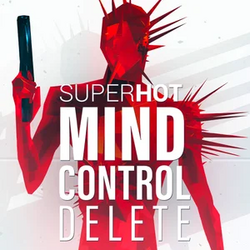

Superhot: Mind Control Delete arrives on PS4 like a philosophical mugging - it punches you with cool mechanics, then asks you to consider all the things you hold dear (including your precious ability to aim). This 2020 sequel from Superhot Team keeps the brain-bending time mechanic of the original at its core, but straps on a roguelike backpack and whispers "procedural" into its ear. If you liked the zen-violence of Superhot - where time only moves when you do and bullets are strangely polite - Mind Control Delete attempts to be that, but louder, longer, and slightly more chaotic. The game was born out of early access in late 2017 and officially launched in July 2020. It shares the minimalist, stylish DNA of its predecessor, adds a chunk of meta-story about obsession, addiction, and giving up control, and dresses the whole thing in glitchy UI nonsense that somehow feels intentionally smug. For PS4 players, this means: same satisfying bullet-dodging ballet, now with hearts to worry about, procedurally assembled rooms to curse at, and roguelike progression choices that tempt you with power-ups that last just long enough to make you feel clever.
If you know the original Superhot, you already know the party trick: time saunters along only when you do. Move and the world resumes its impatient orbit; stand still and everything politely freezes for your drama. Mind Control Delete retains that hypnotic sensation but reconfigures the overall loop into a node-based roguelike. Think of the main map as a chunky, text-mode graph. Each node is a mission: beat a procedurally generated sequence of Superhot maps and you get to move to connected nodes. Fail and you restart the sequence, which is the game's way of reminding you that persistence is the scent of a masochist. Maps spawn enemies endlessly until you collect a required number of kills. Unlike the one-shot delicate flower of the original, your avatar now has hearts. Lose all your hearts and the map sequence is regenerated. This adds an extra layer of tension - you can no longer rely purely on perfect choreography; mercy for human error has been replaced by limited retries. The sequences grow longer and nastier as you climb the four main levels, introducing enemies that explode into projectile confetti, partially vulnerable foes, environmental hazards, shrinking safety, and scenery that likes to glitch out of existence just to keep things interesting. To survive, the game hands you two kinds of temporary toys: one of four permanent "core" power-ups selectable before each sequence and random "hack" power-ups that appear mid-run. The cores are cheekily named: "More" (gives you a third heart), "Charge" (teleports you into punching range of an enemy), "Recall" (katana boomerangs back and slices anything in its path), and "Hotswitch" (the swap ability pulled from the first game). Hacks are the smaller goodies: faster reloads, buffed speed, extra ammo - the usual buffet of temporary nerdery. Find a power-up node and you unlock that power-up for future random rolls, along with a short tutorial explaining it like a polite weapon dealer. On level three things get theatrical: three boss-type nodes introduce invulnerable enemies that can't be killed but must be avoided while you farm kills. Each of these bosses personally validates one of the core abilities: "Dog" uses Charge, "Nindża" uses Recall, and "Addict" uses Hotswitch. They show up later on other maps too, announced by a dramatic musical stab, which is the audio equivalent of a content warning. The narrative is mostly whispered via text fragments on the node map. It teases four characters living inside the Superhot entity - the protagonist "Avarice" (obsessed with getting "MORE"), and the three boss archetypes. The story leans toward interrogation of addiction and obsession, and culminates in a weird meta finale where the game literally forces you to "give up" mechanics. After reaching a glitched fifth level, you are compelled to surrender cores, hacks, then even basic functions like shooting and looking around, until the game declares you have given up "control". If you're into existential video game tantrums, this finale will feel like a long, mechanical hug. There's also a curious post-credits data recovery sequence: three mini nodes start progress bars, one of which is a 2.5-hour real-time affair that plays the song "Niech Wszystko Spłonie" and scrolls the credits backward. After completion, you're booted back to the map with everything restored - and a new challenge mode called Pure that disables hacks and gives you only one heart for those who like their games served with extra spite. It's cheeky, it's bold, and it occasionally feels like the game is gaslighting you into self-improvement.
Mind Control Delete runs on Unity and keeps the series' stripped-back aesthetic, though the Wikipedia dump doesn't dwell on the crimson-white minimalism that made the original so meme-able. Instead, expect glitching scenery, text-mode maps, and a clean, clinical UI that enjoys repeating the word "MORE" as if it's a motivational poster that failed out of design school. The visual style serves gameplay: silhouettes, bright projectiles, and empty spaces make enemy telegraphing and bullet-path-reading easier, which is crucial when you're trying to choreograph death in slow motion. The art direction intentionally avoids photorealism in favor of clarity and attitude. The occasional environmental hazard and exploding enemies add a welcome splash of chaos to the otherwise disciplined look. Musically, the soundtrack by Zardonic and the use of dramatic musical stabs for boss appearances punctuate violent ballet with the kind of beats that make you feel like a stylish assassin in someone else's music video. On PS4 the game looks tidy and runs with the kind of smoothness you need when every frame counts; the glitches are deliberate, not performance bugs (mostly).
Superhot: Mind Control Delete is a love letter to the original boiled into an experimental roguelike cocktail - equal parts satisfying bullet-slowing ballet and rage-tested circuitry. It's best when it keeps a tight focus: the core mechanic of time moving with you still produces those chewy, cinematic moments of heroism (or hilarious incompetence). The roguelike additions add variety, progression, and actual stakes via hearts, but they also complicate what was once a blissfully simple loop - which is precisely the criticism some reviewers leveled: it's a tasty dish that sometimes tries to be a buffet. If you enjoy methodical violence, procedural surprises, and games that are willing to yank control away from you for a message, Mind Control Delete serves up a satisfying portion. If you preferred the original's clean minimalism and pick-up-and-play purity, the added complexity might feel like an unnecessary seasoning. Metacritic averages sit solidly in the "generally favorable" range (PS4: 77/100), and critics split between praising its inventive expansion and cautioning against overcomplication. On PS4 this is worth a rent, and probably a purchase if you fancy repeated runs, unlock systems, and the occasional existential crisis prompted by a menu that demands you give things up for "peace of mind." Score-wise I'm giving it a 7.7 out of 10: a game with brilliant moments, a few design choices that will test your patience, and enough charm to make you forgive it for making you surrender your katana. Play it with patience, a soft chair, and the knowledge that even when the game takes control away, it's usually because it has something dramatic to do with it.
 Control 2 on PS5
 Control: Ultimate Edition Cloud Version on Switch
 Warhammer 40,000: Boltgun 2 on Xbox Series X/S
 PixelJunk Shooter 2 on PS3
 Turok: Dinosaur Hunter on Switch
 Primal Carnage: Extinction on PS4
 Superhot on PS4










 Another SquareThought Site