

 Jan 2020
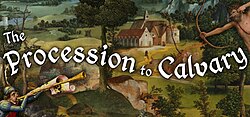

Listen up, young padawan of pixel and polygon: this is not the glossy triple-A spectacle your PS4 home screen usually coughs up between firmware updates. The Procession to Calvary arrives like a lo-fi envoy from another age, a point-and-click adventure that insists on being judged by its wit and its visuals rather than by polygon counts and frame-rate charts. Released in 2020 by one-man auteur Joe Richardson, this game wears its pedigree on its sleeve. Its title and much of its visual DNA are lifted from Pieter Bruegel the Elder's famous painting The Procession to Calvary, and the rest of the scenery is assembled like an art historian's fever dream: collages of Middle Ages and Renaissance works stitched together into a ludicrously tasteful scrapbook. If you are the sort of player who remembers the 1990s heyday of CD-ROM adventures-think scanning manuals, pixel hunting and a healthy skepticism for dead ends-then Richardson's game feels like a respectful nod from across the decades. The protagonist is modeled on Rembrandt's depiction of the goddess Bellona, which should tell you everything you need to know about the game's blind confidence in its conceit. It is not trying to be modern; instead it is trying to be timeless, absurd, and very, very British in its sense of humour. For PS4 owners curious about something different, The Procession to Calvary is the sort of oddball that will unhook you from the carousel of blockbuster sameness and make you remember why adventure games were adored in the first place.
At its heart, The Procession to Calvary is faithful to classic point-and-click conventions: you explore static scenes, pick up items, combine them in your inventory, and use them on the environment or on other characters to progress. Dialogue and written captions carry most of the narrative weight, so players who enjoy reading will be rewarded. There is no motion-kernel modernity here-no twitch combat, no real-time physics puzzles-just the patient logic of an older school of design. That pace is deliberate. The game expects players to stop and look, to squint at a chapel wall and notice that the odd fellow in the background is holding something you might need, or to remember the way a proverb was phrased in an earlier scene and apply it later in a way that would have made a Sierra designer proud. Richardson's prior work set the tone; this is a follow-up that refines rather than reinvents. Puzzle design leans toward lateral thinking, with a streak of the surreal: you will use ecclesiastical paraphernalia in unorthodox ways, barter with figures who seem to have stepped out of a gallery, and resolve problems with the kind of logic that makes you grin when it clicks. The inventory is modest and the solutions rarely require pixel-level precision, so frustration rarely feels punitive. The game is less concerned with taxing your reflexes than with rewarding your willingness to engage with the tableau. Presented on the PS4, the interface translates cleanly to controller input. Point-and-click becomes point-and-select; the d-pad and analog stick are serviceable stand-ins for a cursor, and the shoulder buttons let you cycle text and inventory without ceremony. Purists who insist that point-and-click must be mouse-bound may grumble, but Richardson's interface works well enough that the game feels native to the console. It retains the contemplative tempo of an adventure designed for a late-evening session, back when players smoked and had to blow into cartridges to coax life from silicon. The PS4's crisp display and comfortable controller actually make some of the visual jokes land more clearly than they might on smaller screens. Narratively, processional is the watchword. The game moves you through a string of vignettes and encounters that amount to a loose pilgrimage. There is a sense of purpose without the heavy burden of a linear blockbuster plot. The humour is dry and arch; jokes are offered as if they were historical artifacts. The protagonist, looking like a Rembrandt goddess misplaced at a medieval fair, is an expressive cipher. You, as player, supply the impatience, the curiosity, and the occasional moral qualm. The tone is witty rather than caustic, clever rather than cruel. In places the writing feels like a cross between a satirical pamphlet and a museum audio guide with an edge. Length is modest. This is not an epic that will demand dozens of hours. It is a finely crafted meditation and a series of puzzles that resolve in a satisfying timeframe. That brevity prevents repetition from setting in and keeps the game from overstaying its welcome. For the PS4 owner eager to taste something offbeat between larger campaigns, it hits the spot precisely. Those expecting branching epics or sprawling open-world commitments will find its scope intentionally contained.
The Procession to Calvary has a visual identity that is both its headline and its biggest gamble. Rather than commissioning new assets, Richardson assembles his world from snippets of European paintings-primarily Italian Renaissance and Northern works-and collages them into playable scenes. The result is an aesthetic that feels like walking through a Renaissance-era joke book run through a photocopier and then given a glossy sheen for modern display. On PS4 the effect is arresting. The textures of oil and tempera, the oddly convincing hands, the faces that seem to know secrets, these elements create a tableau vivant that is at once familiar and uncanny. Where many contemporary games strive for photorealism through shaders and polygons, Richardson's approach is retro-futuristic: he achieves a kind of realism by juxtaposition and context, and the PS4's resolution gives each brushstroke and varnish fleck a new clarity. The protagonist herself is lifted from Rembrandt's Bellona, and that choice says a lot about the game's aesthetic arrogance-she looks entirely out of time, which is precisely the point. There are moments where the collage technique yields genuine visual jokes. A knight's helmet might be a cropped corner of a painting, and a background villager could be a repurposed cherub with its expression changed by contrast and context. The effect can be hilarious, sometimes grotesque, and often unexpectedly poetic. Movement is intentionally limited; characters are largely static portraits swapped into frames, which means you will not find buttery walk cycles or motion-captured facial animation. Instead you get the animated equivalent of a stage play, where camera framing and dialogue do the heavy lifting. It creates a theatre-of-painting feel that most triple-A art directors would trade their motion blur for. Technical polish is solid if spare. The game runs smoothly on PS4, and load times are negligible. There are no graphical fireworks, but that is not the point. Where modern games show off particle systems and ray-traced reflections, The Procession to Calvary offers collage, irony and a deep love of pre-modern European visual culture. If that sounds pretentious, it is; if that sounds delightful, then you will likely be in the right mood to enjoy the experience.
The Procession to Calvary is an exercise in auteur curiosity: a game that knows what it is and refuses to apologize. Joe Richardson has created something that could have been mistaken for a lost CD-ROM from 1996 had it been given to the right art director and a hefty marketing budget. It is witty, occasionally baffling in the best sense, and deeply indebted to the visual masters whose works it repurposes. As a PS4 title it offers a comfortable, controller-friendly way to experience a point-and-click adventure whose primary pleasures are discovery, humor, and the slow-building satisfaction of solving cleverly composed puzzles. This is not for everyone. Players seeking visceral thrills, open-world depth, or AAA spectacle will find it too small-bore. But for anyone who still remembers the pride of piecing together an inventory puzzle or who delights in seeing a historical painting wink at you from the screen, The Procession to Calvary is a triumph of style and wit. It earns its modest runtime by refusing to dilute its concept, and it rewards players who are willing to lean into its peculiarities. In short: if you want a game that is as much an art-historical joke as it is an adventure, you will be well served. Consider it a worthy, offbeat companion to the PS4 library-a title with the confidence to be clever rather than big, and the gall to do it with oil paint and irony.
 Turning Point: Fall of Liberty on PS3
 PlayStation Home on PS3
 Ōkami on PS2
 Crash Bandicoot: The Wrath of Cortex on PS2
 MLB The Show 22 on Switch










 Another SquareThought Site