

 Aug 2017
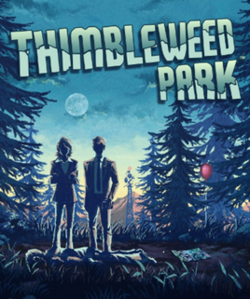

Thimbleweed Park is a love letter to late-80s/early-90s LucasArts-style point-and-click adventures, shipped in 2017 by the indie collective Terrible Toybox. On PS4 it's the same oddball, puzzle-heavy experience that hit PC and consoles earlier in the year, but what's interesting from a technical perspective is how a deliberately retro game ends up making modern engineering choices under the hood. Lead designers Ron Gilbert and Gary Winnick set out to build a game that looks and plays like it was made in 1987, but the pipeline, tooling and engine choices are thoroughly 2010s: a C/C++ 2D engine, SDL for platform glue, and the Squirrel scripting language. If you care about how old-school design sensibilities intersect with contemporary cross-platform engineering, Thimbleweed Park is a tidy case study - and on PS4 it mostly carries that cross-platform DNA intact.
At its core Thimbleweed Park is textbook graphic-adventure engineering: a verb list, point-and-click scene navigation, inventory objects, and multi-character puzzles. The game exposes classic verbs such as "use", "pick up" and "talk to" that the player combines with characters and scene objects to form action sentences. That old system forces the underlying code to be verb-driven; each verb is effectively an input that triggers a collection of scripted behaviors. Those behaviors are authored in Squirrel, the lightweight scripting language the developers chose because it balanced integration ease and scripting power (Ron Gilbert explicitly considered Lua but settled on Squirrel due to syntax preferences). The scripting layer sits on top of a C/C++ runtime, which handles rendering and core systems. From a technical standpoint this is a sensible separation: C/C++ provides deterministic performance for rendering, audio and resource loading, while Squirrel allows rapid iteration on puzzle logic, dialogue and scene scripting without recompiling the engine. The game's chapter structure requires the engine to support stateful scene management and save/load robustness. Chapters present discrete goal sets and puzzle dependencies; designers used puzzle dependency charts during development to ensure that player progression can be validated and that puzzle states don't create impossible situations. The engine must therefore serialize complete state trees for characters, inventory, flags and scene variables - a deceptively fiddly engineering task in any adventure game. That statefulness also enables the five-character swapping mechanic (a callback to Maniac Mansion): multiple player avatars with unique inventories and interactions require the engine to maintain separate entity contexts and to resolve cross-character item usage cleanly. The scripting layer's role here simplifies complexity because designers can author inter-character logic at a higher level without touching the renderer. Cross-platform considerations are visible in the build choices. SDL was used for window creation and input abstraction, which is a pragmatic move for delivering the same runtime across Linux, macOS, Windows, Xbox One, PS4, iOS, Switch, Android and even Amazon Luna. SDL hides platform differences at the OS-layer, so input events and display contexts can be normalized before they hit Squirrel scripts or game logic. This is particularly important for a user interface originally built for pointer-driven interactions: mapping the verb-based interface and cursor to a gamepad on PS4 requires an input abstraction that lets the engine swap input modalities without reworking puzzle code. The developers' custom rendering stack - rather than a canned engine - gave them direct control over how sprites, layers and palette effects are composited, which is why the game hits its retro visual goals while remaining performant on modern consoles. The game's post-release engineering also deserves attention. Terrible Toybox continued to ship updates that didn't just patch bugs but added features like a character-to-character fully voiced conversation system, repurposed as an inventive hint mechanism. They also implemented a classical hint system via in-game phones. That continuous deployment and feature-toggling indicate a development process where scripting and data-driven assets enable additions without invasive engine changes. On PS4 this model translates into timely patches that can touch UI, dialogue or scripting without breaking serialization or save compatibility - a sign of disciplined engine architecture.
Visually Thimbleweed Park intentionally mimics late-80s pixel-art adventures but its asset pipeline is modern. Gary Winnick and team used Adobe Photoshop to draw and composite art; the style was designed to be drawn digitally from the outset, which simplifies texture atlas generation and layering for the custom renderer. The renderer itself is written in the developers' C/C++ codebase rather than relying on a heavyweight 3D engine, so the art gets treated as 2D sprites with manual control over scaling, nearest-neighbor sampling and palette choices. That control matters: it allows the game to present pixel-perfect, intentional 'low-res' art while avoiding the blurriness or filtering artifacts that could come from naive scaling on 1080p or 4K PS4 outputs. On a technical level this design means the graphics pipeline is small and efficient: sprite batching, manual layer ordering, and per-frame composition avoid overdraw and keep GPU costs low. For consoles like PS4, that translates to high and stable frame presentation with little need for aggressive optimization. The team's choice to implement their own rendering also means they could add visual flourishes, like the 'wireframe world' prototype aesthetic in the end sequence, without fighting an engine's abstraction layer. Artists and technical artists benefit from this because the toolchain (Photoshop -> sprite sheets -> engine) is straightforward. The trade-off is engineering responsibility: any bug in rendering or texture management lies entirely with the team instead of a middleware vendor, but the end result proves the approach was viable. Audio and voice systems follow the same practical philosophy. The Kickstarter stretch goals enabled full English voice acting; audio playback is handled alongside the scripting layer so dialogue and conversation logic can trigger voice lines contextually (which also enabled the post-launch character chat update). On PS4 this is important for both immersion and localization; the engine had to support multiple audio streams, voice-over asset management, and context-sensitive mixing to keep lines in sync with onscreen actions.
Thimbleweed Park on PS4 feels like a retro adventure that passed through a modern engineering filter and came out on the other side intact. The deliberate design decision to recreate the feel of an "undiscovered 1987 LucasArts game" is supported by a pragmatic technology stack: a C/C++ renderer for performance and fidelity, SDL for cross-platform input/window management, and Squirrel for rapid scripting. That combo makes the game portable, maintainable, and surprisingly nimble for adding post-launch features like the conversational hint system. If you're evaluating it on technical merit rather than nostalgia, it scores highly: efficient rendering, robust state serialization for chapter-based progression, and a data-driven scripting layer that keeps puzzle and dialogue iteration cheap. As a PS4 package it's not pushing hardware boundaries - it doesn't need to - but it demonstrates how good tooling and clear separations of responsibility (engine vs. script vs. art) let a small team deliver a polished, bug-fixed experience across many platforms. The Metacritic score for PS4 (86/100) and nominations for various awards back that up. For players who enjoy puzzle design, narrative engineering and the nuts-and-bolts of game systems, Thimbleweed Park is a satisfying mix of old-school gameplay with tidy, contemporary engineering. Bring a notepad and a patient thumb on the controller: the puzzles expect you to think like a designer, and the game's architecture makes that thinking work without crashing the console.
 Theme Park on PlayStation
 Park Beyond on Xbox Series X/S
 PlayStation Home on PS3
 Gaelic Football '25 on Xbox Series X/S
 Together! The Battle Cats on Switch
 Unearthed: Trail of Ibn Battuta on PS3
 Return to Monkey Island on Switch










 Another SquareThought Site