

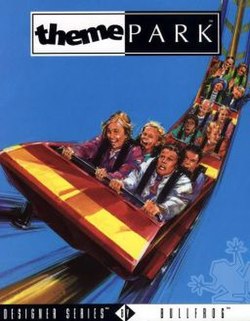

Theme Park on PlayStation is the console cousin of Bullfrog's legendary business-sim playground: a game that asks you to do the cruel, joyless work of turning chaos into queues, and then smile while visitors hand you money for the privilege. Released in the mid-90s and ported by Krisalis to Sony's PlayStation, it keeps the core charm and cartoonish grin of the original while shoehorning a mouse-and-keyboard design into a gamepad world. If you're the sort of person who enjoys watching pixelated people briefly consider life choices before buying an overpriced ice cream, Theme Park is a satisfying, sometimes infuriating, test of management skills. This review zeroes in on the part of the game that matters most for anyone brave enough to sign on the dotted line: the challenge - what makes it hard, what skills you need to survive, and whether the PlayStation version gives you the tools to do it.
At heart Theme Park is about trade-offs. You start with a modest bank balance and a plot of U.K. land, and the game hands you a medieval-looking clipboard full of decisions that are sneaky in their complexity. Every choice - from where you place a stall to how much sugar you pour into the soft-serve - ripples through guest behaviour, maintenance demands, staff happiness and the bottom line. That deceptively simple core is the source of the challenge: it forces you to be ruthless with priorities and patient with outcomes. Resource management is the baseline skill. You must spend money on rides, kiosks, scenery, toilets and staff, while keeping an eye on daily and yearly cash flow. Theme Park doesn't hide the math; it hands you the levers (entry price, shop prices and wages) and expects you to become a small-time economist. Loans are available, but they're a delicious trap: they let you expand faster, but suddenly you have an interest schedule and a ticking clock. You quickly learn to judge when to borrow and when to tighten your belt - treat loans like a wild animal that looks cute until it eats your coaster. Prioritisation and triage are constant. Rides need maintenance, and neglect results in explosions (yes, literal explosions - a wonderful old-school slapstick penalty that converts your pride into a smoking crater). Mechanics, handymen and entertainers all have distinct roles. Hire too few and footpaths grow trashy, queuing becomes a crime scene, and crime becomes a gameplay mechanic - thugs will vandalise the park and beat up entertainers if visitors are unhappy enough. The PlayStation interface forces you to micromanage these problems via controller navigation, which is clunkier than the PC mouse original. That clunkiness increases the skill ceiling: you must be decisive and efficient because navigating nested menus with a pad is slower, and the game still judges you by the end-of-year scoreboard. Reading and predicting guest behaviour is where Theme Park becomes almost psychological. The team programmed each visitor to have a personality (Molyneux bragged they took about 200 bytes each), and you must learn to read what they want: are they after thrills, food, cleanliness or cheap toys? Adjusting shop attributes (for example, changing how sweet an ice cream tastes) affects return rates and spending habits. Research and development are also a key tactical layer. You allocate funds to research to unlock new rides, improve ride durability, tune staff efficiency and increase bus capacity. Picking the right research path at the right time - a classic opportunity-cost problem - separates casual park builders from those who can consistently flip parks for profit and move to exotic new lots. Spatial planning is another facet of the challenge. Over thirty attractions (although the PlayStation port is missing some acts like the medieval and dolphin shows) and many shops must be arranged to optimize flow. Poor layouts create bottlenecks, force unhappy visitors to wander, and multiply the work for your employees. You need to design for circulation, place toilets and benches logically, and balance areas of high footfall so that a runaway coaster doesn't turn the surrounding kiosks into cratered real estate. That's park architecture 101 - except the students are tiny sprites with opinions. Risk management arrives in multiple flavours. There is the obvious physical risk of failing to maintain rides, which leads to catastrophic breakdowns. There's the financial risk of overspending on big coasters that require track design and significant upkeep. There is also political risk: negotiations for wages and supplier contracts are occasionally required; fail a negotiation and you might face strikes or the loss of a shipment, which can screw a carefully balanced revenue model. Theme Park's three difficulty levels adjust how many of these layers are active: on Sandbox you can blissfully ignore negotiations and stocks, while Full Simulation forces you to juggle research funding, logistics, and even share prices. Time and multitasking skills are tested mercilessly. Game time runs by calendar year, and at the end of each year your park is compared to rivals. You must plan long-term investments (build that roller coaster this spring so it fuels summer profits) while reacting to immediate crises (a toilet shortage is not going to wait for research to finish). The PlayStation port allows game speed adjustment, but the controller-based management makes rapid reaction feel more tactical and less reflexive. The best players are those who can split focus: simultaneously monitoring queues, staff deployment, shop stock levels and the research screen without having any of these elements burn down (figuratively or literally). There is a learning curve and it is joyful in the old-school sense: the game expects failure and teaches via amusing failure modes. You will lose parks you thought were safe. The reward loop, though, is strong: get the balance right, and you can auction off a park for a tidy profit and proceed to a new world with different terrain, weather and economics. That cross-world progression adds another strategic layer - adapting your playstyle to local conditions - and demands strategic flexibility rather than single-minded optimisation.
Theme Park's visuals are unapologetically cartoony and absurdly charming. On PlayStation the graphics retain the original's bright, goofy aesthetic, though the port lacks some animations and content found in the PC version (notably the medieval and dolphin shows). The sprites are expressive, rides have personality, and the whole affair looks like a theme park drawn by someone who used too many bright crayons. The PlayStation adds a new view option compared to older console versions, which is nice, but the core issue remains that the game's interface was conceived for mouse control. Expect to spend a little time learning the controller navigation and tolerating overlapping menu systems; reviewers at the time grumbled about having to read the manual. The visuals never try to be realistic - and that's a feature, not a bug. Clarity trumps fidelity here, and the playful visuals help you quickly identify problems (sticky paths, smoking rides, weeping visitors) without squinting at indecipherable numbers.
Theme Park on PlayStation is a lesson in joyful cruelty. It asks you to be an empathetic dictator: kind enough to maintain toilets and amuse crowds, ruthless enough to squeeze profit from every cotton-candy wrapper. The PlayStation port keeps the addictive simulation loop intact while introducing the usual console compromises - trimmed content, the occasional clunky control moment and the absence of a speedy mouse-based UI. If your priority is absolute convenience, the PC original is kinder; if you don't mind a few extra button presses for the pleasure of building a thriving, profitable mess of roller coasters and overpriced souvenir stands, the PlayStation version still delivers a lot of depth. This is a game that rewards systems thinking, prioritisation, time management and a willingness to learn from spectacular failures. For players who enjoy juggling logistics and reading a crowd like a poker hand, Theme Park remains oddly modern in its demand for multi-layered decision-making. The PlayStation port earns a respectable 7/10: a brilliant, sometimes fiddly challenge wrapped in cheeky 90s charm. Put on your managerial cap, prepare for a few explosions, and remember: the happiest parks are the ones where you secretly win at spreadsheets while everyone else enjoys the teacups.
 Theme Aquarium on PlayStation
 Planet Coaster: Console Edition on PS5
 PlayStation Home on PS3
 Crash Bandicoot: The Wrath of Cortex on PS2
 Theme Park World on PlayStation
 MLB The Show 22 on Switch












 Another SquareThought Site