

 Aug 2025
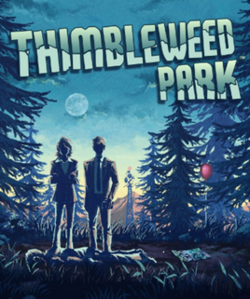

Thimbleweed Park arrives on the Switch with all the narrative weirdness and puzzle-engineered stubbornness you'd expect from a spiritual successor to Maniac Mansion and Monkey Island. From a technical perspective it's an instructive case study in how to take design constraints from the late 1980s and map them into modern, cross-platform code without losing the personality that made the originals sing. The game was build-from-scratch by Ron Gilbert and colleagues using a C/C++ 2D engine, SDL for platform glue, and Squirrel as the embedded scripting language - a tiny toolchain choice that explains how the title managed to ship across Linux, macOS, Windows, consoles, and mobile devices (including the Switch) with relatively few headaches. This review digs into how those technical choices affect gameplay, control ergonomics on the Switch, systems design, assets pipeline, and the updatability that kept the game improving after launch.
Underneath the joke-laced dialogue and Twin Peaks parody is a very deliberate mechanical skeleton. Thimbleweed Park is textbook traditional point-and-click: scenes are third-person, interaction is driven through a verb list (use, pick up, talk to, etc.), inventory items are explicit objects you attach or combine, and the story is gated into chapters that require completing specific goals to progress. That verb-list, sentence-building interface is not merely nostalgia - it defines the game's state machine. Each verb-object-target combination becomes an event that the scripting layer must resolve, invoke animations for, and sometimes trigger cross-character puzzle dependencies. From a systems perspective the team approached puzzle design as a graph problem. Gilbert and Winnick designed puzzles using dependency charts so that each item, action, and character interaction had defined preconditions and postconditions. This makes the engine's job deterministic: Squirrel scripts evaluate preconditions, update inventory and flags, and then queue animations and dialog sequences. The benefit is twofold: it prevents state explosion in later chapters, and it makes it feasible to support multi-character interactions where two or more protagonists must coordinate actions. The game features five playable characters and allows switching on the fly - mechanically similar to Maniac Mansion - which increases combinatorial complexity. The way the codebase handles this is by keeping a central world state that is agnostic to the active protagonist and letting Squirrel handle per-character behavior scripts. That decoupling keeps the core renderer and input loop simple while the script VM runs the game logic. Control on the Switch is the translation layer of interest. The engine uses SDL for input abstraction, which is platform-agnostic by design and explains why a controller-driven UI sits comfortably alongside mouse/touch paradigms. On Switch you can play docked with stick-controlled cursors or in handheld/touch mode where taps approximate classic point-and-click. Because the game expects verb-object sentences, the Switch build needs UI affordances for choosing verbs and targets with limited buttons - the port maps the verb list and inventory to on-screen palettes and buttons so the input layer merely posts the same high-level events the desktop code expects. That gave the developers a clean path to parity: the renderer doesn't care whether the command came from a mouse, a touch event, or a joystick + button; it just gets a verb-target command. That architectural constraint (engine receives canonicalized commands) made cross-platform parity much easier to achieve. The game's pacing is driven by chapter gating and objective lists. Each chapter is essentially a subroutine with entry/exit conditions; finishing a chapter advances a global chapter counter and can flip large state switches (unlock new areas, make characters accessible, etc.). This makes save-game semantics straightforward: the save serializes the global state and the Squirrel VM context flags and resumes deterministically. The choice to make the game's puzzles sometimes require using multiple characters is a deliberate stress test for the engine and scripting model, and it mostly pays off - when the state machine is clean the puzzles behave predictably, but the design also intentionally allows lateral solutions so testing and QA had to be thorough. Post-release support is worth noting from a systems angle. Gilbert and team shipped updates that not only fixed bugs but introduced new gameplay mechanics - for example, fully voice-acted inter-character conversations as an inventive, emergent hint system. Implementing that required extending the dialogue system to support asynchronous, context-sensitive chatter between NPCs and the player party, triggering lines without directly revealing puzzle solutions. A classical hint line was also built (callable through in-game phones) which uses the same contextual state checks on the server-less Squirrel VM to offer targeted nudges. These are examples of a flexible scripting layer earning its keep after launch.
Visually, Thimbleweed Park is an explicit exercise in retro aesthetics, intentionally designed to look like an 'undiscovered LucasArts adventure from 1987.' Gary Winnick, Mark Ferrari, and Octavi Navarro produced the in-world art, with cover work by Nina Matsumoto. The art pipeline was predominantly digital - Winnick used Photoshop and drew initial layouts as sketches - but the output is a stylized, palette-limited look that reads as both nostalgic and practical for a small team. Rendering was handled by the custom C/C++ engine, with Gilbert's own rendering code instead of delegating sprite composition to a middleware renderer. That decision is meaningful: writing a lightweight renderer gave the team exact control over draw order, palette handling, and scaling rules, which is crucial for preserving pixel-art charm across different resolutions and aspect ratios. Because the renderer is part of the homegrown engine, porting to the Switch did not mean fighting a black-box middleware to get the interpolations right. Instead, the build pipeline could tweak the renderer for the Switch's mobile-friendly GPU and its hybrid display modes. The asset pipeline reuses the same sprites and animations across platforms, meaning the artists didn't need multiple sets of exports. The designers even included a 'wireframe world' sequence in the narrative - both a story device and a cheeky homage to prototyping visuals - which hints at how the team thinks about art as data: assets are layered and the renderer can swap palettes and draw passes to achieve distinct visual modes without changing the underlying scene graph. Audio complements the visuals technically and tonally. Steve Kirk's compositions and the later-added full English voice work had to be integrated into the dialogue system so lines could trigger contextually. That required a mapping between Squirrel dialogue nodes and audio assets, with fallbacks for platforms that couldn't ship all voices (early stretch goals promised full English voice acting). On Switch the audio pipeline had to respect memory budgets while delivering crisp voice and sound effects; the engine's asset streaming and audio mixing systems handled that without needing major rework.
Thimbleweed Park on the Switch is a great example of how disciplined engineering choices enable faithful ports. Ron Gilbert's decision to write a custom C/C++ engine and use SDL for platform abstraction, paired with Squirrel as an embedded scripting language, turned the game's logic into a portable, testable layer that could be reused across desktop, console, and mobile targets. From a gameplay perspective that pays dividends: the verb-list mechanics, inventory model, and multi-character state machine come through intact on the Switch, and the control abstractions mean you can interact naturally whether you're using a joy-con or a touchscreen. The game isn't flawless. The deliberate old-school design means some puzzles lean into the obtuse, and hinging puzzles on cross-character solutions increases cognitive load (and QA burden). The visual style is intentionally retro, which some players will adore and others will find limiting. Yet these are design choices rather than technical failings. On the engineering side Thimbleweed Park is a tidy piece of work: deterministic scripting, a compact renderer, a sensible input abstraction, and a philosophy of keeping game logic in a high-level VM made post-release improvements (voice hints, hint phones) tractable. The Switch build inherits those benefits, delivering an experience that feels authentic to the era it emulates while running cleanly on modern hardware. If you care about how games are put together - the plumbing beneath punchlines - Thimbleweed Park is pure candy. It demonstrates how small, deliberate technical decisions allow a boutique studio to build an old-school adventure that behaves predictably, scales across platforms, and continues to evolve after launch. Score-wise, it comfortably sits in the upper echelons of modern adventure design: 8.5 out of 10. Buy it if you like cryptic puzzles, smart engineering, and the kind of off-kilter humor that rewards both patience and curiosity.
 Park Beyond on Xbox Series X/S
 Planet Coaster: Console Edition on PS5
 PlayStation Home on PS3
 Ōkami on PS2
 Crash Bandicoot: The Wrath of Cortex on PS2
 MLB The Show 22 on Switch










 Another SquareThought Site