

 Oct 2016
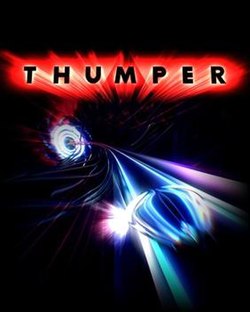

Thumper is the kind of game that politely asks for your soul and then times it to a drumbeat. Developed and published by the two-person outfit Drool, Thumper launched in October 2016 and brought its relentless, high-speed rhythm action to PS4 (with optional VR support). You pilot a chrome beetle down a narrow track, smashing lit notes in time with an industrial, bass-heavy soundtrack while simultaneously dodging walls, spikes, turns and enemies. On paper it's a stylish rhythm game; in practice it's a reflex test dressed up as a cybernetic nightmare-beautiful, punishing, and oddly meditative once you accept you will die a lot. This review zeroes in on the challenge aspects and the specific skills Thumper forces you to develop, with the kind of borderline-sarcastic cheerleading only an 18-year-old and their caffeine budget could appreciate.
Thumper's gameplay loop is pure, unadulterated focus training. The player controls a beetle on a single or multi-track that scrolls so fast your eyes will briefly consider a career in interpretive squinting. Each level is a gauntlet made of segments; after each segment the game tallies a score and hands you a rating like a scolding gym coach. The fundamental input is simple: press a button to hit lit "notes" in time with the music. But simplicity lies to you. The notes are embedded in a highway of challenges: insta-death spikes that ask to be respected, curved walls demanding secure banking and perfectly timed turns, jumps you must hit mid-flight, and enemies that turn rhythm into combat. The challenge design is surgical. The beetle has a shield that absorbs one hit, and if the shield drops a second hit means reset to the last checkpoint. This two-strike system creates a tight tension between playing aggressively for a high score and playing conservatively to survive. That balance becomes a lesson in risk management: when to push for the high multiplier and when to prioritize survival for the next potentially brutal segment. Checkpoints exist, but repeating segments is still very common; the game assumes and rewards repetition, memorization, and that kind of stubborn muscle memory that turns rage into efficiency. One of Thumper's clever mechanical tricks is how levels map to time signatures. Each stage uses rhythms tied to signatures from 1/2 up to 9/8. This isn't just academic flair; those time signatures shape the beat patterns you must internalize. Learning to feel a 7/8 or 9/8 pulse is an acquired skill here-first as a foreign rhythm, later as a hammer you wield. If you've never thought in odd meters, expect your brain to sputter before it snaps into synchrony. The result? A steady progression from panic to poise as you learn to predict the rhythm and anticipate the obstacles that ride on top of it. The Play+ mode is where Thumper becomes legitimately hardcore. After beating a level, Play+ unlocks a single-life run where a single death sends you back to square one. The shield still grants one buffer hit, but the consequence of failure is immediate and merciless. Play+ also increases speed proportionally with your score multiplier, which escalates the physical and mental demands: your eyes must sweep the track faster, your hands must execute faster, and your tolerance for repeated failure must be Olympic-level. Get good at Play+ and you've built an absurdly refined suite of skills: precision timing, razor reflexes, blink-and-you-missed-it pattern recognition, and the ability to perform under pressure. Skills required and trained by Thumper are explicit. Tight timing is obvious-this is a rhythm game after all-so you'll practice striking notes with millisecond precision. Reflexes are essential because the game's fast scrolling offers minimal reaction time; many turns and threats demand instantaneous input. Pattern recognition and short-term memorization matter more than may be obvious at first: the same visual cues appear at consistent points, and learning those sequences lets you move from reactive to predictive play. Spatial awareness is tested by multi-track sections and curved walls; you must hold orientation while pressing notes and performing maneuvers. Concentration and stamina are underrated skills you'll develop-high-intensity runs require sustained focus and emotional control so you don't rage-quit mid-boss. Boss segments are a separate breed of difficulty, where rhythm meets choreography and the level design moves from obstacle course to duel. Boss fights wrap multiple skill demands into one package: sustained rhythm accuracy, dodging new attack patterns, and prioritizing survival while still hunting for score. Beating bosses feels like winning arguments with a jazz drummer who also knows karate. Overall, Thumper's challenge profile is layered rather than spiky. The game rarely surprises you with random cheap shots; instead it designs windows of learning, failure, and eventual mastery. Expect to repeat segments dozens of times while you anneal new muscle memory. If you enjoy refining execution and appreciate a game that treats difficulty like a skill tree rather than a gatekeeping wall, Thumper will make you feel smarter with every tiny victory.
Graphically, Thumper is abrasive in the best way: neon geometry, metallic sheen on your beetle, and surreal visual flourishes that sync tightly to the audio. The visuals are functional and stylish-every obstacle and note pops with enough clarity that the game rarely cheats on visibility even when the sensory assault peaks. The art and music were created by Brian Gibson, and the aesthetic is a key part of the challenge: the sights are designed to be hypnotic, which means the player must learn to parse beauty as a signal and not a distraction. In VR, where Thumper is frequently recommended, that sensory intensity amplifies the stakes. VR magnifies the need for sensory tolerance and the skill of maintaining composure when your peripheral vision is a strobe-lit maelstrom. So graphics here aren't just pretty; they're a functional part of the difficulty curve, training you to stay calm while your eyeballs do cardio.
Thumper on PS4 is an elegant, brutal lesson in applied rhythm. It's short but dense, and its challenge design encourages repetition, learning, and measurable improvement. The skills it cultivates-timing, reflexes, pattern recognition, risk assessment, and sustained concentration-translate into a satisfying sense of competency as you climb the difficulty ladder. It's not for players who want a casual musical stroll; it's for those who like their rhythm games with teeth. If you enjoy a game that will humiliate you repeatedly until you become terrifyingly competent, Thumper is about as close to cathartic as rhythm games get. Score: 9/10. Bring headphones, bring patience, and prepare to get very, very good at hitting things in time.
 1979 Revolution: Black Friday on Switch
 Rhythm Heaven on DS
 Super Crazy Rhythm Castle on Xbox Series X/S
 Touhou Spell Bubble on Switch
 Rhythm Heaven Groove on Switch










 Another SquareThought Site