

 Oct 2025
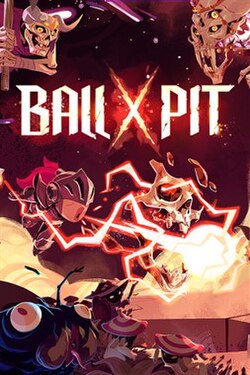

Ball x Pit sells itself as a mashup: imagine Arkanoid went to therapy with a roguelike and came out obsessed with town planning. On the surface it's a gleeful, neon-splattered block-breaker with hordes of monsters and evolving balls. Beneath that surface is a surprisingly tender study of characters - not just the named adventurers you pick on the loadout screen, but the little personalities encoded in your balls, the village that slowly grows like a recovering community, and the bosses who act like tragic milestones. The ruins of Ballbylon and its giant pit are the setting, but the real story is told in the loops: you launch into the pit, get pummeled, return to the surface, and do the emotional paperwork with gold, wood, and blueprints. It's clever, weird, and occasionally brutal, but it rewards attention to how small choices accumulate into meaningful arcs.
Ball x Pit's two-stage loop is where its characters live and breathe. The adventurers are the playable faces of the game's drama: they arrive at Ballbylon's crater with different starting ball inventories and personalities implied by those loadouts. One run is a chapter in an adventurer's life - they begin naïve, with a modest cache of balls, and through gem pickups and choices they either become a chaotic, multi-hit spectacle or a focused, surgical instrument. Leveling up is framed like character growth. When you choose to add a new ball, you're giving the adventurer a new skill; when you level a ball, you're deepening a trait. The ability to fuse two balls or evolve a ball is the game's version of identity crisis and reinvention. Fuse a homing orb with a piercing spear and you get an adventurer who suddenly has both cunning and blunt force - it's character growth with literal explosive consequences. The monsters and bosses are more than HP bars. Regular mobs are the noisy background supporting cast: predictable, relentless, but sometimes the source of comedic missteps. Mini-bosses at the end of early segments act as rite-of-passage tests, the way a teenager in a coming-of-age movie must steal the car and live to tell the tale. Boss fights are tonal punctuation marks in an adventurer's arc. Defeating a boss yields gears and sometimes narrative weight; failing rewrites the story as a tragic stumble that still contributes to the long-term plot via resources that push the village forward. The game smartly uses failure as part of character development - runs end, but nothing is truly lost; instead it compounds into the evolving village and new options for future runs. The town-building stage is the slow second act. Every return to the surface is like a scene change: you see your adventurer in silhouette as workers bustle, buildings rise, and the community learns to stand on its own two feet. Buildings unlock new adventurers or improve everyone's starting stats, which reads like mentorship, schooling, and family support. Assigning workers to resource spaces feels like delegating chores to side characters: they grind away in the background while you head back down the pit to perform the next scene of the main character's life. The elevator's gears - the key to deeper levels of the pit - are literal plot devices; they let you access new monsters and bosses, which means new chapters and new thematic challenges for your adventurers to face. Over multiple runs, the village's expansion reshapes the stakes: what began as mere survival becomes legacy-building. The Regal Update added two explicit characters, The Falconer and The Carouser, and a handful of special balls, and they demonstrate how the game treats its cast. The Falconer feels like the stoic mentor who prefers precision and aerial control, while The Carouser is loud, chaotic, and a walking party - perfect for players who want personality to be as unhinged as their ball loadouts. New balls and an endless mode broaden the kinds of arcs available: the endless mode is the equivalent of a spinoff series where a side character gets to tell their own uninterrupted tale. The game's progression mechanics - gems for temporary buffs, fission items that split into multiple powerups, fusion options to combine skills - are all narrative devices disguised as loot systems. Choices feel consequential because the game remembers them via the village, and the village remembers you as it grows. If you're paying attention, the real cast list is a little larger than the character select screen suggests: your balls, your passive items, the workers, the elevator, and the bosses all function like characters with motivations. Balls crave evolution; workers desire tasks; the elevator hungers for gears. This anthropomorphism isn't cute for no reason - it helps the roguelike loop land emotionally. Each run has stakes, even if those stakes are quirky: will your adventurer return with the blueprint that unlocks a mentor? Will the fission item scatter powerups that let you survive a boss? The answer shapes that adventurer's arc and, cumulatively, the story of Ballbylon's reconstruction.
Built in Unity, Ball x Pit wears a bright, stylized aesthetic that owes more to modern indie bite than retro pixel nostalgia. The game uses clear shapes, neon accents, and readable visual language so that the chaos of bullet patterns never becomes a mess. On PS5 the visuals are crisp: effects pop, particle trails make each ball feel tactile, and bosses have distinct silhouettes so you never really get lost in the noise. Amos Roddy's score supports the emotional beats - tense during boss fights, whimsical when you're back at the village - and the sound design gives every ball a satisfying thunk or sizzle that feeds back into the character metaphors. There are occasional moments where the screen becomes a ballet of lights and hazards, and the engine holds together without blurring the important bits. The village's visual growth is a nice touch: new buildings actually change the skyline enough that returning players get a small dopamine hit seeing progress rendered in the environment.
Ball x Pit is a roguelike that sneaks emotional architecture into a frantic, bouncy action core. Its genius is in treating systems as characters: your loadout choices are personality, fusions are identity arcs, workers are the supporting cast, and the village is long-form character development. It's clever, addictive, and surprisingly moving for a game where your primary mechanic is launching balls at monsters. The PS5 version lands the experience cleanly, and the Regal Update's new characters show the developer knows how to expand narrative possibilities without breaking the loop. If you're into bite-sized runs with meaningful long-term progress and you enjoy seeing incremental growth translate into tangible village changes, Ball x Pit will scratch that itch. It isn't flawless - the loop can be punishing and some fights spike in difficulty - but it turns repetition into a saga rather than a grind. Recommended for players who like their roguelikes with a side of personality and their block breakers with actual emotional stakes.
 PES 2009: Pro Evolution Soccer on PS3
 Arcade Archives 2: Gee Bee on Switch 2
 Cities: Skylines Remastered on Xbox Series X/S
 SimCity DS on DS
 Dawn of Discovery on DS
 Bulwark Evolution: Falconeer Chronicles on PS4










 Another SquareThought Site