

 Oct 2025


PowerWash Simulator 2 arrives on PS5 with a very specific promise: catharsis through high-pressure water and the obsessive satisfaction of removing filth pixel by pixel. FuturLab keeps the sequel intentionally focused - more tools, more jobs, more locales - and ships it at a tempting US$25 price point. The studio has taken the original's minimalist loop and instrumented it with additional mechanical knobs and a few user-interface conveniences. This review looks at the PS5 build through a technical lens: systems design, input affordances, progression telemetry and how new mechanics change the game's computational and experiential profile.
At its mechanical core, PowerWash Simulator 2 is an exercise in deterministic cleaning: dirt states transition from dirty to clean based on agent input (nozzle type, pressure and soap application) and the environment's surface parameters. The sequel preserves that loop while expanding the action space in meaningful ways. Nozzles retain their roles as variable-width, variable-pressure tools, but the new adaptable nozzle that can be manually adjusted opens a continuous control dimension: rather than swapping discrete nozzle types you can tune spray diameter and intensity on the fly. That change alters the game's skill ceiling because it converts a previously categorical decision into an analog one, increasing the number of viable strategies for tackling layered grime. FuturLab also reworks consumable management. The original's soap economy introduced resource planning; the sequel removes scarcity and normalises soap across surfaces. This design choice reduces the meta-game of economic optimization and instead pushes the player toward technique optimization - think of it as trading inventory micromanagement for mastery of pressure modulation. From a systems perspective, the visible persistence of applied soap is a small but consequential UX signal: it encodes partial progress, reduces ambiguity in large scenes and makes troubleshooting missed patches much faster. The circular surface cleaner is another ergonomics improvement, essentially an area-of-effect tool that increases throughput on planar geometry and changes the cost-benefit calculus of methodically tracing every tile versus more sweeping motions. New mission-specific hardware - a scissor lift and abseiling rig - introduces verticality into the previously horizontal-focused work. These are not just cosmetic: they affect pathfinding and movement budgets within jobs and require the underlying level streaming and collision systems to accommodate new traversal states. Jobs with multi-stage progression (exterior then interior, for example) gate content behind completion triggers, which helps pace the reveal of assets and prevents the engine from rendering or simulating unnecessary entities until required. UX aids like the "dirt finder" are smart accessibility and QA-driven additions. Automatically highlighting residual dirty zones operates as a form of state visualization, lowering cognitive load during the final sweep and reducing the number of frustrating missed pixels at 99% completion. Multiplayer has been expanded thoughtfully: split-screen local multiplayer is a demanding feature on console hardware because it doubles rendering and simulation throughput; adding shared campaign progression for online play demands consistent state replication and reconciliation across peers. FuturLab's implementation keeps progression consistent between solo and co-op play, which indicates a robust server-authoritative or deterministic replication model for progression-affecting actions. Economy and progression remain familiar: players earn in-game currency and PowerWash Points to buy equipment, upgrades, cosmetics and furniture for a new home base. The home base functions as a hub with persistent state: cleaned furniture, mementos for replaying jobs and cosmetic customisation. This is efficient from a systems architecture standpoint because it centralises saved-state manipulation and offers a low-cost way to surface DLC items and monetisation hooks without tacking them onto core gameplay loops. There are 38 base-game jobs and a wider geographical sweep across Caldera County - Lubri City and Pumpton join the series' original town. The variety of environments helps test the asset streaming system, as larger, denser urban maps stress texture streaming, draw-call budgeting and the PS5's IO prioritisation. FuturLab also committed to post-launch content with free bonus jobs and paid IP DLC scheduled for 2026 (Adventure Time and Star Wars among them), which suggests a live-service-ish pipeline for content authoring and packaging.
Visually, PowerWash Simulator 2 is not about photorealism so much as readable fidelity. The game's core graphic problem is the accurate representation of 'dirt' as a separate material layer that responds predictably to cleaning actions. The sequel improves the readability of grime through consistent shader blending and a persistent-soap overlay that both informs the player and reduces trial-and-error. Surface shaders appear to use layered albedo and roughness masks to separate clean and dirty states, allowing nozzle interactions to act as a mask eraser rather than brute-force texture swaps. This approach scales well: it keeps material memory requirements bounded while providing the visual feedback necessary for player satisfaction. Particle effects and water spray are where the eye goes. Power washing in a game like this is a forced perspective on particle LOD: droplets serve primarily as feedback more than as a physics simulation. The adaptable nozzle's varying spray cone seems to alter both particle density and influence radius, which provides tactile visual information about effective range. Lighting and reflections are competent; puddle reflections and wetness cues are handled via roughness shifts and local specular boosts rather than expensive screen-space ray-traced water, which is a pragmatic performance choice for a game that often needs to render a lot of geometry and dynamic particles concurrently. On PS5, the biggest stressors are split-screen and densely detailed urban or industrial maps. Asset streaming, occlusion culling and draw-call reduction are clearly part of FuturLab's toolkit - the engine avoids obvious hitching during most jobs - but instances of shader pop or texture stream-in are occasionally visible during transitions into large stages. The art direction keeps a slightly stylised palette, which hides seams in high-frequency detail and helps the engine maintain consistent frame pacing while still delivering gratifying visual outcomes when grime transitions to clean surfaces.
PowerWash Simulator 2 is an exemplar of iterative design that chooses to deepen rather than overhaul. Its technical choices - from the adaptable nozzle's continuous control to soap persistence and the dirt finder - improve readability, reduce frustration and expand player agency without introducing unnecessary complexity. Multiplayer additions, including local split-screen and shared online progression, are non-trivial engineering wins on PS5 and broaden the audience for couch co-op cleaning sessions. The trade-offs are visible: removing soap scarcity reduces some emergent economic tension and occasional asset streaming hitches appear in larger jobs, but these are minor against a foundation of satisfying, well-instrumented mechanics. If you enjoyed the original or simply want a low-stress, highly tactile simulation with polished systems and a fair price, FuturLab's sequel is a clean hit. Score: 8.2/10.
 Microsoft Flight Simulator 2024 on PS5
 Farming Simulator 22 on Xbox Series X/S
 Pro Evolution Soccer 2015 on PS4
 MotoGP 19 on Switch
 Derby Stallion 04 on PS2
 Power Pro Kun Pocket 13 on DS
 Velocity 2X on PS4
 PowerWash Simulator 2 on Switch 2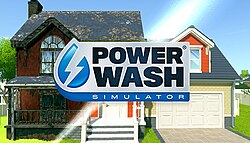










 Another SquareThought Site