

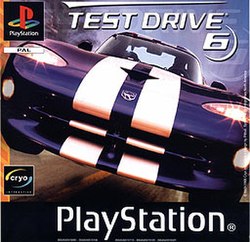

Test Drive 6 arrives on the PlayStation as the latest in a long lineage of highway hot-rodders and traffic-terrorists. Pitbull Syndicate dresses up the familiar Test Drive formula with a glossy showroom of licensed iron, a thumping industrial/techno soundtrack and a handful of modes meant to add longevity to what is, at its core, an arcade racer. For a series that once traded on the thrill of outrunning the cops on two-lane blacktop, TD6 tries to be everything-career, single race, multiplayer and even cop duty-but does so without quite committing to excellence in any single area. From the moment the menu music starts (a welcome mix from names such as Fear Factory, Lunatic Calm and Cirrus), the game sells a confident image: 37 licensed cars plus four police variants, exotic locales, and a career mode built around buying, upgrading and wagering in tournaments. Licensing is a bright card in the pack-except for one sour note: General Motors cars appear only as traffic, not driveable models, a casualty of licensing negotiations. That omission is curious but forgivable for the casual arcade fan. What matters more is how those cars feel, how the tracks are laid out, and whether the split-screen multiplayer can still stir up living-room grudges. Test Drive 6 offers flashes of fun, but the overall experience sits firmly in the 'mixed bag' category, a title that will please someone looking to rent a weekend thrill but frustrate anyone chasing the textured, simulation-leaning realism of its contemporaries.
At its fastest heartbeat, Test Drive 6 is unapologetically arcade. The game splits play into Single Race for quick pick-up-and-play action, Race Menu for a career-style progression, and a splitscreen multiplayer for console duels. Single Race is the classic instant-gratification mode: choose a car, pick a track, and hammer the throttle without worrying about money or unlocking progress. It's the kind of mode you break out when you've had a bad day and need to vent on someone else's pixelated bumper. Race Menu is where the authors tried to add depth. You start by purchasing a vehicle from a Tier 1 dealership and then enter a succession of tournaments tied to tiers. Each tournament uses in-game currency and wagering: you bet on your races and get bonuses for overall placement. That mechanic gives the career a gambler's thrill-win smart, and you can finance upgrades or level up to better machines. The tier structure imposes sensible progression: tournaments lengthen, AI stiffens and payouts grow accordingly. The bite-sized economy of this mode is one of the game's smarter touches, injecting risk and reward into races that might otherwise feel like the same lap repeated. Where TD6 makes another interesting, if uneven, move is with its police-focused content. Stop The Racers and Stop The Bomber are two modes that flip the script and let you play law enforcement in a police car, pulling off pursuits instead of fleeing them. These modes add variety and are pure arcade cat-and-mouse, leaning into bumping, pursuit tactics and sheer chaos. The inclusion of four police variants broadens the fantasy of the chase, and for a player who enjoys a good cinematic takedown they're unexpectedly satisfying. Driving itself sits between floaty and stiff. Steering leans toward arcade looseness; cars don't punish mistakes with crushing realism, but neither do they feel completely weightless. This middle ground makes TD6 approachable for newcomers but occasionally frustrating for players who expect consistent handling across the vehicle roster. Licensed cars look distinct on paper, but their in-game personalities are less distinct: the exotic roster is largely cosmetic once you're on the track. AI behavior follows a familiar 'rub-and-run' arcade script-competitors feel more like traffic with a vendetta than a cunning racer. On the upside, the physics favor spectacle: dramatic spins, opportunistic overtakes and the occasional contact-driven revenge moment make for entertaining short bursts. Multiplayer is simple but effective. Split-screen racing is a living-room staple, and TD6 delivers enough wriggle room for two players to trade insults and collisions. It lacks the refinement of split-screen modes that would follow on more powerful hardware, but the presence of local multiplayer is a practical lifeline for replay. Car selection and licensed content are big selling points: 37 licensed vehicles provide a nice sweep of desirables, though the absence of playable General Motors cars-sequestered to background traffic due to licensing constraints-will irk some car-heads. The roster still manages to serve fantasies of exotic ownership even if the economic system in Race Menu prevents you from buying every toy on day one. If the game has a recurring problem, it's inconsistency. Modes are present and conceptually sound, but execution falters in places: AI can be erratic, handling can shift unpredictably between models, and the career's wagering system, while novel, can become grindy if you string together a few poor bets. That said, for an hour at a time, Test Drive 6 captures the rush of arcade racing well enough to warrant a rental or casual session with friends.
Graphically, the PlayStation release of Test Drive 6 is competent but not show-stopping. The cars themselves are detailed enough to recognize shapes and bodywork, and the PAL cover's Dodge Viper ACR swagger translates into in-game presence. Tracks evoke real-world cities and highways with acceptable texture work, but the PlayStation's limitations are evident: draw distance is short, pop-in occurs, and environments can feel boxy compared with the emerging standards set by the likes of Gran Turismo. Lighting and reflections are serviceable but never extravagant; night racing feels moody but not atmospheric. Performance is generally stable for the hardware it targets, but concessions are apparent. Vegetation and roadside clutter are economical, and scenery sometimes serves as wallpaper rather than a believable world. Animations for collisions and spins sell the arcade impact, though the lack of nuanced damage modeling keeps crashes purely cosmetic. Reviewers of the era were split: some praised the selection of vehicles and the spectacle of the visuals, while others found the game 'not poised to be the leader' on the system-a fair appraisal when comparing TD6 to more polished racers of the time, especially on next-generation hardware. Sound design compensates somewhat for graphical humility. The industrial and techno soundtrack is loud, forward and unapologetically late-'90s, which fits the game's temperament. Engine noises and collision effects are punchy even if they don't approach simulation-level fidelity. Altogether, Test Drive 6 looks like a game that spent its budget on cars and music first, scenic atmosphere second.
Test Drive 6 is a product of transitional times: an arcade racer released near the end of the original PlayStation's life cycle, trying to straddle the line between casual thrills and career-style progression. It succeeds as a competent arcade experience with a strong licensed roster, a crisp industrial/techno soundtrack, and a couple of genuinely entertaining modes-particularly the police pursuit variants. Its shortcomings are equally clear. Handling inconsistency, middling AI, and graphics that do not push the platform leave TD6 in a crowded field where competing titles offer either deeper simulation or crisper arcade polish. For a serious car fan looking for realism and long-term engagement, this is not the Test Drive to crown. For a player wanting accessible, explosive races and local split-screen tussles with friends, it delivers enough fun to justify a moderate score-especially if you encounter it as a rental or during a weekend play session. In the end, Test Drive 6 is like a weekend supercar sighting: exciting, slightly flawed, and something you'll brag about in the moment even if you'll forget the finer details later. Drive it if you want a short, noisy, late-'90s joyride; don't expect it to replace the genre heavyweights that were sharpening their claws at the time.
 Test Drive: Off-Road 2 on PlayStation
 Test Drive 4 on PlayStation
 Roary the Racing Car on DS
 Team Sonic Racing on Switch
 Garfield Kart: Furious Racing on Switch
 Ben 10: Galactic Racing on PS3
 Big Air on PlayStation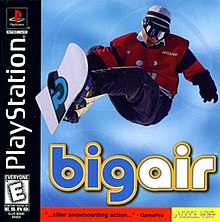












 Another SquareThought Site