

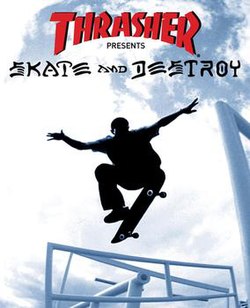

Thrasher Presents: Skate and Destroy is the video-game equivalent of a crusty skate zine you find under a pile of gig flyers and forgotten vinyl: slightly rough around the edges, defiantly authentic, and carrying more attitude than a neon-lit skatepark at 2 a.m. Built by Z-Axis and published by Rockstar Games for the original PlayStation, Thrasher doesn't try to be everyone's Tony Hawk; it announces from the curb that it's here to document the real, sometimes painful poetry of skating. Where the Tony Hawk series taught you how to chain impossibly forgiving combos like an arcade button concerto, Thrasher pushes you into a sim-like courtship with the physics of a board and a stubborn audience of urban hazards. It expects you to learn. It expects you to fail (often spectacularly). It also gives you the quiet, incremental rewards of getting better: sponsors, decks, threads, and ultimately the right to stand on the metaphorical-literal-cover of Thrasher Magazine. As a game that values technical nuance over instant gratification, it doubles as a surprisingly juicy stage for character work: six fictional skaters, each a blank-ish silhouette on the surface, become believable through mechanics, wardrobe choices, and the slow accretion of status. This review reads those mechanics as character arcs, because when a game makes you grind the same rail until your thumbs learn to behave, that struggle tells a story.
Skate and Destroy's core mode, Skate Mode, is a tightly wound novella about risk, consequence, and shiny stickers. The player picks from six fictional skaters (renameable, re-clothable, and full of hidden potential) and navigates 12 levels across the globe in a series of two-minute runs. The level design and rules create one of the game's most interesting narrative devices: each run is a chapter where ambition collides with time and the looming threat of getting chased off the scene by a Police Officer, a Guard Dog, or a Street Mugger. Those chasers appear visually when the run hits the final ten seconds, not as a melodramatic twist but as a simple mechanic that says: behave, or suffer the social death of losing your score and having to try again. On the surface, this reads like an arcade contest, but underneath it is a rigorous simulation. The game is built around technical tricks, efficiency, and consequence. Ragdoll physics (still novel at the time) mean that bailing is not just cosmetic: you can break a board, or worse, bones. That physical jeopardy pushes the player into choices that define a skater's personality. Do you play it safe-use the bail and tuck controls (L2 + R2 and Circle) to reduce damage when the air goes wrong-or do you ratchet up risk for higher scores and risk a literal broken leg? Those decisions become the emotional beats of the player's arc. Character archetypes in Thrasher aren't served with biographies; they are built from stats, special moves, and wardrobe. These six skaters come with distinct statistics that influence how they perform tricks, and each possesses a special move unlocked through a specific button combination. Because you can rename and re-clothe your skater, your choices in outfits and sponsors function as costume changes in a coming-of-age story. Sponsorship decisions-offered at key moments in the campaign-serve as plot points: each sponsor brings new decks and clothing, which alter your public identity and, by extension, your perceived competence. Picking a sponsor feels like choosing a mentor or a crew, which is deliciously on-brand for a game rooted in underground skate culture. If we map the mechanics to classic story arcs, the game's progression becomes surprisingly cinematic. The Rookie (stat-light, eager), starts as a clumsy novice; early runs are about learning bail timing and surviving chaser encounters. The Technician (high in finesse stats), has an arc of solitude and mastery: long sessions spent learning to chain high-difficulty tricks without repeating them to avoid score devaluation become quiet montages of focused improvement. The Showboat (flashy special move, high style) lives a "rise-and-fall-and-rise" arc: early high scores and dangerous risks lead to spectacular bails and broken boards, forcing humility and the eventual tempering of style with substance. Competition levels-one at the end of each zone-shift the narrative tone. These are judged for high difficulty, risk, and style, and they specifically discourage trick repetition. That rule reads like a requirement to evolve your repertoire: repeating the same stunt is narrative stagnation. To win, your skater must reinvent themselves within the confined stage of a level-an arc of creative growth that mirrors real-world skaters who must innovate or be forgotten. Multiplayer, while not the heart of Thrasher's narrative, offers micro-arcs in turn-based duels. Seven modes-Sessions, Nickel Bag, H.O.R.S.E., Top Dog, Sick Fix, Long Grind, and Big Wallride-force players into social contests of skill, sabotage, and one-upmanship. The ragdoll-heavy Sick Fix is a comedic Greek tragedy where players choreograph spectacular bails to inflict damage. Turn-taking creates a soap-opera rhythm of challenge and response: one player's virtuoso becomes another's gauntlet. What the game does beautifully is allow character evolution through repetition and consequence. Being classified as a 'Pro Skater' after completing the Expert setting is one milestone, but the game begs for an epilogue: to make the cover of Thrasher Magazine you must return and photograph your best tricks. That final act is a meta-narrative beat-your skater's career culminates not in a numerical score but in curated image-making, which is how skate fame works: a single photograph that rewrites reputation. It transforms a sequence of technical hurdles into an emotional payoff: the underdog who learned to bail less, to vary tricks, and to time risk perfectly is rewarded with immortality on the magazine's front page.
On the PlayStation, Thrasher's visuals don't win any awards for photorealism-this was 1999 hardware-but the aesthetic choices fit the game's personality. Levels are detailed enough to communicate landmarks and trick opportunities: rails, ledges, walls, and gnarly street geometry that invite experimentation. The animation of tricks is mechanically readable; you can sense when a trick is executed cleanly versus when your skater is about to explode into ragdoll. Those ragdoll moments are grotesque and hilarious, offering both punishment and spectacle. Compared to contemporaries like Tony Hawk, Thrasher sacrifices some visual polish for physics and fidelity to skate behavior. That trade-off is intentional: the less glossy models and rougher environments make crashing feel real and winning feel earned. The game's UI and presentation lean toward the utilitarian-scores, timers, sponsor logos-and that utilitarianism supports the narrative voice: this isn't about flashy production values, it's about authenticity. Also, the soundtrack's focus on late '80s/early '90s rap and hip-hop is a bold stylistic choice; it adds texture to the world and separates Thrasher from the skate-punk-saturated soundscapes of its rivals.
Thrasher Presents: Skate and Destroy is not for button-masher romantics. It is a stubborn, rewarding simulation that turns gameplay systems into narrative scaffolding. The six skaters, while not given verbose backstories, are written through mechanics: stats, special moves, bail consequences, sponsor choices, and the slow accumulation of image and reputation. Those mechanics craft arcs of apprenticeship, hubris, reinvention, and eventual vindication on the cover of Thrasher Magazine. If you're after instant, arcade-friendly joy, Thrasher will test your patience. If you enjoy the quiet triumph of slowly mastering a craft and watching a fictional persona evolve because your thumbs finally stop betraying you, then this game is a guilty-pleasure biography in plastic form. It ages like a well-loved deck-scuffed, a little chipped, and full of character. For players willing to invest in its learning curve, the payoff is the funniest, most human kind of skate story: one where scars matter, photos mean everything, and reputation is only as good as your next clean run.
 Crash Bandicoot: The Wrath of Cortex on PS2
 MLB The Show 22 on Switch
 Accolade Sports Collection on Xbox Series X/S
 Deca Sports DS on DS
 Alan Hansen's Sports Challenge on PS2
 EA Sports MMA on PS3
 Dave Mirra Freestyle BMX on PlayStation
 Dave Mirra Freestyle BMX: Maximum Remix on PlayStation
 Alexi Lalas International Soccer on PlayStation












 Another SquareThought Site