

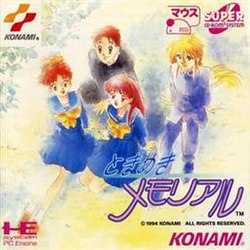

Tokimeki Memorial: Forever With You is the PlayStation incarnation of the game that quietly taught an entire generation of players how to manage schedules, emotions, and passive-aggressive gossip. Built on Konami's original Tokimeki Memorial formula, the PlayStation release amplified the game's strengths: more events, sharper visuals for its era, and a deeper invitation to micromanage teenage relationships. On paper it is a dating sim about a male freshman at Kirameki High School. In practice it is a social-stat simulator and a moral math puzzle where every skipped lunch can ripple into heartbreak. This review focuses not on mechanical minutiae alone, but on what the game asks you to shape: the characters and their arcs, and how your attention - or neglect - acts like both balm and grenade.
Gameplay in Tokimeki Memorial is deceptively tranquil. You pick options in conversations, raise social statistics, attend classes and events, and attempt to win the hearts of multiple girls over the school years. The PlayStation version is lauded for expanding the number of events and polishing the presentation, but the beating heart of the experience is the social system: characters are represented not only by dialogue trees but by meters and schedules that respond to your choices. The famous 'bomb' mechanic is the most narratively fascinating element the game uses to force arcs into motion. If a girl is neglected for too long, she becomes upset and tells her friends; this negatively affects everyone's love meters and can derail relationships you thought steady. From a character-arc perspective, the bomb is brilliant storytelling disguised as punishment: it prevents the player from treating characters as static prizes and insists they be treated as people who react - emotionally and socially - to neglect. In effect, the game stages multiple parallel coming-of-age narratives where your attention determines whether a girl's story bends toward trust and intimacy or toward resentment and distance. Consider the player as a director with limited rehearsal time. Each girl has a private trajectory that arcs through curiosity, warmth, rivalry, and sometimes refusal. The stat-raising mechanics function like character development budgets: investing in intellect, sports, or charm opens different conversational beats and events. A girl's arc will frequently hinge on a confluence of stats, timing, and prior choices. This means what looks like a cold stat screen is actually your storyboard: failing to attend to the small daily beats means the big emotional scenes never happen. Shiori Fujisaki deserves specific mention. The documentation notes her prominence in the series' music and events, famously singing the game's ending theme in some releases. On the PlayStation, with more scenes and better-suited art, Shiori operates as a focal point for the game's emotional center, even for players who try to date everyone else. Her arc in the meta-text of the franchise is illustrative: she is often the anchor women gravitate toward in promotional materials and story outcomes, representing the 'canonical' emotional payoff. Whether or not you steer toward her in a playthrough, her presence acts as a benchmark that highlights the differences in how other girls' arcs resolve. If Shiori is the lodestar, then the other characters are satellites who light up only when properly tended. The playthroughs that become memorable are those where the player learns to balance romance with school life. Round-robin dating strategies - hopping between characters to avoid letting any one become a bomb - are humorous and tactical, but they also generate unique micro-arcs: girls who start wary of a sporadic suitor can slowly warm to someone who learns to read their calendars. Conversely, the same mechanic can produce tragic little arcs of missed signals: a player who focuses on stats while ignoring personality events will find the girls polite but distant, a realistic depiction of relationships where effort is misaligned. Tokimeki Memorial also resists reduction to explicit content: it is notable for eschewing sexualization in favor of subtler emotional development. The game asks players to understand the slow accumulation of trust and the social ecology of high school. Characters gossip, attend group events, and influence one another. This embedded sociality means arcs cannot exist in isolation; a single character's disappointment can cascade through friend groups. From a writing and scenario perspective, those dynamics are evidence of care - the characters change in ways that feel systemic rather than scripted, and the bomb mechanic is the system's way of ensuring consequences feel organic. One quibble is that character depth sometimes depends heavily on encountering specific events, which can be hidden behind stat prerequisites. The PlayStation version ameliorates this by increasing the number and subtlety of events, but players new to social stat sims may find it opaque at first. Still, mastering the balance between dates, training, and attentiveness rewards the player with satisfying narrative payoffs: not just endings, but meaningful scenes that trace believable arcs from awkward freshman moments to mature decision points. As an exercise in emergent storytelling, Tokimeki Memorial's gameplay is generous. The game rarely hands you a single canonical arc to follow; instead it offers a garden of possible outcomes that bloom differently according to how you water them. That garden makes you complicit in both romance and heartbreak, and it delights in demonstrating how small choices compound into major emotional shifts.
The PlayStation version's graphics are an upgrade from the PC Engine original: Famitsu's reviewers praised improved visuals and more events in the PS release. The anime illustrations are clean and characterful, and even if the style is decisively 1990s bishōjo, they capture a warmth that complements the game's intent to evoke high school nostalgia. Where the Super Famicom port trimmed audio and visuals, the PlayStation release restored and expanded scenes; voice clips and enhanced imagery on the PS and later PSP versions help give characters more immediate presence. From an arc-analysis standpoint, presentation matters because art and performance provide emotional shorthand. A well-rendered event portrait or a brief voice clip can transform a stat increase into a moment: the flush of a girl's face, the slightly nervous pose, a shy line delivered in a clipped voice - these details make arcs feel lived-in. The PlayStation's production values do a lot of the heavy lifting in making those micro-moments land. They supply the little human beats that turn mechanical progress into real emotional change. The limitations are obvious to modern eyes: backgrounds are static, animations are limited, and voice work is sparing. Yet those constraints become part of the aesthetic charm: scenes feel like diary entries or radio dramas, which suits the game's nostalgic ambitions. The PlayStation release succeeds where it matters most for a character-driven sim: it gives faces to names, and those faces react. That reaction is what makes arcs convincing; you can watch a relationship deflate or swell in the span of a few event portraits and lines of dialogue, and that is more than many contemporaries attempted.
Tokimeki Memorial: Forever With You remains a master class in character-driven design disguised as a school sim. Its real achievement is not simply the number of dates or the quality of its PS-era visuals but the way its systems generate plausible emotional arcs. The bomb mechanic, the social-stat economy, and the expanded events on PlayStation combine to create a living high school where characters change because the player has chosen to change them - or chosen not to. If you approach the game expecting a linear, authored romance you may be frustrated; the game delights in emergent narrative and requires patience. If you approach it like an anthropologist of teenage life with a scheduling app and a slightly manipulative streak, you will be rewarded with endings that feel earned. Shiori Fujisaki and the rest of the cast are more than illustrations: they are nodes in a social network whose arcs depend on your choices, and the satisfaction here comes from watching those arcs resolve in ways that feel like the result of real interaction. The PlayStation release elevated Tokimeki Memorial from a notable experiment into a cultural touchstone by deepening events and polishing presentation. It is the version that convinced many players that dating sims were worthy of attention. For players who want to learn how to read people via menus, who enjoy slowly coaxing a personality into bloom rather than hammering toward a preset finish, Tokimeki Memorial: Forever With You still offers an experience that is both wise and mischievous. It teaches an important life lesson: neglect has consequences, gossip spreads faster than study hall wifi, and sometimes the best way to help a character grow is to show up for lunch.
 Tokimeki Memorial Private Collection on PlayStation
 Professional Baseball Spirits 4 on PS3
 Monster Rancher on Switch
 Thousand Arms on PlayStation
 Kitty Powers' Matchmaker on PS4
 Eternights on PS4
 Days of Memories 3 on DS
 Metal Gear Solid: Integral on PlayStation
 ISS Pro Evolution 2 on PlayStation
 Pro Evolution Soccer 2 on PlayStation
 Metal Gear Solid 3: Snake Eater on PS2
 Dance Dance Revolution Best Hits on PlayStation












 Another SquareThought Site