


 Dec 1999
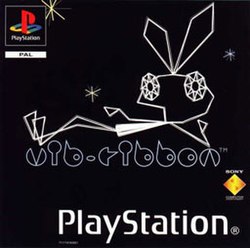

Vib-Ribbon is the kind of game that sounds like a fever dream you'd have after listening to a mixtape at 3 a.m. It arrived on the PlayStation in 1999 and looks like someone stripped gaming down to its skeleton, gave that skeleton a top hat, and told it to hop to the beat. You play as Vibri, a spindly wireframe rabbit who runs across a minimalist world made of white vector lines while the universe throws timed obstacles at her based on music. The wild bit? Once the game loads into the PlayStation's memory, you can eject the disc and shove in any audio CD you own to generate a unique level from a track. That mechanic alone turned boring car ads and late-90s store-bought CDs into your personal rhythm gauntlet. The origin story is weirder than the visuals: Vib-Ribbon started its life as a Mercedes-Benz A-Class ad. The car flopped its moose test, the ad plan was scrapped, but the game lived on - rescued by designer Masaya Matsuura and a tiny team of eleven who clearly liked making small things that punch above their weight. What they produced is a ruthlessly simple rhythm game with a cult following, a soundtrack by Laugh and Peace, and a visual style that convinced some publishers to say, 'No thanks,' and others to say, 'Please never stop.' The end result is a sticky little experiment that still feels fresh because it trusts the player and their music more than most polished rhythm games of the era did.
Vib-Ribbon's brain is both tiny and brilliant. Gameplay is stripped to essentials: Vibri runs along a line and encounters four basic obstacles - block, loop, wave, and pit - which correspond to pressing L1, R1, X, and Down respectively. Sometimes obstacles merge and demand two-button choreography. Hit the correct button at the right beat and Vibri sashays on; miss and she devolves into a messy scribble. Keep messing up and the rabbit regression continues: rabbit to frog to worm, and too many worm hits and it's game over. Hit enough notes in rabbit form and Vibri becomes Super Vibri, and then you feel like the kind of unstoppable boss that opens jars for a living. Scoring is simple but satisfying. Symbols appear as you play, converted into points at the end of a run, and Vibri offers a little victory song if you do well - because who wouldn't want a tiny synthesized rabbit to serenade them? The base game ships with six songs split into bronze, silver, and gold courses, but the real party trick is the CD analysis. Once the game is in RAM you can pop out the Vib-Ribbon disc and insert any audio CD. A programmer figured out how to let the PlayStation analyze CD audio about eight seconds ahead and create obstacles from 'interesting' frequency changes. That means your dance-pop guilty pleasures will play differently from your death metal vinyl-sounding cousin, and the difficulty scales with the intensity of the music. That feature is charming, maddening, and occasionally inconsistent - reviewers noted timing could feel a little off with some tracks, and custom-CD levels can be 'cruel on the highest difficulty.' The game's difficulty curve is honest rather than manipulative. There's no flashy combo counter or micro-transaction nonsense - just timing, rhythm, and the occasional moment where your favorite song betrays you by turning into a mangled obstacle soup. The simplicity is intentional: the team wanted both hands on the controller, inspired by Matsuura's drumming obsession. If you like rhythm games that make you feel like a percussive wizard without smothering you in visual confetti, Vib-Ribbon hits the sweet spot. If you want tutorial overkill or a story that explains why rabbits listen to techno, you might grumble. But if your idea of fun is proving your mixtape deserves respect, this game is the musical litmus test you didn't know you needed.
Visually, Vib-Ribbon looks like an art-class project conducted inside a 1990s screensaver. The aesthetic is pure white vector lines on a neutral canvas with crude, angular drawings forming the level geometry and characters. Those graphics weren't just an artsy choice - they were a practical one. The developer wanted the entire game software to be small enough to run from the PlayStation's memory after load so players could swap discs and insert CDs. Minimalism was born out of necessity and affection for early computer graphics. That lack of texture and color somehow becomes the game's personality: stark, hypnotic, and utterly unconcerned with photorealism. Critics either adored or were baffled by it. Some saw the wireframe look as refreshing and philosophically on point - Cam Shea from Hyper even read 'survival of the fittest' into the evolution visuals - while others admitted they stared at the screen like a raccoon caught in headlights. Vibri's voice, generated with a speech synthesizer, and the transformation animations (rabbit to frog to worm) are small touches that sell the game's quirky charm. The visuals also make the level generator more readable; when everything is stripped back, rhythm and obstacle placement are easier to interpret at a glance. It's a style that ages weirdly well: it's not trying to hide its age because its charm was never about pixels per inch, but about the precise interaction between music and minimal design.
Vib-Ribbon is a tiny experimental gem that punches far above its minimalist visuals. It's equal parts rhythm trainer, mixtape judge, and abstract art installation. The mechanics are elegantly simple - sometimes maddeningly so - and the CD-import feature is one of those designer winks that still makes modern games look overcautious. Critics were split on the timing consistency and some players found custom-track generation a little flaky, but the concept was strong enough to earn a cult following, spin-offs in Japan, and even a place in the Museum of Modern Art. If you value creativity over gloss, and you enjoy the idea of turning your music collection into a personal obstacle course, Vib-Ribbon is a must-try. I give it an 8/10. It's not flawless, it won't hold your hand, and your favorite song might make you cry when it forces you to tap Down at the worst possible moment - but it's unforgettable. Plus, there's something deeply satisfying about a game that can be loaded, discarded, and then asked to judge your CDs like a tiny, polite music snob. Long live Vibri, the rabbit, the audio critic, and the best excuse to dust off that weird old CD you hoped you'd never play in public again.
 Wayward Strand on Xbox Series X/S
 Bridge Constructor Portal on Switch
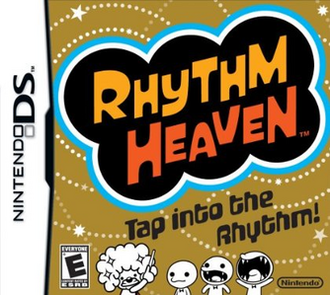
 Rhythm Heaven on DS
 Super Crazy Rhythm Castle on Xbox Series X/S
 Touhou Spell Bubble on Switch
 Rhythm Heaven Groove on Switch
 PaRappa the Rapper 2 on PS2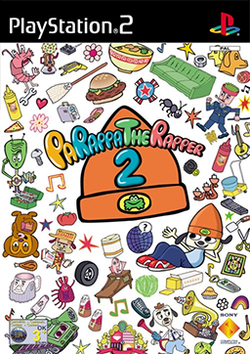










 Another SquareThought Site