

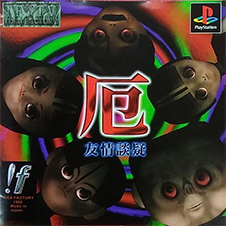

Yaku: Yūjō Dangi arrives like a dusty cassette found in the back of a closet - familiar, a little warped, and oddly compelling if you squint and remember how games used to be. Released for the PlayStation in January 1996, this early Idea Factory title (co-developed with Axis Art Amuse and directed by Shingo Kuwana) stakes its claim in the nascent CD-era horror genre. It is a visual novel built around five former classmates who return to their old elementary school to exhume a time capsule, and of course nothing peaceful ever happens when adults dig up childhood secrets. The game is an exercise in atmosphere and structure rather than twitch reflexes: it offers multiple viewpoints, branching dialogue menus and endings, and a design philosophy that favors mood over modern production gloss.
On the surface Yaku follows the straightforward visual-novel template of mid-90s Japan: read walls of text, make choices at discrete branching points, and watch as the narrative unfolds into one of several conclusions. The wrinkle - and the one feature that still feels slightly ahead of its era - is the ability to switch perspectives among the five protagonists. Each character supplies a different lens on the same events, turning what might be a linear mystery into a rotating portrait. On a first run the game limits you to two interchangeable points of view, which helps the story drip-feed itself, and later playthroughs unlock the remaining scenarios. That structure encourages replay, not because the mechanical systems are deep, but because the plot is deliberately compartmentalized: answers come from stitching together the disparate pieces each viewpoint supplies. This is both Yaku's greatest strength and its most obvious shortcoming. It rewards patient readers and players with a taste for piecing together narrative shards, but it punishes the impatient with repetition and, occasionally, clumsy pacing. The pacing problem is worsened by faith in its CD medium - long loading times interrupt the mood more often than they enhance it - and the sparse soundscape. The game relies heavily on silence and isolated musical cues to generate dread, but the lack of ambient effects and more dynamic audio design frequently turns intended scares into dead air. The choice architecture itself is straightforward and rarely surprising: there are moments that feel consequential, and others that are little more than illusionary branches guiding you toward preordained encounters. Still, the perspective-swapping mechanic makes replay worthwhile for those who enjoy literary puzzles and the slow accretion of dread. Multiple endings and scenario-specific revelations give the game replay value beyond the novelty of its premise.
The visual presentation in Yaku is a study in contrasts. The character portraits and background art are deliberately crude by later standards, often appearing blocky and low-resolution even for 1996. Instead of polishing this away, the developers leaned into the aesthetic: reviewers at the time - and a few modern commentators - argued the roughness creates a unique, uncanny flavor. The art can look simultaneously flat and expressive, like photocopied nightmare sketches that have been run through a bad TV screen, and for a title aiming to unsettle, that ambiguity works at times. Critics were divided: some praised the creepy atmosphere engendered by limited fidelity, while others found the designs emotionally distant and hard to sympathize with. Audio, regrettably, does not save the visuals. The soundtrack is minimal and the sound effects are sparse to the point of absence, which means the game places heavy burden on the static images and text to do the heavy lifting. Loading pauses between scenes were frequently noted in contemporary reviews as breaking immersion; they remain the game's most tangible technical nuisance on original hardware. If you approach Yaku as a museum piece - as an artifact of 1990s CD-era experimentation - its visuals have charm and character. If you expect polished presentation or cinematic flair, the graphics will likely come off as undercooked or unfinished.
Yaku: Yūjō Dangi is not a horror masterpiece and it is certainly not a modern visual novel: it is a product of a particular moment when teams were learning what the CD format could do for storytelling. Idea Factory and Axis Art Amuse were inexperienced at the time - a fact their director Shingo Kuwana has candidly acknowledged - yet the game demonstrates ambition in structure and concept. The perspective-switching mechanic remains the game's most defensible innovation, offering a small but genuine sense of discovery across multiple playthroughs. On the negative side, inconsistent pacing, long loading times, thin audio, and occasionally immature handling of themes such as bullying undercut the emotional impact. Contemporary critics were split, and anyone approaching the title today should do so with tempered expectations: Yaku rewards curiosity more than comfort. If you collect PlayStation oddities, enjoy retro horror experiments, or want to trace the early work of Idea Factory (which would later find clearer voices), this is worth a look - particularly now that a fan translation exists for English-speaking players. For the casual horror fan expecting refined scares or cinematic tension, look elsewhere. For the patient, slightly masochistic player who enjoys piecing together a narrative from uneven shards, Yaku delivers a strange, occasionally effective experience. It's not essential, but it's memorable in the way old VHS tape nightmares are memorable: imperfect, occasionally unnerving, and stubbornly of their time.
 Tokimeki Memorial Drama Series Vol. 3 Tabidachi no Uta on PlayStation
 Oshiete! Popotan on PS2
 Princess Princess on PS2












 Another SquareThought Site