

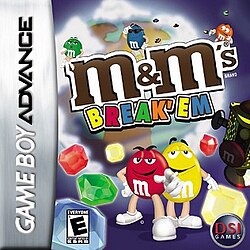

I remember the 1990s as a time when reviewers wore seriousness like a uniform and handhelds were judged with the ruthless logic of battery percentage and patience. Approaching M&M's Break' Em on the Nintendo DS, I slipped back into that era: stylus in pocket, D-pad under thumb, and an odd sense of duty to evaluate yet another licensed confectionery tie-in. Frame Studios Interactive, the small Italian house that produced Gem Smashers, has taken its bouncing-orb puzzle formula and coated it in candy-colored branding. The end result is a curiously earnest little game that seems torn between being a tidy puzzle diversion and an extended advertisement for sweets. It wants to be clever, sometimes is, and often feels like it forgot the sugar was supposed to taste good.
M&M's Break' Em is built on a deceptively simple conceit: you control one of five colored M&M characters that never stop bobbing vertically. Your only real job is to guide them left and right while they ricochet off blocks, smash matching crystals, and free imprisoned M&M citizens. That vertical bounce is the game's metronome; mastering the rhythm is both the joy and the mild frustration it offers. Levels sit on a map with orange nodes for standard stages, blue nodes for boss encounters that are unlocked by clearing every local level, and pink nodes hiding extras that require you to find keys tucked away like afterthoughts. Controls are straightforward in the old-school sense. Use the D-pad for lateral movement, or-for those who bought the DS version expecting touchscreen wizardry-use the bottom screen to drag your M&M left or right. In practice the D-pad remains the more precise tool, while the stylus option is serviceable but slippery. You can alter your candy's hue by smashing into hidden color pots or blocks; the color mechanic is the game's primary puzzle hook because crystals only shatter when they match your current candy color. This encourages a mix of planning and improvisation as you chase a color, bounce back, and hope a hidden pot hasn't been tucked behind a skull block. Skull blocks are instant KO hazards that enforce caution and route memorization. Power-ups litter the stages, some helpful, some mischievous: speed boosts, slowdowns, and temporary control reversals all make for a surprisingly varied suite of stage conditions. Each level imposes a timer, and failure to clear the room in time unleashes a bouncing skull that hounds you relentlessly. These pressure elements lift Break' Em from passive puzzle fare into something that occasionally flirts with frantic action. Boss fights are the game's most interesting gamble. You still bounce, but now the boss usually sports physical appendages that must be struck while they match your color. The idea of color-locked boss damage is novel for a puzzle game and is a legitimate reason to keep playing for a while. These battles can be clever, yet borderline repetitive: once you learn a boss's pattern, the challenge transforms into a racket of safe bounces and timing windows. The single-player campaign stages travel through themed locales like a forest, an underwater stage, and a tropical island. The level design is competent and occasionally sneaks in satisfying puzzles, but many rooms repeat motifs and layouts in a way that dates the game quickly. Multiplayer is the kind of local competitive spectacle only true handheld nostalgists will appreciate. Two players face off to break more crystals across two arenas, but you need two cartridges to play. That limitation feels archaic even in a 2007 context, and the mode itself is functional rather than inspired. The continue system is stingy; lives are not handed out like Halloween candy, and some reviewers at the time found the economy of continues frustrating. The DS version offers touchscreen sensitivity options, but the handle on the DS hardware never quite elevates Break' Em into a touch-native experience. Ultimately, the gameplay sits in the middle ground: occasionally clever, sometimes maddening, and often content to be a competent time-eater rather than a classic.
Visually, Break' Em is a mixed bag. The palettes are bright and saccharine, which fits the M&M franchise, but the sprite work lacks the polish expected on the DS. Critics pointed out that sprites can look rough around the edges and that the occasional animation-like freed M&M citizens flying at the foreground-can obscure your own character for a beat, an unfortunate design hiccup in a game that requires split-second positioning. Backgrounds and level themes are pleasantly varied but rarely memorable; they provide context without ever stealing attention away from the mechanics. Sound follows the same pattern: jaunty, unobtrusive tracks that set a bouncy mood but don't linger after you close the lid. The cutscenes lean on static images and text rather than voice acting, which makes the branding feel thin. If you hoped for a fully voiced candy crew narrating your triumphs, you're out of luck. Presentation choices make the game feel more like a modest handheld puzzle cartridge than a premium licensed title, which may be either a blessing or a disappointment depending on your expectations.
M&M's Break' Em is the sort of handheld puzzle title that will split opinions along the exact same fault lines it did in its initial reviews. It borrows a proven bouncing-orb formula from Frame Studios' prior work and seasons it with a handful of original twists-color-changing pots, timed skull chases, and boss fights that demand color-matching precision. Those elements are enough to keep a patient player entertained for a dozen hours if repetition doesn't bother them. On the other hand, visual roughness, thin audio, a stingy continue system, and a multiplayer mode that demands two cartridges mean the game rarely aspires beyond competent. If you approach Break' Em as a light, rhythmically driven puzzle diversion and a nostalgic piece of DS-era oddity, it will deliver modest pleasures. If you wanted a polished, fully flavored licensed title where the candy license felt essential rather than decorative, you'll be disappointed. For collectors and fans of small-scale puzzle design, there's charm here; for everyone else, it plays like a candy wrapper promising a rich filling and delivering something a little harder and more utilitarian. In the end I find it fair to slot Break' Em into the middle shelf of the DS puzzle cabinet: not rotten, not sublime, but undeniably its own peculiar confection.
 Dragon Drive: Tactics Break on PlayStation
 Chaos Break on PlayStation
 Puzzle by Nikoli 4: on PS4
 Twinbee Taisen Puzzle Dama on PlayStation
 Tokimeki Memorial: Taisen Puzzle-Dama on PlayStation
 Professor Layton and the Last Specter on DS












 Another SquareThought Site