

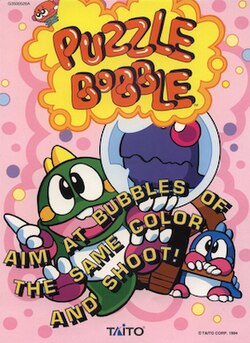

Puzzle Bobble DS wears its lineage on its pixelated sleeve: it is a handheld echo of Taito's 1994 tile-matching darling sometimes known as Bust-A-Move, which itself is a cheerful offshoot of Bubble Bobble. On the surface this is a friendly, deceptively simple game of shooting colored spheres and watching them pop like guilty secrets at a family reunion. Underneath, however, there is an unexpectedly dramatic soap opera of characters - both the named protagonists and the anonymous blobs they fire. In this review I will give Puzzle Bobble DS the treatment it secretly deserves: an in-depth analysis of personalities, motivations and story arcs, seasoned with the practicalities of gameplay and a pinch of snark. The goal is to explain why a game whose plot can be summarized as 'match three or cry' still manages to feel like a saga when you get deep into it.
Puzzle Bobble's gameplay is the stage on which its characters act, and the mechanics provide most of the emotional beats. Each round opens with a prearranged pattern of colored bubbles clinging to the ceiling of a rectangular arena. From the bottom, the player controls a pointer that aims and fires bubbles up the screen. The fired bubble travels in a straight line and can ricochet off the sidewalls - the old physics trick that allows you to be both a patient planner and a reckless artist. The color of the fired bubble is not a spiteful random - at least not entirely evil - it's randomly generated from the palette still present on the playfield, which keeps the drama constrained and, crucially, fair. If you think this sounds minimalist, you're right - and this minimalism is the secret to the characters' arcs. Take Bub and Bob, the brothers-of-sorts borrowed from Bubble Bobble lore. They arrive with no monologues, no cutscenes, but their identity is embedded in every shot. They are less Shakespearean heroes and more sitcom protagonists: predictable, well-meaning, frequently flummoxed. Their arc across the game's levels is one of competence and escalation. In early stages they fumble with obvious matches - three-of-a-kind solutions that are practically spoon-fed to them. As levels progress, they evolve into strategists, coaxing cascades and orchestrating mass drops that feel for a moment like acts of high heroism: one well-placed shot topples entire sections of the hanging menagerie, and heaven and score tallies align. The rest of the cast is the chorus: the anonymous colored bubbles. They have no names, but they carry personality by distribution. Groups of the same color are cliques; match three or more and they vanish, sometimes taking with them those who were merely hanging on, guilt by association. Bubbles hooked to nothing are the tragic figures of the game, plummeting into oblivion the moment their support is removed. The 'ceiling' is the show's looming antagonist - an indifferent force that drops the battlefield downward after a fixed number of shots. This ceiling is merciless but fair: the number of shots before it advances is influenced by how many colors remain, which rewards elegant clearing and punishes scattershot chaos. Musically, the game hints at the villain's approach: the tempo increases as the cluster descends, turning ambient bubble-popping into a ticking-clock soundtrack. It is a classic escalation mechanic that converts spatial pressure into visceral urgency, and it gives the entire match a three-act structure - setup, complication, and often, spectacular failure. Mechanically there are more subtleties worth exploring. The arcade original consisted of 30 levels; each cleared arena brings a new pattern and a new opportunity for Bub and Bob to display character growth. A quirk that deserves a soap-opera aside: the bubbles will fire automatically if you remain idle. This peculiar bit of game design is a character moment in itself - a whisper of impatience from the gameworld. It reads like this: 'We can wait for you to think, but the story moves on with or without you.' Players who hesitate are punished by the game's own agency, which occasionally takes over and makes decisions that reveal the player's indecision in the scoreboard. The multiplayer mode - the place where interpersonal drama actually plays out - turns competitive timing and tempo into intimate conflict. Contemporary critics praised two-player matches for their highlight moments; they felt like short, sharp duels rather than extended sagas. Indeed, competitors find emotional catharsis here in the form of spike combos and counter-attacks that send lines of bubbles cascading toward the other player's field. The single-player mode, by contrast, is a slow-burn Bildungsroman for a bubble shooter: the protagonist becomes proficient, learns to manipulate the ceiling, and occasionally achieves the gloriously satisfying chain reaction that validates every hour spent plotting bounce angles. Critic reception at the time (applied to earlier ports like SNES and 3DO) treated the gameplay as both a blessing and a limitation. Next Generation called it 'addictive as hell' - a statement that reads like a genre eulogy and a compliment all at once. Some outlets accused it of lacking intricacy or longevity because the base rules don't change dramatically. That criticism is valid if you demand constant reinvention, but it's missing the point if you appreciate refinement. Puzzle Bobble is a play about escalation inside strict constraints, and it reveals character through the choices you make with those constraints. On DS this ethos translates well to a handheld: the short sessions, immediate feedback, and bite-sized tension are practically custom-made for bus rides and procrastination interludes.
Visually, Puzzle Bobble DS inherits the 'kawaii' aesthetic that made the original charming. The game trades gritty realism for cute Japanese animation, and nowhere is this cuteness more narratively effective than in the way bubbles express fate. A bubble that is safe and snug is visually content; the moment it loses support it becomes a tiny doomed soul, tumbling toward the bottom in a miniature tragedy. The original presentations on SNES and arcade were criticized by some critics for lacking 3D effects - GamePro griped about the absence of 'any 3D effects' - but that criticism overlooks a stylistic choice. Puzzle Bobble doesn't need 3D to be expressive. Its 2D sprites and bright color palette make the battlefield legible at a glance, which is essential when chain reactions and ricochets are happening at speed. On handheld hardware like the DS, pixel clarity and color contrast are more important than fancy shaders. The original game's sounds and music also contribute to the visual story by setting mood: bouncy, cheerful tracks that shift tempo as danger approaches, a device that anthropomorphizes the playing field. While some ports added stereo sound and minor tweaks, the core audiovisual identity remains simple and effective. If you want high-fidelity visuals, you will find Puzzle Bobble to be modest. If you want a game whose look serves the gameplay and nudges you emotionally when the roof starts falling, it will deliver with quiet competence. The character art - the iconography of Bub and Bob, the smiling little dragons-turned-shooters - is intentionally minimal and broadly appealing. It does a lot with very little, and that restraint supports the game's larger narrative mode: a puzzle strip where each level is an episode in which the protagonists try, occasionally succeed, and sometimes spectacularly fail. This graphical economy is in keeping with the era of the game's origin and functions well on a DS screen, where too much visual noise would obscure crucial information.
Puzzle Bobble DS is a portable theater of tiny dramas. It takes Taito's simple, elegant rule set - aim, fire, match, watch gravity administer poetic justice - and lets you watch character arcs unfold without dialogue or exposition. Bub and Bob's growth from fumbling shooters to masterful cascade artists is mediated entirely through level design and your own decisions, which is a neat storytelling trick: player skill substitutes for conventional plot. Critics of the era were split between calling it an addictive classic and lamenting an apparent lack of long-term variety. Both views have merit. If you measure a game's worth by its ability to reinvent itself forever, Puzzle Bobble will feel shallow; if you measure it by the pure joy derived from optimizing angles and engineering chain reactions, it still ranks highly. As a DS experience, the formula's strengths are well suited to handheld life: short matches that escalate quickly, satisfying payoff loops, and an audiovisual language that punches above its weight. The multiplayer remains the game's most electric place - a tiny arena for interpersonal spite and gleeful revenge - while the single-player mode is a steady apprenticeship in spatial reasoning and timing. For players who enjoy tidy, brainy puzzles delivered with kawaii swagger, Puzzle Bobble DS is a comforting, occasionally thrilling pocket companion. It may not be a sprawling epic, but its compact acts of bubble-based catharsis make for one of the more charming and reliable puzzle experiences in the Taito stable. Who is this for? People who like their puzzles lucid, immediate, and forgiving of short attention spans. Who is this not for? Those demanding deep narrative layers or constant mechanical reinvention. Final verdict: the classic formula still snaps, pops, and sings - and watching the little cast of bubbles live, die, and fall gives the game a surprisingly human rhythm. Score: 7.5/10.
 Professor Layton and the Last Specter on DS
 Puzzle Kingdoms on DS
 Puzzle de Harvest Moon on DS
 Densha de Go! on PlayStation
 Arcade Archives: Cadash on Switch
 Space Invaders Extreme on DS
 G-Darius on PlayStation
 Darius Gaiden on PlayStation












 Another SquareThought Site