

 Jun 2020
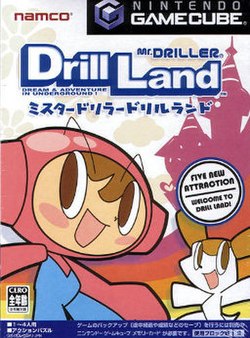

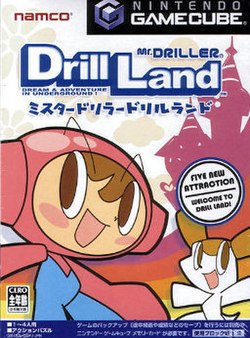
Mr. Driller Drill Land is the 2002 love letter to coloured-block entropy that Namco made for the GameCube and eventually dusted off and remastered as Mr. Driller Encore for modern platforms, including the Nintendo Switch. At its core it preserves the lean, Tetris-adjacent rule set of the series: dig down by destroying clusters of coloured blocks, manage oxygen as a soft timer, and avoid being crushed by physics-enabled rubble. What takes Drill Land from 'another block puzzler' to 'something with personality' are the structural design choices - five distinct attraction-like game modes, collectible systems and a light meta layer of stamps, shop currency and unlocks that reward repeated play. The remaster brings that package to the Switch with updated visuals and a beginner-friendly Casual mode, but the DNA of the original - chain reactions, gravity, oxygen management - is where the real design work lies.
Technically speaking, Drill Land is a compact systems-of-systems puzzle game. The atomic unit of play is a block with a colour attribute. Blocks that touch and form a connected component of size four or more are removed from the field; that single rule creates the combinatorial possibilities that drive strategy. Because blocks can be adjacent in multiple directions, and because destroying one set can reconfigure adjacent groups, players are asked to plan not just the local removal but the topological consequences - which is to say: think two or three moves ahead and remember that gravity will do the rest. Gravity is an intentional second-order system: unsupported blocks fall and can crush the player character. This makes the environment function like a tiny physics sandbox with deterministic collapse rules. From a technical design perspective that is brilliant because it mixes deterministic matching rules with emergent, position-dependent hazards. You are not simply matching colours; you are managing column stability. The result is a pleasing tension between planning for a big chain and avoiding a lethal drop. Oxygen is the sashimi-shaped metronome of Drill Land. An oxygen meter constantly depletes, applying a continuous time pressure that discourages overly cautious play. The game provides small air capsules that replenish exactly 20% of oxygen and introduces brown "X-Blocks" which deduct 20% when destroyed. Those fixed percentages are good design decisions: they are large enough to be meaningful but small enough to keep the player within a predictable resource calculus. You can reliably compute how many air capsules you need to survive a section and whether a risky X-Block clear is worth the oxygen cost. That lends the game a poker-ish quality: read the board, compute risk, pull the trigger. Drill Land layers new mechanics on top of the core rules through five themed attractions, each acting as a sandbox with its own rule tweaks. Drill Land World Tour is the baseline: classic Mr. Driller rules and the cleanest expression of the connected-components mechanic. The Hole of Druaga borrows from Namco lore with a key-and-door objective - now you must shape your dig path to access an item rather than merely reach the bottom. This reorients the player's heuristic from vertical progression to route planning, which is an elegant way to repurpose the same block physics into different cognitive challenges. Horror Night House flips the rules again by introducing ghost-filled blocks that require 'Holy water' injections - a stateful block type that forces interaction rather than deletion. Drindy Adventure adds environmental hazards like rolling boulders and spikes, injecting moments of deterministic external danger that can override your chain-planning. Star Driller reintroduces timing pressure on individual blocks: "Star Blocks" flash and disappear briefly, which creates a short-lived resource and pushes the player into timing-based micro-decisions. Each attraction effectively modifies one axis of the core problem (resource, route, timing, hazard), turning the same engine into a pentaptych of puzzles. Progression is handled with a light meta loop. Completing attractions grants stamps; collecting all five stamps around the in-park hub lets you face a gatekeeper boss - Dr. Manhole - whose defeat unlocks the next level. This stamp-and-gate mechanic provides a compact form of gated progression that encourages replay without bloating complexity. Completing attractions also yields currency: a shop lets you purchase power-ups, souvenirs and trading cards. Because the currency sink is mostly for quality-of-life or cosmetic items, the shop breaks up the action and provides a low-variance reward loop that nudges replay. The game was originally designed with local multiplayer in mind - a four-player mode was shown in prototype - and critics praised the multiplayer for its intensity and replay value. While the remaster details don't enumerate changes to multiplayer physics, the original's mechanics lend themselves well to competitive emergent gameplay: players can create chain reactions that both help and hinder others, and the oxygen mechanic translates neatly into offensive/defensive play. There are a few intriguing hardware-era flourishes: the GameCube version supported the GameCube-Game Boy Advance link cable to import the "Pacteria" digital pets from Mr. Driller A for parade appearances and exclusive shop items. It's a reminder that Namco was thinking about ecosystem features even at the time, and the remaster's 'Encore' branding acknowledges that historical linkage. From a balance perspective the fixed oxygen replenishment and penalty values plus the deterministic connecting/destroying threshold (four) are statistically transparent, which is a plus for players who like to optimize. The designers intentionally avoided probabilistic block behaviour or hidden RNG for core mechanics; instead, they expose trade-offs and make the player's planning and execution the primary variance source. That design choice keeps high-level skill ceilings clear and rewarding.
Drill Land's visual design is deceptively important for its technical clarity. The original GameCube build used bold, saturated colours to make block types instantly legible; that was a smart accessibility choice because the game's core challenges are visual and spatial. The remaster applies enhanced graphics while preserving the original colour languages and UI layouts, so you get crisper sprites and cleaner animation without losing feed-forward clarity. On the Switch, the increased resolution and smoothing matter for two reasons. First, micro-visual cues - a block flickering, a slight wobble before a fall - are easier to read; that improves player reaction and reduces frustrating deaths caused by ambiguity. Second, the HUD elements (like the oxygen meter and small air capsules) scale better and remain readable in docked or handheld modes. The remaster also adds a Casual mode for beginners which likely adjusts either oxygen depletion rates or air capsule frequency; while the documentation only mentions its existence, such a mode typically changes deterministic parameters to broaden the player base. Audio is an underrated part of the technical experience. Go Shiina, the composer on the original, delivered a soundtrack that critics called "gorgeous," and Drill Land's sound design functions as non-verbal UX. Rhythmic hits cue successful clears, and musical swells accompany chain reactions, creating an auditory feedback loop that reinforces the visual. For a puzzle game where split-second decisions matter, audio feedback is not icing - it's a gameplay signal that helps players track internal game state without parsing numbers. The amusement-park theming is more than cosmetic. Visual signposting communicates rule changes between attractions: décor, block skins and subtle particle effects tell the player what new mechanic to expect. That is an economical and technically sound method of onboarding: instead of verbose tutorials, the game places you in a landscape where visual affordances teach rule variants implicitly.
Mr. Driller Drill Land is a textbook example of iterative systems design: take a simple, robust matching rule and explore its phase space by adding gravity, a time resource (oxygen), and a set of targeted rule variants across multiple modes. The result is a puzzle package that feels larger than the sum of its blocks. The remaster on Switch preserves the deterministic clarity that makes the game satisfying for players who like to plan and execute, while the enhanced visuals and Casual mode make it more approachable. If you enjoy puzzle games as engineered systems - where you can measure risk, compute outcomes and execute strategies - Drill Land is deeply rewarding. If you're after narrative depth or open-ended exploration, it will feel compact and focused; its joys are in precision, not story. At 8.2/10, Drill Land earns a spot in the 'must-play for puzzle fans' shelf: it's smart, mechanically transparent, and still manages to wear a theme-park costume without screwing with the underlying mechanics. For technical players and speedrunners alike, the game's deterministic rules and clear feedback make it a pleasure to dissect - and occasionally to smash through in a glorious chain reaction while the soundtrack applauds your hubris.
 Mr. Driller Drill Land on Xbox One
 Mr. Driller Drill Land on PS5
 Puzzle by Nikoli 4: on PS4
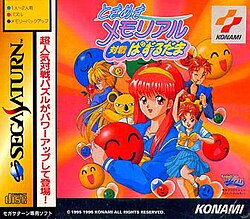
 Tokimeki Memorial: Taisen Puzzle-Dama on PlayStation
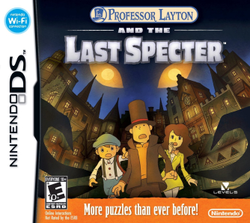
 Professor Layton and the Last Specter on DS
 Tokimeki Memorial 2 Taisen Puzzle Dama on PlayStation
 Mr. Driller G on PlayStation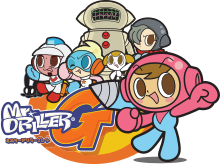










 Another SquareThought Site