

 Dec 2017
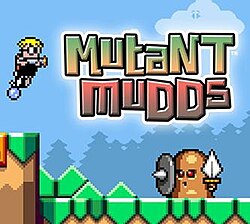

Mutant Mudds started life as a scrappy indie concept that morphed from a polygonal experiment into a highly refined 2D platformer, and the Mutant Mudds Collection on Switch is the tidy box-set culmination: Mutant Mudds Deluxe, Mutant Mudds: Super Challenge, and Mudd Blocks bundled into one portable package. This collection is an interesting case study in minimal-but-disciplined design that trades flashy tech for tight mechanical execution. If you like your platformers with precise physics, deliberate level geometry, and a fetish for layered planes, this is a compilation that rewards close attention. The collection also doubles as a micro-history lesson in indie development: a title that began as a modified 3D engine from Renegade Kid's Moon, then intentionally pivoted to 2D for sharper control and clearer design. The Switch release is a welcome home for these games: they sit well on a handheld with modern ergonomics while preserving the original quirky design decisions-like jumping between foreground and background and collectibles that force you to re-examine every tile for secrets.
Mutant Mudds is a mechanical game first and a narrative afterthought. The control schema is deceptively simple, and that's the point: jump, hover, and shoot. On the original 3DS, the A or B button performs a single jump with the option to press again midair to initiate a multi-second hover. Shooting is mapped to X or Y. That mapping translates naturally to the Switch controllers, so anyone picking this up will find the inputs familiar and unambiguous. What makes the feel work is the hover: it's not a floaty secondary jump so much as a controlled reduction of gravity for a fixed window. This creates a predictable, programmable arc for the player to exploit-gaps, enemy clusters, and platform edges are designed with that arc in mind. Precision is everything. The shooting model is deliberately low-friction. Max has effectively unlimited ammunition and the guns act like zoning tools; enemies generally require several shots to down, which nudges the player toward positioning and pattern exploitation rather than twitch-spam. The enemies themselves are mostly reactive obstacles with predictable telegraphs, so the player's skill is measured by path planning: choosing where to hover, when to bail to the background, and how to conserve hearts. The three-heart health system, coupled with instant death hazards like spikes and lava, sets up a layered risk model: contact damage chips away at margin for error, while environmental hazards punish sloppy movement. For a technically minded player that translates into two sets of collision logic to internalize-soft collisions (enemies, projectiles) and hard collisions (instant-kill geometry). Level architecture is the game's real laboratory. Each main stage presents three objectives: reach the Water Sprite (the end goal), collect all 100 golden diamonds, and locate a hidden portal to one of the themed secret lands (CGA-land, G-land, V-land). The 100-diamond requirement is not filler; it forces designers to distribute micro-challenges throughout the map so that every subzone has a purpose. From a systems perspective, that creates an elegant tension between short-path speedruns and exhaustive exploration. Some diamonds are in plain sight but require tricky platforming to access, others are deliberately tucked behind destructible barriers or gated by upgrade-dependent paths. Upgrades are unlocked by diamond thresholds and are designed as discrete progression modules: extended jetpack, rocket jump, and bazooka. Each one rewires how the player interacts with space. The extended jetpack increases the hover window and gap-crossing potential; the rocket jump trades height for a dramatic vertical burst; the bazooka alters level geometry by breaking barriers. The game's gating design is clever in that only one upgrade can be equipped at a time, forcing the player to make loadout decisions that shape route choices. Granny's bonus levels invert this constraint-she can use all upgrades simultaneously, converting later stages into experiments in combinatorial traversal. From a design standpoint, that contrast is instructive: the core game teaches mastery through limitation, while the Granny levels are a sandbox for unrestricted ability stacking. The foreground/background plane-shifting is the headline gimmick but it's more than a novelty. Orange launch pads send Max between planes and the mechanic is used to hide geometry, create depth puzzles, and emulate the 3D essence the title once had. The 3DS used stereoscopic depth to sell the illusion; the PC version approximated it with depth-of-field effects. On the Switch, where stereoscopy is absent, the game relies on parallax and sprite scaling to differentiate planes-an artful compromise that preserves spatial memory without hardware dependency. As a programmer, that mechanic demands a robust spatial partitioning system: collision detection has to reconcile which plane an entity occupies at any time, and the camera needs to anticipate plane transitions to avoid momentary disorientation. Renegade Kid's move to 2D mitigated the combinatorial explosion of full 3D collision while keeping the depth illusion intact. Difficulty balance is mostly fair, but intentional spikes exist. Later worlds lock behind a gate that requires defeating a requisite number of previous levels, which effectively enforces completionism. The optional secret lands are short but brutally designed-think concentrated platforming puzzles that test the player's internalized movement model. Time constraints are worth noting: the four-minute timer is a 3DS-specific concession; it functions as a soft pressure mechanic that nudges the player toward momentum. That timer was omitted from other versions, and it's a good example of platform-specific design trade-offs: limited handheld session lengths on the 3DS probably motivated the constraint, whereas modern ports can relax it. On the compilation level, Mutant Mudds Deluxe and Super Challenge are complementary. Deluxe offers the core campaign with expanded content and the free DLC that added 20 Granny levels, while Super Challenge is a distilled, harder set of stages aimed at players who have internalized the core rules. Mudd Blocks is a small puzzle detour that borrows the IP's visual language. Packaging these together on Switch is sensible from both a user-experience and technical standpoint: asset reuse minimizes memory overhead and keeps load times short, while the modular build allows the Atooi team to deliver multiple binaries within one cart without duplicating too many resources.
Visually, Mutant Mudds wears its inspiration on its sleeve. The aesthetic is a deliberate '12-bit' homage-an expression of restraint rather than retro fetishism. Jools Watsham's pixel-forward art direction uses limited palettes, readable silhouettes, and high-contrast foregrounds to ensure mechanical clarity. From a technical perspective, that's an excellent optimization strategy: fewer colors and simpler tilesets mean smaller texture memory footprints and faster sprite batching. The secret lands (CGA-land, G-land, V-land) are not just stylistic gags; they function as deliberate palette-swapped platforming tests that also showcase how much expressive variety you can squeeze from constrained palettes. The porting lineage matters here. Mutant Mudds was originally prototyped on a modified 3D engine, then rebuilt in 2D for precision. That history shows in the careful plane transitions and sprite shading that give a pseudo-3D depth without the complexity of full 3D engines. On 3DS, stereoscopic layers were a selling point; on PC, developers used depth-of-field to similar effect. On Switch, the trick is efficient parallax scrolling and crisp upscaling. The sprites remain sharp, and animation frames are economical but communicative-enemy telegraphs, Max's hover posture, and launch pad transitions all read clearly. Audio design complements the visuals with a concise, loop-friendly soundtrack of 21 tracks by Troupe Gammage. The music is engineered to be unobtrusive but rhythmically supportive of the platforming cadence. From an implementation perspective, offering the OST with an open-price model is a neat indie-era touch; it also signals a low-overhead audio pipeline that uses short loops and compact samples-again, good for portability and minimal disk/flash use. Sound effects are functional: hit confirmations, launch thumps, and the satisfying chime of collected diamonds all provide immediate feedback without clutter. Performance on the Switch is generally uncontroversial because the game is not graphically demanding. The more interesting technical achievement is fidelity preservation across multiple platform generations. Asset reuse, careful palette management, and deterministic physics all make it easy to keep the game's mechanical identity consistent between the 3DS, PC, and Switch builds. The real test is input fidelity: the game rewards tight timing, and the Switch's control options (Joy-Con, Pro Controller, or handheld) all translate the original mappings faithfully. If you're someone who analyzes hitboxes and micro-physics, you'll appreciate how stable and deterministic the engine behaves across levels.
Mutant Mudds Collection on Switch is a textbook exercise in doing more with less. The compilation packages three related experiences that share mechanical DNA and aesthetic cohesion while providing layers of optional challenge for players who like to squeeze every last diamond out of a stage. From a technical perspective, its strength lies in focused design decisions: a simple, low-variance input set; explicit plane partitioning; deterministic hover physics; and compact assets that prioritize clarity over spectacle. Those choices make the games feel tight, consistent, and fair even when they lean into brutality. If you want a showy tech demo, look elsewhere. If you want a platformer where every jump, hover, and shot has predictable outcomes and where level design consistently interrogates those actions, Mutant Mudds is excellent value. The Switch is the ideal modern host: portable, comfortable, and capable of presenting the collection without sacrificial compromises. Score-wise, the package lands comfortably in the high eights: well-crafted, lovingly tuned, and technically coherent. It's the kind of indie platformer that reminds you why precision still matters in game design-plus it gives you 100 diamonds per level to obsess over, which is basically the indie equivalent of catnip.
 Teenage Mutant Ninja Turtles: The Cowabunga Collection on Switch
 Tokimeki Memorial Private Collection on PlayStation
 The Wacky History of Platform Games
 Toki Tori on Switch
 PlayStation Home on PS3
 Obscure: The Aftermath on PS2










 Another SquareThought Site