

 Feb 2019
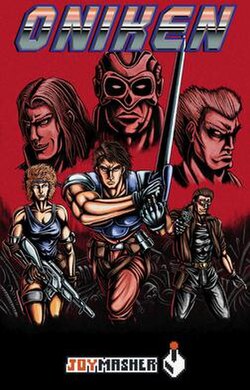

Oniken: Unstoppable Edition is Joymasher's love letter to the 8-bit era, delivered with the blunt force trauma of a pixelated katana. On Switch the game arrives as a compact, blood-splattered retro romp: six levels, one extra Contra-style mission, and a boss at the end of every stage to remind you that patience and pattern recognition are the new black. Oniken wears its inspirations-Ninja Gaiden, Strider, Contra-on its sleeve and then jumps off a neon rooftop to stab you with nostalgia. But this review is less about whether the jumps feel tight and more about the people and machines that make this tiny apocalypse hum. Characters in Oniken are brief, archetypal and theatrical, and yet the game squeezes surprisingly potent story beats out of very little text. That economy is worth talking about: how an eight-bit aesthetic shapes personality, how a single name (Zaku) can do narrative heavy-lifting, and why the villainous Oniken armada functions as more than just a spawn table for lasers.
Oniken's core loop is the classic slasher-platformer formula: run, jump, slash, learn boss patterns, repeat-except it often feels like the game expects you to learn quickly or die inventively. There's a satisfying brutality to the controls that matches the game's world: every level is a gauntlet that funnels the player's rage into memorization and precision. Oniken gives you six main stages and then, as a reward for surviving the main story's pixel storm, an extra mission that swaps the feel into Contra-esque run-and-gun chaos. It reads like a mid-80s cheat code: if you survive the ninja poetry, here's your explosive arcade adrenaline. In terms of character-driven gameplay, the designers use Zaku's identity as both flavor and function. He is a legendary ninja mercenary with an unknown past, and his moveset-fast, deadly, little room for error-mirrors that archetype. You feel like a hired blade rather than a wandering platforming tourist; the combat encourages single-minded, lethal efficiency. Boss encounters are structured as short, sharp duels that almost narrate Zaku's journey by framing each encounter as a test of resolve: the mechanics strip scenes down to pure motion and consequence. The Oniken commanders are less about exposition and more about performance; each boss fight is a mini-act where the enemy reveals character through behavior-an armored commander that forces you to zig when you expect zag, a missile-spewing colossus that turns the stage into a choreography of dodges. General Zhukov's role in actual gameplay is mostly symbolic rather than mechanical: he exists to catalyze the plot and to give Zaku a mission. In terms of pacing, Zhukov's appearance is the narrative equivalent of a quest-giver dropping a letter into your lap and then disappearing to a smoky bunker. That lack of screen time doesn't diminish Zhukov's importance; instead, it forces you to piece together the stakes from level design and enemy placement. The world-building-oppressive robotics, ruined human outposts, last-stand encampments-does much of the storytelling that the game doesn't spell out with dialogue. Where Oniken really leverages its characters is through implication. Zaku's mystery-no backstory dumped mid-level, no endless flashbacks-acts like a pressure cooker. The player becomes the one who fills in blanks: why does a mercenary suddenly join a resistance? What ghosts is he fighting? By refusing to over-explain, the game invites you to assign motives and gravitas to a helmeted silhouette who could otherwise be just an evil-splitting machine. That narrative economy often works better than oversized cinematic exposition because it treats the player like a co-author.
Visually, Oniken is unabashedly 8-bit in its painterly chips and limited palette. On the Switch the pixel art reads cleanly and feels lovingly handcrafted rather than lazily emulated. Backgrounds are spare but evocative: ruined cities that suggest histories of conflict, and command bases that feel functionally built for the efficient cruelty of an armada. Zaku's design nods to classic anime protagonists-Joymasher explicitly cites Kenshiro as an inspiration-and that silhouette reads immediately: broad shoulders, angular stance, a fighter who walks like a threat. Enemy design follows the same economy: Oniken units are visually distinct by function, and their movement tells you how to react. Boss sprites, in particular, are given enough scale and animation frames to feel cinematic within the 8-bit constraints. The presentation also uses limited graphical storytelling to good effect. Instead of cutscenes, the game relies on environmental cues, stage transitions and striking boss reveals to sell plot points. On a screen of chunky pixels, a single animation-an Oniken banner unfurling, a commander slamming a fist into the ground-carries more weight because there's no competing gloss. The Switch's docked and handheld modes both handle this aesthetic well; the art doesn't try to upscale itself into modern 3D fidelity, and that restraint is precisely the game's charm. If you're looking for fidelity, Oniken doesn't apologize; if you want atmosphere packed into sprites and pattern-based encounters, it delivers.
Oniken: Unstoppable Edition is a compact, muscular piece of retro design with more character than its word count suggests. Zaku's arc-if you can call it that in a game with minimal dialogue-is a study in heroic implication: a nameless past, a present mission, and a path cleared by falling Oniken commanders. The resistance, led by General Zhukov, exists mostly as a moral backdrop and a narrative engine, but their existence gives weight to each ruined stage. The Oniken armada functions as an effective antagonist not by philosophy but by presence: cold, methodical, and mechanically expressive. Oniken isn't a role-playing epic; it's short, hard, and confident about what it wants to be. If you came for a faithful 8-bit homage that respects the player's imagination and punishes sloppy inputs, you'll have a good time. If you came for an expansive story full of character development in the modern sense, you might leave wanting more scenes and exposition. For what it sets out to do-deliver sharp, old-school action with personality-Oniken earns its place among modern retro revivals. It's a satisfying blast of arcade-era drama with a pixelated heart, and on Switch it's an accessible bite of nostalgia that still stings when a boss one-shots you. Recommended for fans of Ninja Gaiden-style intensity and anyone who likes their storytelling terse, implied, and delivered in the form of a boss pattern. Final score: 7.5/10.
 Tomoyo After: It's a Wonderful Life on PS3
 Talisman: Digital Edition on Xbox Series X/S
 Disney's Chicken Little: Ace in Action on PS2
 Onimusha: Dawn of Dreams on PS2
 Action Man: Operation Extreme on PlayStation
 Door Kickers: Action Squad on Switch
 Blazing Chrome on Switch
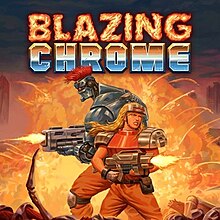 Blazing Chrome on PS4










 Another SquareThought Site