



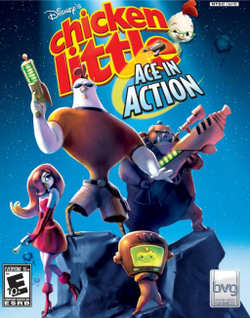
Tie-ins are a delicate art: balance faithfulness to source material, accessibility for younger players, and a technical execution that doesn't make players weep into their controllers. Disney's Chicken Little: Ace in Action (PS2) takes the film's 'movie-within-a-movie' concept and turns it into a decent mid-2000s action-platformer. Avalanche Software-best known at the time for licensed family titles-built a 24-level romp that leans heavily on explosive weapons, vehicle segments, and boss encounters. If you expect breakneck innovation, you'll be disappointed; if you want an approachable, technically competent licensed shooter-platformer with a few clever design choices, it's worth a rental or a budget buy.
At its core Ace in Action follows an action-heavy template reminiscent of Ratchet & Clank: tight, arena-ish combat encounters interspersed with linear platforming and vehicle stages. The PS2 package contains 24 levels and six bosses, and the engine is tuned to support quick transitions between on-foot shooting (Ace), tank-driving (Runt) and ship piloting (Abby). From a systems perspective this tri-modal approach is the game's biggest technical and design gambit: the team needed a single control paradigm that could scale across three very different gameplay loops without feeling slapped together. Controls and input mapping are unambiguous on the DualShock 2. Movement is mapped conventionally, with a face-button trigger for primary fire and context-sensitive secondary actions. Responsiveness is the title's strong suit; inputs translate to on-screen motion without significant lag, which is essential for the frequent wave-based encounters the designers favor. Enemy spawn patterns often create compact combat arenas where strafing and angle management-more than complex combos-determine survival. This leads to a gameplay rhythm that feels deliberate: clear, engage, relocate, repeat. When Smash TV-esque mechanics are invoked in reviews, they aren't exaggerating-the game funnels you into rooms where enemy density and projectile patterns are the primary challenge. Weapon design is functional rather than flashy. The arsenal provides a pleasant variety of projectile behaviors (spread, rapid-fire, charged shots), and the feel of weapons is weighted so that even the default gun is serviceable. Where this causes friction is depth: there isn't an extensive upgrade tree or customization layer like contemporary action-platformers such as Ratchet & Clank, so once you've sampled the main weapons the incentive to experiment dwindles. That simplicity becomes a double-edged sword; it makes the game approachable for younger players but reduces long-term mechanical engagement for seasoned action fans. Level design does a commendable job of mixing traversal with combat. Platforming sections demand timed jumps and occasional precision, but the platforming rarely veers into punishing territory-the tuning skews toward accessibility. Vehicle sequences are a highlight technically: they change the camera dynamics and require the engine to manage different physics profiles and collision schemas without hiccups. You can discern the developer's attention to collision handling in these segments; tanks feel hulking, ships are nimble, and on-foot navigation strikes a middle ground. Cameras, however, are where the PS2 version shows its age. The fixed/auto hybrid camera works well in many rooms but occasionally gets stuck on geometry or fails to track fast-traveling projectiles, which can lead to unfair deaths or clipped sightlines during dogfights. AI in Ace in Action is straightforward but competent. Grunts exhibit predictable but effective flanking and dodging behaviors, while mid-tier enemies use shielding or burst attacks to force movement. Boss encounters are designed around pattern recognition: telegraphed attacks followed by vulnerability windows. That structure benefits players who can read attack cues but will feel repetitive after several bosses are cleared because the game tends to reuse attack archetypes rather than iterate them significantly. Progression and pacing sit comfortably in the casual-to-moderate difficulty band. The 24-level count is generous for a licensed title of this era, and mission lengths are varied enough that the game rarely overstays its welcome per session. Checkpoint placement is generally forgiving, which aligns with the family-friendly target audience while still allowing challenge peaks in boss rooms and vehicle gauntlets. Save mechanics and level select are standard for the platform and unobtrusive. From a performance point-of-view the PS2 build is stable: frame pacing is acceptable for the genre, with drops primarily occurring during large on-screen explosions or densely populated enemy waves. Memory constraints manifest as texture pop-in and occasional low-detail LODs, but Avalanche keeps these issues from crippling gameplay. On the technical side, the most interesting design constraint solved here is how the engine handles mode switching: different collision shapes, camera behaviors, and input responsiveness for three distinct gameplay types, all while maintaining consistent physics feel and enemy logic.
Ace in Action's visual identity leans toward a stylized, hyperbolic superhero sheen-appropriate given that the game adapts the in-film 'Ace' fantasy rather than the film's realism. On PS2 hardware that means lower-res textures, modest polygon counts, and an emphasis on readable silhouettes rather than photoreal detail. Character models are expressive enough for the film's cartoony cutscenes, and the game interscopes original Chicken Little and friends into framing sequences that use simpler animation rigs. The cutscenes are the production values' best foot forward: they keep the license feeling authentic by featuring the recognizable character designs and the fourth-wall framing of the 'kids watching a movie' conceit. Lighting is basic but serviceable: there's mostly baked ambient light with local dynamic contributions for explosions and weapon effects. This saves GPU cycles while maintaining the spectacle of larger encounters. Particle effects-projectiles, smoke, and explosion debris-are used liberally to sell the action, and they do a lot of heavy lifting visually. The trade-off is obvious: the particle density is sometimes the trigger for the only notable framerate stutters on the PS2 build. Draw distance and LOD transitions are conservative, which reduces pop-in during traversal but does lead to flatter-looking vistas at times. Animation quality is mixed. Movement and combat animations are snappy and well-timed, so the player character feels responsive, but some NPC animation loops are repetitive. Bosses tend to have a few well-animated telegraph moves, which is precisely what the combat rhythm needs, but sub-bosses or fodder enemies may reuse the same loops excessively. Texture work is pragmatic: decals, UI readouts, and HUD elements are clear and readable at PS2 resolutions, which matters more than pretty textures when the screen fills with bullets. On audio the game leans into cinematic cues: punchy weapon SFX, cartoonish explosions, and a soundtrack that elevates pacing without trying to be memorable on its own. Voice work appears in cutscenes and does the job of preserving character identity. From a technical perspective the PS2 sound mix is well-balanced; effects, music and dialogue rarely clash and dynamic mixing helps keep important audio cues audible during dense combat.
Ace in Action on PS2 is a competent licensed action-platformer that prioritizes accessible, satisfying combat and a stable technical foundation over deep mechanical systems or cutting-edge visuals. Avalanche Software managed to stitch together three distinct gameplay modes into a single coherent experience without breaking control responsiveness or immersion, and the 24-level run time gives players a solid chunk of content. The game's weaknesses are predictable for its pedigree: a camera that occasionally misbehaves, recycled enemy and boss archetypes, and limited weapon progression that keeps long-term engagement muted for core action fans. For an 18-year-old with a nostalgic itch for mid-2000s licensed games, or someone who enjoys concise, arena-style shooters with vehicle diversions, Ace in Action is an agreeable time. It hits that comfortable middle ground reviewers noted on release-competent, occasionally clever, and rarely frustrating enough to quit. If you're hunting for a technical showcase, look elsewhere; if you want an enjoyable, well-executed licensed title with stable performance on aging PS2 hardware and a clear sense of audiovisual identity, Ace in Action delivers. Final verdict: a solid 7/10-polished where it counts, limited where it could have surprised.
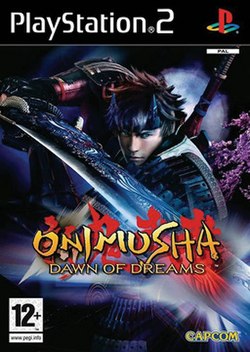
 Onimusha: Dawn of Dreams on PS2
 Disney's Chicken Little on PS2
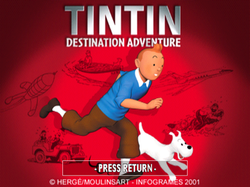
 Tintin: Destination Adventure on PlayStation
 One Piece Grand Adventure on PS2
 Taiko no Tatsujin: Dokodon! Mystery Adventure on Switch












 Another SquareThought Site