

 Jul 2023
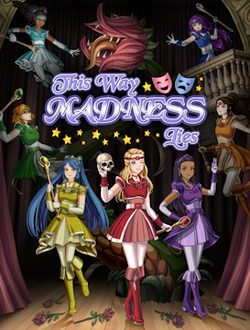

This Way Madness Lies feels like someone fed Shakespeare into a 1990s JRPG cartridge, added a sugar rush of 'magical girl' sparkle, and then sent it off to college on a poetry scholarship. The result is a compact, charming single-player RPG that leans into theatricality as both theme and mechanic. On Switch, it carries the retro pixel-art vibe Zeboyd Games does so well and wraps it around a short but surprisingly sharp narrative about fandom, performance, and what it means to be heroic when your hero is the sort of tragic-romantic lead who moonlights in sonnets. The premise is deliciously odd: a troupe of magical girls, openly obsessed with Shakespeare, take it upon themselves to help Romeo fight monsters. That sentence alone should tell you whether this game's eccentricity speaks to you. If it does, the rest of the game - its humor, pacing, and affectionate nods to both JRPG conventions and Elizabethan tropes - will feel like a cozy stage-play where you get to press the 'confirm' button for all the dramatic moments.
If you want a play-by-play of the systems, here's the blunt instrument: This Way Madness Lies is a turn-based JRPG in the old-school style. Combat is menu-driven, characters have unique skill sets, there is no equipment to juggle, and the party levels up as a single unit. The twist for a review focused on character arcs is that the mechanical choices are deliberately minimalistic, which puts narrative and personality front and center. The game asks you to take the troupe seriously as performers first and fighters second. That design decision does a lot of heavy narrative lifting. Start by imagining the party as a small repertory company rather than a conventional RPG party. Each magical girl is essentially a role: a comedic foil, a stern director, a naive ingénue, a wounded veteran, and so on. The game rarely treats them like interchangeable stat blocks. Instead, each ability menu reads like stage directions. A defensive buff isn't just a buff; it's an assertion of character. A healing move becomes an act of emotional labor. The lack of equipment and the unified leveling system reinforce the idea that growth in this world is communal and dramaturgical - you train as an ensemble, sharpen your timing together, and reap the narrative rewards as a troupe rather than as lone method actors. Romeo, who would traditionally be the star of his own tragedy, arrives more as a prop and magnet for other people's growth. That inversion is the game's smartest trick. If the story were strictly about Romeo's arc, you'd expect soliloquies, heartbreaking choices, and a playbill full of doom. Instead, Romeo operates as the impetus that reveals the magical girls' arcs. Helping him fight monsters becomes the external action through which the ensemble discovers its internal stakes. Rather than centering the narrative on a single tragic arc, Zeboyd gives us interlocking mini-arcs: the leader who learns to listen, the jokester who learns the cost of performance, the outsider who learns the power of belonging. Each of these arcs is reinforced by the way combat plays out: specific skills unlock at narratively appropriate beats, and certain battles feel staged-literal set pieces where the group's emotional development is on display as much as their health bars. The humor is not merely for laughs; it's narrative scaffolding. The team's constant Shakespeare references do double duty, serving as both homage and commentary. They use lines and allusions to interpret their reality, to cope with setbacks, and occasionally to make bad puns in the middle of fights. That meta-theatrical tone makes the characters feel like people who read deeply and then decided the best possible thing to do with all that knowledge was to turn it all into a punchline. The result is a game that never feels ashamed of its love for both the Bard and JRPG tropes; instead, it remixes them into character beats. Mechanically, combat borrows from tactical JRPGs without overcomplicating things. Menus reminiscent of classic games like Shining Force make each choice feel like selecting a line in a script: timed, meaningful, and often leading to satisfying payoff. You don't manage weapons or armor pieces, which some players might miss, but the omission keeps the focus where the game wants it - on relationships and theatrical progression. Because the party levels up together, the usual tension of leaving a favorite character underleveled is gone. This is a blessing for anyone who prefers story momentum over grinding spreadsheets of stats. Replayability and variety are, however, the game's weak spots. The short runtime is praised by several outlets and intentionally designed to be snack-sized, but that also means the arcs conclude briskly. The game is structured like a one-act play that occasionally flirts with a second act. You'll walk away satisfied, but you won't necessarily feel like you lived multiple seasons with these characters. Still, the pacing is tight: Zeboyd avoids filler and uses each encounter to advance character beats, which is refreshing. Difficulty is adjustable at any time, which is a considerate inclusion that lets you prioritize story momentum over combat challenge. On Switch, expect a momentary hiccup in the form of a long initial load time, but once you're in, the performance is steady. From a performance standpoint, the way the game stages its set pieces is worth noting. Boss fights function like climactic scenes in a play. They often come with heightened dialogue exchanges, minor role reversals, and revelations about how the characters view one another. Because characters don't equip items or get delayed progression, key turning points in their arcs tend to come through dialogue choices and the unlocking of signature skills. It's a compact storytelling method, and while it doesn't replace full-blown character-driven sims, it's surprisingly effective in creating emotional resonance over a short playtime.
Zeboyd's pixel art persists as the game's visual leitmotif: retro, crisp, and pleasantly characterful. The sprites are small but expressive, and the way scenes are staged has an almost miniature-theatre quality. If the dialogue is the script, the pixel art is the set design - purposely economical and evocative. Backgrounds and character portraits lean into theatrical cues: curtains, spotlight effects, and stage-like framing that reinforce the game's consistent motif. Critics singled out the art as a highlight, and it's easy to see why. The aesthetic choice also helps the narrative: by keeping visuals stylized and intentionally non-photorealistic, the game keeps the focus on performance and voice rather than on spectacle. On Switch, the art translates well to handheld play, though reviewers have noted a slightly long load time on the initial startup. Once past that, the frame-rate and animation are benignly reliable, and the overall presentation supports the story beats rather than overshadowing them.
This Way Madness Lies is not the longest, flashiest, or most mechanically dense JRPG you'll play on Switch, but it's one of the few that turns theatricality into both theme and mechanic without feeling gimmicky. The game's central conceit - magical girls who are Shakespeare superfans helping Romeo fight monsters - could easily be a novelty act. Instead, Zeboyd turns it into a sincere exploration of ensemble storytelling. The party-as-repertory-company idea is clever and reinforced by design choices like unified leveling and equipment-less progression. The humor is sharp, the pixel art is charming, and the combat is satisfying without being needlessly complicated. If you want a sprawling epic with dozens of sidequests, this isn't it. If you want a compact, witty, and character-forward experience that treats every battle like a scene in a play and every ability like a line in a script, you'll find a lot to love here. Critical reception has been favorable, and for good reason: the game is an excellent snack-sized title for fans of Shakespeare, magical girls, and old-school JRPGs. Play it when you want something short, smart, and theatrical - and if you're lucky, you'll walk away humming a sonnet and wondering which ensemble member would get top billing in their own spin-off.
 Kamiwaza: Way of the Thief on PS4
 Onimusha: Way of the Sword on PS5
 Combat Elite: WWII Paratroopers on PS2
 The Banner Saga 2 on PS4
 Arcania: The Complete Tale on PS3
 Predecessor on PS4
 Cosmic Star Heroine on Switch










 Another SquareThought Site