

 Aug 2022


Two Point Campus trades the squeaky gurneys of Two Point Hospital for squeakier dorm-room carpet and the eternal question: did you go to bed at 3am binging wizard musicals or do you actually care about your GPA? On the Switch, the game is the portable, cheeky college simulator you've always wanted but were probably too busy skipping a lecture to play. The hook is deceptively simple - build classrooms, hire staff, keep the campus tidy - but the game's real shorthand is people. Not big, over-plotty people; little procedural humans whose tiny dramas accumulate into a surprisingly affecting tapestry. Two Point Campus wants you to be both dean and soap-opera writer, and it mostly succeeds with a grin and a glittery toga.
At surface level you build rooms, lay paths and slap down decorations until prospective students file in and your university goes from 'shabby prefab' to 'Hogwarts cosplayed by a tasteful interior designer'. The twist, and the part that gives the game the heart of a teen drama, is how those students behave. They are procedurally generated archetypes with personalities and needs, and they stick around long enough to grow, mess up, fall in love, and either graduate triumphantly or vanish in a melancholic dropout montage. Two Point Studios added a trait system precisely so those arcs could exist. Traits let students form friendships, rivalries and romances; they influence attendance, mood and the choices students make about nightlife and studying. A student who likes the nightlife might skip Tuesday's quantum knitting lecture and show up on Wednesday explaining why the cafeteria is now a small jazz club. The consequence system is part sitcom, part morality play - neglect their needs and they fail or drop out, shepherd them wisely and you watch them strut across a stage at graduation with a cap that someone definitely glittered in the dorms. Story arcs here are emergent, not authored. There aren't scripted five-season character arcs with neatly timed cliffhangers; instead the game offers micro-arcs that feel personal because you watched them. The student you met in Semester One as a wide-eyed applicant becomes the roommate who binges space academy tutorials in Semester Three and possibly the TA you wish you'd had in Year Two. Because students remain enrolled for longer stretches than patients did in Hospital, their development matters. You get to see cohorts evolve over in-game years (around twenty minutes each), which creates a rhythm of arrivals, awkward midterms, romances and graduation ceremonies that reward attachment. The staff are their own dependable, underappreciated supporting cast. Lecturers, teaching assistants and janitors don't get soap-opera close-ups, but they anchor the campus. A janitor who finally gets proper equipment might quietly turn into the unsung hero of an entire term; a lecturer you hire for that bizarre Knight School course can become the charismatic mentor for a bunch of medieval-bard wannabes. Speaking of Knight School: the game's willingness to let you run exotic courses is where comedy and character collide. Students thrown into Spy School, Space Academy or Medieval Studies will adopt behaviors and relationships related to those programs. That allows arcs that feel custom-made: a timid student blossoms into a confident Codebreaker in Space Academy, while the perennial partygoer in Spy School somehow learns punctuality because sneaking into lectures requires timing and discipline. Two Point Campus borrows from The Sims in its character-first philosophy and from film inspirations like Animal House, Pitch Perfect and Grease in its tone; you can tell the team wanted a comedic, affectionate college drama. The developers explicitly hoped players would feel a pang when waving off their first cohort at graduation - and the game largely delivers. The emotional beats arise from investment: you designed their study spaces, assigned their teachers, chose to host giant themed events that either united a campus or sent half the population into the arms of a rival university. Where the campus management systems are strongest is in their support of storytelling. Financial management and cleanliness affect outcomes, yes, but they're also plot devices. Tight budgets lead to creative teacher hires and cramped dorms, which breeds roommate rivalries. A clean, well-decorated quad encourages mingling and makes the cliques collide in satisfying ways. Because students interact with each other, the arcs are social - friends form study groups, enemies prank each other, and sometimes those pranks become legendary campus lore you never intended to write. The game also seeds its world with callbacks to Two Point Hospital, so returning fans will spot cameo threads that connect the shared county. Those cross-references read like guest appearances in a long-running sitcom: familiar faces with a new beat, reminding you that this is a world that keeps on living even after you log off. DLC packs (Space Academy, School Spirits, Medical School) expand the possible arcs with new student types, courses and maps - think of them as new semesters with specialties that let you explore different narrative flavors.
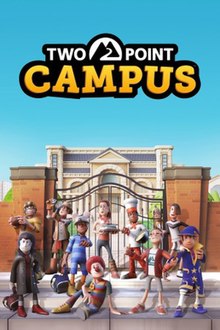
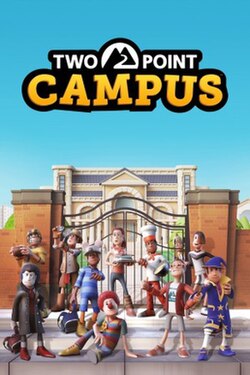
Two Point Campus favors a cartoony, colourful aesthetic that pairs perfectly with its comedic writing and student dramas. On the Switch the visuals are cheerful and readable: characters are expressive enough that you can guess their mood from a glance, buildings have personality, and courses like Knight School or Space Academy get distinct visual flavors that help personalities cohere. The game isn't about photorealism; it's about clarity. Animation cues - the way a student slouches after a bad grade, or the way a group dances awkwardly at a themed event - supply half the character work. Those tiny visual moments are what make emergent stories land. Because the students are procedural, the visual variety matters: hairstyles, outfits, dorm clutter and decorations all act like shorthand for character traits. A kitchen covered in pizza boxes tells you more about the student arc than a hundred lines of text. The art direction leans into the ridiculous in a way that gives the game emotional license - you can build a ridiculous campus, and when your students spiral into absurdity it reads as charming rather than sloppy. On Switch you get all of that in a portable package, so your campus soap opera can follow you to lunch, class, or wherever you are pretending to study.
Two Point Campus on Switch is a management sim that secretly wants to be a serialized teen dramedy - and it succeeds by giving you the tools to play both dean and dramaturge. The characters aren't hand-crafted Broadway leads; they're procedural archetypes whose small choices, friendships and foibles accumulate into genuinely moving arcs. The trait system and the decision to keep students around long enough to grow were smart moves: you end up caring about cohorts in a way that the predecessor's one-shot patient model couldn't achieve. If you like building pretty campuses, juggling budgets, and watching chaos resolve into a graduation montage, this game rewards patient, watchful players. It will make you laugh, occasionally groan at the chaos, and occasionally mist up as you wave off a graduating class your weirdly paternal dean-self shepherded to success. The DLC expands the genre playgrounds you can write stories in, and the light-hearted visuals keep everything readable on the Switch. It's not perfect - you won't get HBO levels of plotting - but for a game whose primary job is systems and comedy, it nails the emotional homework. Enroll, build, meddle, and prepare to develop a roster of characters you'll remember and complain about in equal measure.
 Two Point Hospital on Switch
 Two Point Campus on Xbox Series X/S
 Pro Evolution Soccer 2015 on PS4
 Derby Stallion 04 on PS2
 MotoGP 19 on Switch
 Power Pro Kun Pocket 13 on DS
 Two Point Museum on PS5
 Two Point Campus on PS5
 Two Point Museum on Switch 2










 Another SquareThought Site