

 Dec 2018
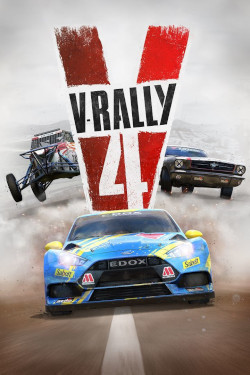

V-Rally 4 is a comeback attempt from a franchise that last puttered along consoles in 2002. Developed by Paris-based Kylotonn - a team that includes staff who worked on previous V-Rally entries and the studio behind WRC 2017 - it promises a modern rally package built around five distinct disciplines, 51 cars from 19 manufacturers, and global stages ranging from Monument Valley to Romania and Malaysia. The Nintendo Switch edition arrived later than the other platforms (December 2018 in PAL regions, February 2019 in North America) and carries the expectations and compromises typical of a cross-gen port. This review is focused on the nuts-and-bolts: how the underlying systems (content scope, mechanics, modes, and the visible/presentational tech) stack up on the Switch, and whether the portable format enhances or neuters what Kylotonn intended.
V-Rally 4's core loop is classical: pilot rally cars through special stages and disciplines, shave seconds off your time, and progress across a career and multiplayer modes. From a systems perspective the title is not trying to be a raw simulation; aggregated impressions from contemporary reviews crystallize it as an arcade-leaning rally game with authentic accents. That balance matters technically because it determines what the engine prioritizes: visceral control and spectacle over fully simulated subsystems. The roster and content are solid on paper and relevant to a technical appraisal. Fifty-one cars from nineteen manufacturers give the physics and handling teams a decent playground - different vehicle classes with varied weight, power, and drivetrain configurations provide the substrate for meaningful handling differentiation. Five disciplines suggest mechanical variety rather than a single-purpose physics model: a single, monolithic handling curve would have been a red flag. The presence of multiple disciplines implies Kylotonn had to tune suspension, traction, and weight transfer per discipline, which is encouraging for players who like to feel a change between, say, tight, technical stages and faster, more open runs. Where the technical design starts to fray is in mode depth and progression. Multiple sources cited in contemporary reception notes call out that "the rally fundamentals are there, but so is a disappointingly shoddy career mode." For a game that sells itself on content breadth, career progression is the connective tissue that makes those cars and stages meaningful over hundreds of kilometers. From a systems architecture point of view, a thin career mode often points to insufficient backend systems: weak AI scaling, shallow vehicle upgrade trees, or undercooked meta-progression. Any of those would reduce long-term engagement even if the stage-by-stage handling is gratifying. Handling itself leans toward accessibility. IGN described V-Rally 4 as "an arcade racing game with some spectacular moments, whose roots are guiltily stuck in the past," which implies that while the physics model delivers fun peaks (track memorization, jumps, drifts), it occasionally resorts to conventional arcade shortcuts - simplified tire models, forgiving collision responses, or generous recovery mechanics. Those design choices are defensible on Switch, where pickups and portable sessions push toward immediate, pick-up-and-play fun, but they will frustrate sim purists who expect granular tuning and unforgiving physics. Multiplayer and single-player are both present, but networked modes were not a focal point of the documentation available. Given the mixed critical reception, it's reasonable to infer that online implementation was competent but not exemplary; an outstanding multiplayer component typically attracts praise that would have shown up in aggregated scores and excerpts. The underlying takeaway is that V-Rally 4 is a mechanically competent rally package whose systems prioritize pleasurable moments over exhaustive technical simulation.
Visually, V-Rally 4 attempts variety over glossy photorealism. The stage list (Monument Valley, Niger, Romania, Malaysia) reads like a checklist of distinct biome types designed to stress the rendering pipeline: high-contrast desert lighting, dense vegetation, and variable terrain textures. For a cross-platform title, that array requires scalable assets and LOD systems to keep performance consistent, especially on less powerful hardware like the Switch. Aggregate scoring data tells the next part of the technical story. On GameRankings the Switch version sits at 62.50%, while Metacritic lists a 51/100 for the platform. Those numbers are materially lower than the PC version's 80% listing, and that gap is a useful heuristic for understanding port compromises. Lower aggregate scores on Switch usually spring from one or more of these technical causes: reduced texture quality and draw distances, simplified post-processing (fewer particle effects, bloom, or motion blur), and conservative frame pacing to maintain stability. Kylotonn had to balance visual fidelity with the Switch's limited GPU/CPU budget; the result is a package that looks respectable in screenshots of clean angles but reveals simplifications in motion, particle density, and distant detail during real-time play. The critical consensus also flagged a lack of polish in places, which maps onto rendering and animation artifacts, occasional collision oddities, or inconsistent environmental interactivity. Those are the sort of small technical flaws that reviewers tend to surface: they don't break the game, but they chip away at immersion. On the plus side, the variety of environments and a reasonable car model count mean the art pipeline did its job delivering diversity. For players who prize variety and portable convenience over top-tier lighting and ultra-tight frame delivery, the Switch visuals are serviceable if not spectacular.
V-Rally 4 on Switch is a pragmatic, sometimes enjoyable rally game that feels like it was conceived for multiple platforms and then creatively necked to fit the Switch's constraints. The technical foundation - a varied car roster, multiple disciplines, and globally diverse stages - is solid and shows Kylotonn's competence with rally systems (not surprising, given their WRC pedigree). However, the experience is marred by a career mode that reviewers called undercooked, polish that sometimes falls flat, and platform-specific compromises that left the Switch version trailing its PC sibling in aggregated scores (GameRankings 62.5% / Metacritic 51/100 on Switch versus much stronger PC numbers). If you want a portable rally game that delivers good moments: big jumps, memorable stage sequences, and a roster that rewards experimentation, V-Rally 4 will scratch that itch. If you are chasing razor-sharp sim fidelity, a deep career meta, or a Switch port that pushes visual and performance limits, this is not pole position material. The title occupies a middle lane - competent, occasionally brilliant, and also occasionally frustrated by its own compromises. Treat it as a fun, technically respectable rally buffet rather than a fully tuned championship car.
 Pro Rally 2002 on PS2
 WRC 2: FIA World Rally Championship on PS3
 Roary the Racing Car on DS
 Team Sonic Racing on Switch
 Garfield Kart: Furious Racing on Switch
 Ben 10: Galactic Racing on PS3
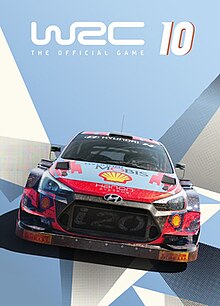
 WRC 10 on Xbox Series X/S
 WRC 9 on PS5
 WRC Generations on Xbox Series X/S
 WRC 10 on PS5
 WRC 5 on PS3










 Another SquareThought Site