

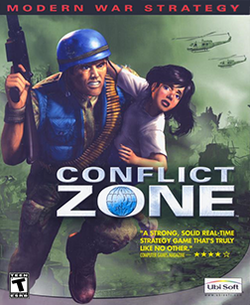

Conflict Zone is the kind of RTS that looks at the usual base-building, resource-hoarding ritual, shrugs, and says: "What if the battlefield were a reality-TV show?" On PS2, MASA Group and Ubi Soft shipped a concept-heavy title where propaganda - not metal or oil - is the name of the game. You pick a side: the squeaky-clean International Corps for Peace (ICP) whose PR department would make a toothpaste brand blush, or Ghost, a shadowy gang that treats ethics like a business expense. Rather than the usual mining-and-building loop, Conflict Zone forces you to manage hearts, cameras and moral tax audits, while occasionally managing troops. If you want a comforting exercise in clicking units to death, go play something else. Conflict Zone is an oddball challenge that tests a different skillset: multitasking under narrative pressure, juggling public opinion, and pulling off staged events that look simultaneously like brilliant strategy and questionable journalism ethics. The PS2 port struggles to make those systems feel slick, but if your brain enjoys juggling PR crises while a mortar lands on your refugee camp, this is the sort of game that will make your palms sweat for reasons most strategy games don't.
At the core of Conflict Zone's design is a simple but brilliant twist: civilians are the resource. Popularity Points (PP) - the currency of hearts and minds - unlock units and buildings. Money exists, but it's second fiddle. That single design choice turns the entire risk calculus of every mission into a moral math problem that you have to solve while being shot at. There are two campaigns and each faction plays almost like a different game. The International Corps for Peace is the close-encounter, high-tech faction. Their units are quality-over-quantity: well-trained troops, better gear, and the brute force you expect from a militarized humanitarian outfit. Their challenge is a litigious one: save civilians, keep collateral damage to zero, shepherd rescued civilians into refugee camps, and generally make the TV crews love you. Every civilian you fail to rescue, or accidentally turn into a smear on an evening newsreel, eats into your PP. The skill here is precision: timing rescues, protecting convoys, and micro-managing high-value units while simultaneously shepherding non-combatants to safety. Ghost is nastier and messier. Their units are cheaper, weaker on paper, but they carry a higher unit cap, letting you swarm and sow chaos. Their bread and butter is spectacle. Ghost earns PP by turning violence into a narrative - shooting down ICP rescue helicopters, ambushing patrols in sight of civilians, or using enlistment camps to blur the line between civilian and soldier. They even have cameramen. Yes, camera crews are a tactical tool in this game. Position them, stage events, and let the world react. The skill set for Ghost is improvisational: bait enemy forces into looking bad, multitask with vast numbers of low-cost units, and time camera shots so the media circuit will feed your popularity. That media-first economy imposes a constant tension. Acting purely militarily, even if it would win you the fight, can cost you the campaign. Conversely, playing PR chicken with civilians invites tactical disaster. The interesting moments come when both systems collide: do you risk burning a refugee camp to deny your enemy a PP source? Do you lure an ICP convoy into a minefield knowing the footage will swing public opinion? The game rewards sideways thinking: staging, deception, and psychological operations. If you get a kick out of chess but prefer your pawns to influence TV ratings, Conflict Zone has your name on it. You also get AI commanders who can be assigned sectors and tasks. Each commander has a specialty - attack, defend, specialist, commando - and you allocate resources, units and bases to them. Delegation is an essential skill here. Good AI management turns a messy multithreaded battlefield into a concatenated machine: you free yourself up to run the PR side, while commanders execute your strategic intent. Bad delegation looks like giving a toddler the car keys. The toggle between macro-level PR decisions and micro-level unit commands is the game's main cognitive load. Expect to feel like a cable news producer who also has to build sandbags. Missions are varied in geography and flavor - fictionalized conflicts in places that mirror Ukraine, Indonesia vs Malaysia, India vs Pakistan, Nigeria vs Niger - and many are built around base construction objectives. Traditional RTS instincts still matter: map control, unit composition, chokepoint denial, timing pushes, and scouting. But success depends equally on camera placement and rescue timing. You need serious multitasking chops to run simultaneous rescue operations while staging propaganda hits and managing logistics. The PS2 experience complicates these demands. The console pad isn't the ideal way to micromanage large-scale RTS operations; the control scheme feels blunt compared to a mouse and hotkeys. That's a mechanical challenge you can learn to mitigate - grouping units, using the commanders to offload detail, and slowing the pace - but it raises the bar for patience and control discipline. The game doesn't babysit you: if you fail to assign priorities or misplace a cameraman, the resulting PP drop is blunt and immediate. Difficulty in Conflict Zone isn't about higher enemy damage numbers; it's about cognitive pressure. The AI isn't simply a damage sponge. It's a narrative threat: the enemy will attempt to manipulate the same public opinion system you rely on, which turns every encounter into both a tactical fight and a PR duel. That duality rewards creative problem solving: timing smoke screens so a rescue looks professional, or sending a commando raid timed to a press pickup to shift the story mid-battle. Mastery involves learning to think in two planes at once: the kinetic battlefield where units die, and the broadcast battlefield where perceptions live. Successful players are good at prioritizing under stress, delegating cleanly, and exploiting the map's civilian hotspots. If you enjoy juggling timers, reading the flow of an unfolding story, and piloting multiple operations at once, Conflict Zone is a feast of strategic discomfort. Despite these strengths, the PS2 edition exposes the concept's weaknesses. The interface is clunky on a controller, unit pathfinding and AI quirks create frustrating moments where your staged spectacle becomes an accidental tragedy, and the learning curve is steep because you have to rewire your RTS instincts. These are solvable issues with time and patience, but they do make the PS2 variant better suited to players who like a strategic puzzle more than lightning-fast micro. If you treat Conflict Zone like an endurance test in attention management, you'll get the best out of it.
Graphically, Conflict Zone lands in the "functional but forgettable" bucket. The engine gets the job done: units are distinguishable, maps have identifiable landmarks, and the camera-work mechanics make sense visually. It never aspires to be pretty - textures are flat, and animations are basic - but the important thing is readability. The PS2 version's visuals suffer from that generation's limitations and the port's compromises: draw distance wobbles, models look blocky close-up, and the UI occupies a disproportionate slice of the screen. That said, aesthetics are secondary to the game's message: it's not trying to dazzle you with pyrotechnics so much as making sure your staged propaganda looks coherent. The cameramen mechanics do an effective job; when you position a camera and trigger events, the sequence reads well enough to make the PP feedback feel meaningful. If you expect slick cutscenes or modern visual polish, you'll be disappointed. If your priorities are tactical clarity and seeing who's screaming in the refugee camp, the visuals deliver the functional clarity you need. Sound design deserves a nod for helping sell the drama. Radio chatter, distant explosions and the occasional sobbing civilian add weight to decisions. On PS2 the soundscape is what keeps moments tense when the visuals are doing the heavy lifting. Just don't expect an audio tour-de-force; it's convincing rather than cinematic.
Conflict Zone is an unusual beast: a real-time strategy game that makes media manipulation the center of play. Its core idea is clever and the gameplay challenges are unique - juggling PR and battlefield decisions, delegating to AI commanders, and executing staged events requires a blend of multitasking, prioritization and moral tightrope-walking you don't often see in RTS titles. Those who enjoy strategy as a mental triathlon - managing multiple streams of information, setting up narratives, and timing operations for maximum public effect - will find it rewarding. The PS2 port, however, is a mixed blessing. The controller makes the multitasking harder, the interface sometimes fights your intent, and the visual polish shows its age. Reviews at the time reflected that roughness: Dreamcast and PC versions earned mixed notices, while the PS2 release attracted generally unfavorable responses. That doesn't mean PS2 players can't enjoy it; it just means you should come for the concept and stay for the challenge, not for the console-smooth controls. If you're an 18-year-old who likes thinking three moves ahead, enjoys the weird deliciousness of staging a morally ambiguous PR win, and doesn't mind wrestling with a clunky control scheme, Conflict Zone on PS2 will give you a strategic workout unlike most other games on the shelf. If you want flashy visuals, tight micro controls, and a forgiving learning curve, this is probably not your cup of tea. Consider it a demanding classroom in warfare and public relations - one that will make you smarter, more twitchy, and a bit morally uncomfortable. Which, frankly, is a fun Tuesday for a strategy nerd.
 Danger Zone on PS4
 NBA In The Zone on PlayStation
 Nobunaga's Ambition: Iron Triangle on PS2
 Time Commando on PlayStation
 Time Crisis on PlayStation
 Prince of Persia: The Sands of Time Remake on PS4












 Another SquareThought Site