

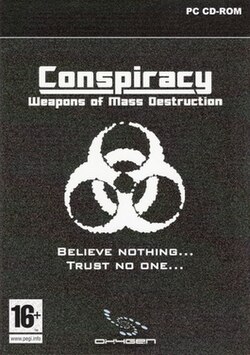

Conspiracy: Weapons of Mass Destruction is the sort of game that reminds you consoles are finite-state machines and sometimes developers forget to feed them competence. Built by Kuju Entertainment and published by Oxygen Interactive in 2005 for PlayStation 2 (also on Windows and Xbox), it casts you as Cole Justice, a retired Secret Service agent dragged back into action to vanquish Hydra - a villainous organization experimenting with chemical and biological weaponry. The premise is a by-the-numbers action-movie affair, but what makes this title noteworthy isn't its plot twists; it's how painfully obvious the game's technical shortcomings are on a platform that, by 2005, was already hosting some very polished shooters. This review is aimed at folks who care about the nuts-and-bolts of game tech: rendering constraints, animation fidelity, AI patterns, input handling, and whether the game makes good use of the PS2's hardware. If you like your critiques served with sarcasm, precise data points, and a no-nonsense dissection of what went wrong, buckle up. If you came for thrilling espionage or clever level design, you might want to sit this one out or at least warm up with something that doesn't feel like a 3D relic being operated with a spanner.
Gameplay is single-player only and wears its inspirations on its sleeve - it plays like a very simplified throwback to early PS1-era shooters, minus the charm. You move through a series of linear levels, shooting goons and triggering set pieces. On paper that's fine; in practice the game leans hard on scripted sequences because the underlying systems don't support emergent interactions. Control and input mapping on the DualShock 2 are functional but lack nuance: movement uses standard left-stick/WASD equivalents, aiming is stiff, and there is a distinct absence of aim assist or smoothing that other contemporary console shooters leaned on to compensate for controller aiming imprecision. The weapon handling is textbook arcade: weapons fire, enemies react, and ammunition is a bland resource to be scavenged. Recoil is almost non-existent, and there is no convincing weight model for firearms - bullets feel like instant hits with little tactile feedback beyond the muzzle flash. The sound design attempts to sell punch but the audio mix is thin; weapon samples are recycled and lack low-frequency punch that would have given shots heft on the PS2's audio pipeline. Enemy AI is where the technical debt is most visible. Enemies mostly follow rudimentary state machines: patrol, detect, shoot, and die. Detection cones are generous and inconsistent, resulting in enemies who either magically know you're there through walls or never notice you at close range. Pathfinding suffers from token navigation meshes and brittle waypoints; enemies will sometimes clip into level geometry or get stuck behind simple objects because the collision and avoidance layers are poorly tuned. This creates combat that vacillates between trivial (enemies running in like bowling pins) and frustrating (enemies taking perfect aim from cover while your shots register late). There is no dynamic cover system or flanking logic, which makes firefights repetitive - they rely on spawn placement and ammo scarcity rather than tactical design. Level design is linear to the point of being a corridor simulator. Each stage funnels you from setpiece to setpiece, and the pacing is driven by scripted events. Scripted events are double-edged: done well they create memorable moments; here they often feel like band-aids for world interactivity that never arrived. The game lacks physics-driven destruction - explosions are visual effects with minimal environmental consequence, and the censorship note in the documentation reveals that in some regional versions bodies do not burn from grenades, which also hints that the basic death and ragdoll systems are constrained or trimmed back depending on release territory. Checkpointing and save behavior are functional but not forgiving. Death sequences are described by contemporary reviewers as dull, and the game's response to player death is mechanical rather than cinematic: reload checkpoint, repeat encounter. There's no clever retry system, no adaptive difficulty, and no incentive structure that rewards creative playstyles over brute-force gunfights. As a result, the mechanical loop becomes grind: move, shoot, trigger, repeat. The single-player mode doesn't try to innovate on enemy variety, gadget usage, or environmental puzzles. If you approach it as a technical exercise in how not to prioritize systems design on a constrained console, it's a valuable case study; if you approach it as entertainment, it'll likely feel tired quickly.
Graphically the game sits uncomfortably between late PS1-era geometry and the more polished PS2 output of its contemporaries. Character models are low-polygon with texture sheets that betray their low resolution on close inspection. Texture filtering is basic, and mip-mapping transitions are noticeable - surfaces pop as you move through a scene. Lighting is predominantly baked rather than dynamic, which results in flat-looking interiors and harsh transitions between lit and unlit areas. The PS2 was capable of impressive tricks with carefully authored art pipelines and clever use of specular highlights; Conspiracy rarely makes the engine sing. Draw distance and level-of-detail (LOD) scaling feel aggressively conservative. Scenes are architected to hide distant geometry as much as possible, which might be a memory-budget choice but translates into visible fogging and pop-in when moving quickly. Shadows are either blob shadows or completely absent on many NPCs, reducing the impression of depth. Particle effects for explosions and muzzle flashes are serviceable but not varied, and because there's limited physics-driven response, explosions rarely change the environment in a meaningful way. On the animations front, skeleton rigs are basic and lip-syncing/dialogue animation is minimal to non-existent for many NPCs. Death animations are short and often identical across enemy types, which undermines immersion and makes combat feel like a conveyor belt. Ragdoll physics are either absent or minimal; enemies tend to go limp into static poses rather than collapse realistically. The overall art direction is competent enough to read what's happening on-screen, but it lacks polish, variety, and the small technical flourishes (blended animations, dynamic lighting, responsive particle systems) that turn functional 3D into a believable world. The PC Zone criticism highlighted that the PC version had no option to raise screen resolution from 640x480 - that's telling because it suggests the underlying renderer was designed with a very low resolution target in mind. On PS2, this low-detail approach translates to a fuzzy output on standard-definition TVs, with jagged edges and small HUD elements that can be difficult to parse. Borderline acceptable in 2000, questionable by 2005 standards.
Conspiracy: Weapons of Mass Destruction is a textbook example of a title where the ambition (make a modern console shooter) collided with limited execution in systems engineering, art pipelines, and QA. The PS2 could, and did, run shooters with tighter AI, better animation, and more believable environments - Conspiracy simply doesn't make the cut. It funnels the player through linear levels, hides behind scripted moments, and relies on basic state-machine AI and low-detail assets instead of pushing interactivity or polish. Critics were brutal for good reason: many called it laughable or dated, and the numerical scores reflect that consensus. There are a few moments of competent design, and the underlying shooter loop functions at a base level, but the technical shortcomings - poor AI, low-poly models with weak textures, minimal dynamic lighting, lackluster animation and ragdoll, and thin audio - cumulatively throttle the experience. The regional censorship details on German versions (blood removal and bodies not burning on PC/Xbox) are a footnote that further illustrates how the game's presentation was fragile enough to be altered rather than robust. If you're an 18-year-old with a soft spot for retro oddities and want to study what early-2000s budget shooters looked like when they fell short, Conspiracy can be an instructive, occasionally amusing playthrough. If you want a satisfying PS2-era FPS with confident tech and gameplay, look elsewhere. My score lands on the harsh end of the scale because the game doesn't merely have rough edges - it lacks the technical ambition and polish necessary to make its simple ideas engaging. Final verdict: a cautionary piece of console archaeology, 1.5/10.
 Onimusha 3: Demon Siege on PS2
 Evil Dead: The Game on Xbox Series X/S
 PixelJunk Shooter 2 on PS3
 Primal Carnage: Extinction on PS4
 Tower of Guns on PS3
 Commandos: Strike Force on PS2













 Another SquareThought Site