



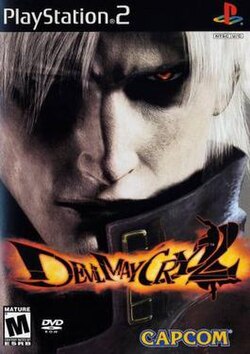
Devil May Cry 2 arrives like a tuxedo-wearing bouncer at a punk rock party: slick, larger-than-life, and somehow bored. Capcom handed the sequel to a different team than the original, and the result is an oddly split personality - a game that wants to be the elegant dancer of stylish action but sometimes trips over its own coat tails. If you come in with memories of Dante's first outing and expect a direct upgrade, you'll notice changes immediately: the world is more open, Dante talks less, Lucia shows up, and the difficulty has been flattened to make room for a wider audience. If you play for spectacle rather than punishment, DMC2 delivers moments of balletic violence - spins, gunplay, demon forms - but this time the challenge shape has shifted. The game trades some of the tight, cramped combo kitchens of its predecessor for open arenas and mission-based layouts that change how you string moves, punish mistakes differently, and ask for different skills. Below is the lowdown on what the game expects from you as a player and what skills you actually need if you want to be judged 'Showtime' instead of 'Don't Worry.'
Devil May Cry 2's scoring and progression systems are where its challenge philosophy is most visible. Each mission gets a rank from D to S based on five things: time, Red Orbs gathered, style, items used, and damage taken. Style is the ostentatious diva of that list - it's cruel, opinionated, and unforgiving. The style meter rewards long uninterrupted combos, creative mixups, and absolutely not getting hit. If an enemy lands a punch, the meter yanks you back to 'Don't Worry' like a teacher catching you texting in class. Skills demanded: tight timing, combo choreography, and hit avoidance. To shine you must memorize move strings, understand enemy hitstun windows, and be able to improvise a micro-combo when a stray enemy walks into your choreography. The game converts short button sequences into flashy actions, so muscle memory for specific inputs (air juggling, launcher into weapon-swap finisher, that lovely Stinger follow-up) is a major advantage. Devil Trigger management is another subtle test. The Devil Trigger gauge fills when you attack or taunt in normal form, and using DT gives you boosted attacks, health regen, and mobility. The trick is juggling when to build DT by playing aggressively and when to spend it - especially because Dante has a Desperation Devil Trigger that activates under low health. This creates a risk/reward loop: aggressive play builds the resource you need for even more aggression, but being hit resets your style and drains that precious opportunity for higher ranks. Taunting enemies to charge DT and then capitalizing without getting hit is a delicious tiny skill challenge. Evasion is new in this entry. A dedicated evade button lets you roll, dodge, or run along walls; mastering its invincibility frames and directional usage is essential for high-level play. Many fights in DMC2 shift from cramped corridors to wide, open arenas where enemies spawn at range. This openness demands spatial awareness - you must read which enemies will close and which will kite, then thread your combos accordingly. The spacing can make classic DMC juggling harder; instead of auto-staging enemies into your combo, you often need to reposition, predict movement, or use ranged weapons to herd foes together. Weapon switching was simplified with a dedicated button, which helps with flow but raises the skill ceiling for players who want to grind style points. Instead of fiddling in an inventory, you can instantly swap ranged tools mid-combo to extend sequences and keep the style gauge climbing. That requires not just memorizing combos but planning branches: sword string into shotgun blast, into aerial rocket, back to sword - all while keeping rhythm and avoiding damage. Resource management (Red Orbs) is also a skill: deciding when to spend orbs on upgrades versus saving for survival items becomes a meta-challenge if you aim for perfection. Boss fights in DMC2 are more of a mixed bag. Many bosses are less chess-like than in the first game - fewer phases of strict patterns, and sometimes more emphasis on spectacle than tactical puzzle solving. That makes them faster to learn for newcomers but less satisfying for players seeking multi-layered boss duels. However, the game compensates by unlocking harder modes and characters - Lucia plays differently from Dante, and Trish becomes available after clearing Hard Mode with Dante. Those unlockables reintroduce difficulty and require adaptation to different movement priorities and attack rhythms. Finally, the style judging system itself is notoriously harsh. To score well you can't just mash - you need to diversify attacks, avoid damage, and keep the meter climbing with strings that look cool and actually do damage. In short: the game wants you to be a stylish choreographer who can also dodge like an irritated cat.
Visually, DMC2 is a textbook of contrasts. The levels are much larger and more varied than the first game - open plazas, corporate towers, oil rigs - and the team aimed for cinematic B-movie elegance rather than photorealism. Texture work leans handmade, producing a slightly 'drawn' look compared to the first game's more photo-textured realism. That aesthetic gives the game a unique coat of paint but also means some environments feel emptier, especially in wide arenas where enemy spacing hobbles combo potential. Technical flourishes like Devil Trigger effects and several pre-rendered cutscenes add to the atmosphere, and motion-capture work gives certain attack animations a satisfying weight. On PS2 hardware the frame rate and responsiveness are generally acceptable, but you'll notice how larger stages and distant enemy spawns change the gameplay - not always for the better from a combo-centric perspective. Still, the character models age reasonably well for the era, and the redesigned Dante (more stoic, more angsty) looks the part even if fans argued with his personality change.
If you're a player who measures fun by flash and spectacle, Devil May Cry 2 will give you plenty of cinematic slashes and a handful of systems to master: combo timing, weapon-switch improvisation, Devil Trigger economy, and precise evasion. Its difficulty curve is friendlier than the original, which helped it reach a broader audience, but that accessibility comes at a cost: some bosses and encounters feel less demanding strategically, and the wide-open stage design can punish players who expected cramped combo-friendly arenas. Where DMC2 earns grudging respect is in its hidden toughness. The style meter is merciless - earning S-ranks requires the same discipline as the original, and the game's unlockables (Hard Mode, Trish) bring the bite back. If you treat the game as a platform to practice specific skills - timing, situational awareness, resource juggling, and stylish improvisation - you'll find a reward loop that improves your play and looks glorious on-screen. If you want a sequel that refines every part of the first game, you'll be left wishing for crisper encounters and a Dante who tells more jokes. At 6.5 out of 10, DMC2 is an imperfect trainer for stylish action: clumsy in places, polished in others, and ultimately honest about what it asks of you. It wants you to be creative, fast, and unforgivingly precise - which, when you put in the work, is exactly the kind of challenge that makes you feel like a demon-hunting rock star.
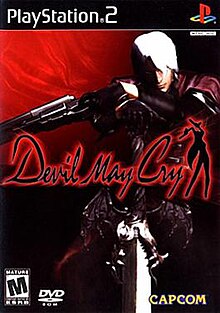
 Devil May Cry on PS2
 Devil May Cry on Switch
 Devil May Cry HD Collection on PS3
 PlayStation Home on PS3
 Ōkami on PS2
 Gaelic Football '25 on Xbox Series X/S
 Unearthed: Trail of Ibn Battuta on PS3
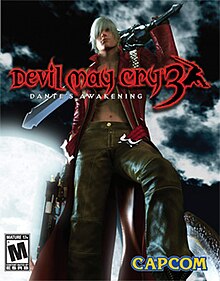
 Devil May Cry 3 on Switch
 Capcom VS SNK: Pro on PlayStation
 Dead Rising on PS4
 Mega Man X8 on PS2
 Devil May Cry 2 on Switch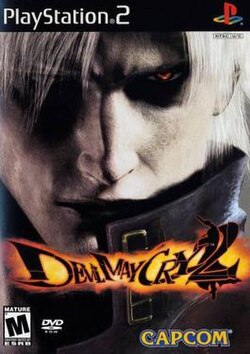












 Another SquareThought Site