



Downforce is the sort of game that reads like a university lecture got bored, put on a racing suit, and decided to make friends with yaw rates. Presented on the aging hardware of the PlayStation 2, it masquerades as a racing game but mostly wants you to know how the shape of a wing, the angle of attack, and the square of your speed will decide whether you hug the apex like a pro or vault over a crest like a lawn ornament. The source material for this review is not a glossy press kit but a surprisingly thorough encyclopedia entry on downforce and aerodynamics, which the game treats like a rulebook with torque. If you have ever wanted your tyre grip explained via Bernoulli's principle while being gently judged by a rear diffuser, this is the title for you. It is not fast and reckless for the sake of it; it is fast and calculated, which makes it the videogame equivalent of a very polite car crash.
Gameplay in Downforce is less about drifting into a petrol station and more about convincing the air to stay angry at your car in a useful direction. Core modes split neatly between on-track racing and setup simulation, and the latter is where the game truly finds its personality: a spreadsheet married to a steering wheel and several children named "Camber," "Splitters," and "Midwing." The central conceit is simple and mercilessly satisfying - the aerodynamic setup you choose is a series of trade-offs. Increase wing area, boost angle of attack, and you will be rewarded with more vertical force on the tyres, otherwise known as downforce. Also known as "please stop spinning." Increase those same things too much and you will pay in drag, which turns high-speed straights into slo-mo regret. The game does a good job of turning the equation F = -CL * 1/2 * rho * v^2 * A into something you can feel when you lose half a corner and three tenths of a lap time. Tracks are curated to test those trade-offs: some are long into-the-void straights where drag is a crime, and others are Monaco-like twist-fests demanding all the lowspeed stick you can get. The game nudges you to adjust the car for each circuit, which is basically an invitation to become needlessly obsessive about the placement of vortex generators. There is a convincing difference between the front wing's effect - used both to create grip and to feed clean air to the rest of the car - and the clumsy, heavier duty rear elements that must produce twice the downforce to keep the handling balanced. The front/rear balance is an elegant little tug-of-war that often ends with the narrator saying, in the smallest of voices, "Perhaps less angle of attack." Tire and suspension choices interact with aero in the expected ways. Mechanical grip remains stubbornly physical, so transmissions of force to asphalt are still defined by rubber and mass. The game forces the distinction between "mechanical" and "aerodynamic" grip until you start naming your front splitter. It also models the square-of-speed relationship nicely: at low speeds, the wings are about as helpful as a napkin in a hurricane. At racing velocity they become authoritarian. This leads to satisfying moments where you watch lap times fall precipitously once the car hits a critical speed and the aero kicks in like an overenthusiastic bouncer. Pit stops become small tactical novels. Most racing rulesets in the game's universe forbid active aero adjustments mid-race, but allow setup changes during pits. That creates tense decisions: do you start with a conservative setup and hope to outbrake rivals later, or do you set everything aggressive and pray the straights don't turn you into a blimp? The game does not shy away from the risks of over-optimizing. There are consequences for unstable aero: tiny changes in ride height or a slipstream over a crest can flip your car from glued to the tarmac into a very dramatic physics lecture. For those who like their races with emergency geometry, the occasional spectacular flip - a salute to real-life disasters - is both horrifying and educational. Downforce rewards learning curves. There is a meta-game about reading airflow, analyzing the underside and diffuser, and placing small wings in unusual places. The simulation allows midwings, sidepod appendages, and that forbidden 90s X-wing aesthetic, and sometimes it is tempting to patchwork your car into an exhibit for a drifting Museum of Regulations. The AI is judicious in its application of pressure; it exploits your weaknesses rather than simply being faster. If you drive like someone who believes in traction control and good vibes, it will punish you in tasteful, aerodynamic ways.
On the PS2, Downforce presents itself like a textbook gone surprisingly photorealistic in places and deliberately schematic in others. Textures on the cars are fine, but the thing the game wants to show you - airflow - is rendered as a series of lines and shaded fields that flow over models. This is not flashy in the way modern titles are flashy; it does not try to sell you on explosion porn. Instead it shows, with clinical calm, how the underside curves and diffusers accelerate air, or how the rear wing's multi-element design sacrifices cleanliness for compulsion. The visualizations are functional and oddly comforting, like watching wind tunnel footage but with fewer spreadsheets. There are limits. PS2-era polygon counts mean the environment sometimes looks like a diorama someone forgot to press "finish." Crowds are decorative, and the lighting is competent rather than revelatory. Where the game scores is in its data overlays: lift coefficients, pressure maps, and readouts that translate the math into something your brain can trust. The HUD is refreshingly free of bling; it behaves like an engineer who wears sensible shoes and remembers torque specifications. When the car's aerodynamics go wrong, the camera does not melodramatically linger - the replay shows the moment, the telemetry unfurls, and then you are back to tweaking the angle of attack, which is the emotional arc of this game.
Downforce is niche by design and strangely humane in its obsession. It is not the best racing game if your main criterion is the ability to ram someone into a wall while honking. It is, however, excellent for anyone who secretly enjoys the idea that racing is 80 percent airflow and 20 percent prayer. The game treats aerodynamic principles - Bernoulli's principle, angle of attack, aspect ratio, diffusers, splitters, and the square-law relationship of speed to downforce - not as academic window dressing but as the core language of competition. If you want immediate, visceral thrills, look elsewhere. If you want to learn why a rear wing might have three elements and why the front wing's job is also to be a first-class traffic director for the rest of the car, Downforce will teach you with deadpan patience. It is equal parts simulator and lecture, balanced like a car on a finely tuned rake. The occasional stability horror show is a salutary reminder that aero is not a magic box; it's a negotiation with the air, and like any negotiation it can end in someone being airborne. Score: 7/10 - competent, clever, occasionally thrilling in the way a physics experiment is thrilling, and recommended for players who prefer their speed with a side of calculus and a diffuser diagram.
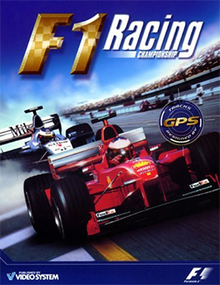 TOCA 2 Touring Cars on PlayStation
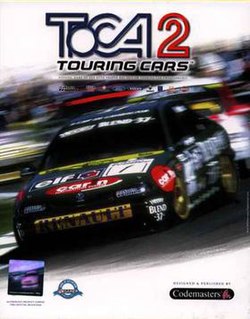 TOCA World Touring Cars on PlayStation
 Roary the Racing Car on DS
 Team Sonic Racing on Switch
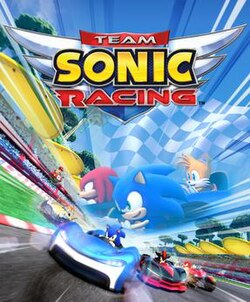 MotoGP 19 on Switch
 Derby Stallion 04 on PS2












 Another SquareThought Site