

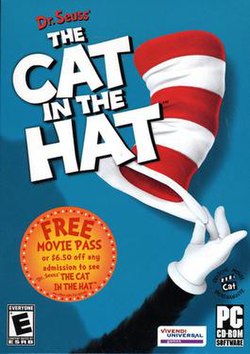

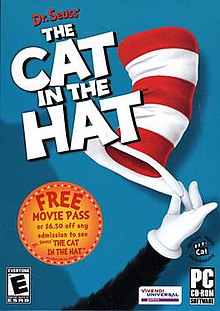
If you grew up on Dr. Seuss you probably remember the Cat as a mischievous whirlwind of stripes, curiosity and bad ideas that somehow involve excessive cleaning apparatuses. In 2003 someone thought, "Hey, let's put him in a 2.5D platformer and also tie it to that big, shiny movie." The result for PS2 is Dr. Seuss' The Cat in the Hat, a game that wears its source material on its sleeve and its game design like a hand-me-down sweater. It's loud, colorful and occasionally charming - like a birthday party where half the guests are sugar-high and the other half are wondering why the piñata exploded so early. This is not the worst licensed kid's game of its era, but it also doesn't do anything to change your mind about Hollywood tie-ins. It has the Cat's voice (Chris Edgerly), a handful of Seussian set pieces, and a hub-world version of the family house that acts like a magical theme park gone slightly off the rails. If you're after a short, whimsical romp that leans heavier on licensed charm than mechanical polish, you might have a decent time. If you're chasing tight platforming that rewards skill and precision, you'll often feel like you ordered fine cuisine and received instant noodles with a sticker on top.
Mechanically the PS2 Cat is firmly in the early-2000s platforming mold. The house serves as your hub, a tidy place to return to after you hop through increasingly oddball rooms that have been warped by runaway magic. There are ten main levels, a bonus stage, and a trio of boss fights where you get to tango with Quinn's contraptions and shove projectiles into exhaust pipes like you're cleaning a particularly judgmental vacuum cleaner. Simplicity is both the game's charm and its Achilles' heel. The Cat can jump, glide, and slam the ground with his umbrella - a move that makes the Cat feel appropriately theatrical while also being the primary tool for solving platforming puzzles. Enemies and explosive goo get trapped in bubbles and can be hurled as projectiles, which is fun for about three levels and then becomes the gameplay equivalent of reheating leftovers. Health is represented by five hit points; cupcakes top the meter up, and hearts grant extra lives. Hit a bottomless pit or run out of lives and you're sent back to the last checkpoint, which is mercifully frequent, because the game expects you to be distracted by the surrounding chaos. The game's collectible economy is cute on paper: clusters of magic in different colors act as currency and stage requirements, and gathering all of them in a stage restores that area of the hub to its un-bewitched state. Finding all four keys in a stage - stolen by Thing One and Thing Two, naturally - opens a bonus door with extra goodies and a gem. Collect all the gems and you unlock a secret level, Mystical Mirror, which is about as dramatic as it sounds. There are also clapperboards to find if you enjoy unlocking movie clips in the menu, because nothing says "interactive tie-in" like the promise of behind-the-scenes footage. Where the game starts limping is in variety and design polish. Many stages recycle the same ideas with new paint jobs: different hazards, same fundamental tasks. Boss fights boil down to pattern recognition but lack the spark that would make them memorable. Controls are generally responsive enough for a younger player, but veterans of platformers will spot imprecision in movement and occasional collision quirks inherited from the game's less-than-stellar PC sibling. Level design sometimes treats you like a rubber ball: bounce you around, toss you an objective, and hope you don't notice the seams. The GBA version has its own identity with scuba stages and a driving bonus level, but on PS2 you're getting the big-screen Seuss experience: loud, colorful, and a little sloppy. If you're playing with kids, the forgiving checkpoints and the familiar characters buy the game a lot of goodwill. If you're a 20-something platformer snob who still cries over lost precision, you might find yourself counting the things the Cat has knocked over.
Graphically the PS2 offering is a mixed bag. The game leans into the bright, saturated palette you'd expect from a Seuss adaptation, and when the environments are doing their job the levels look like children's book pages that someone handed to a cartoonist with a sugar rush. Backgrounds and set pieces capture the whimsical shapes and skewed perspectives of Dr. Seuss, which helps sell the fantasy. On the downside, a lot of the detail sits at the 'good enough' level. Textures can look a bit soft up close, and some backgrounds suffer from pixelation and low-res detail - the sort of visual compromise that was common in licensed games trying to meet a movie deadline. Animations are serviceable and often expressive: the Cat flails and preens with attitude, which keeps things lively. But there are moments when the camera and depth feel awkward in the 2.5D presentation, especially when foreground and background elements try to play hopscotch and the Cat decides to audition for a physics experiment. Sound design and music are probably the game's strongest presentation elements. Composer Keith Leary delivers a soundtrack that's catchy and bouncy, leaning into Seussian whimsy without turning everything into ear-splitting sugar. The voice work is solid: the Cat's performance is enthusiastic and fits the character, while the fish - who doubles as your in-game guide - provides the necessary bossy commentary. Presentation-wise the title captures the spirit of Seuss better than the film did for some reviewers, even if the visuals and polish sometimes betray its budget and timeline.
If Dr. Seuss' The Cat in the Hat on PS2 were a bowl of cereal it would be colorful, get your sugar quota, and have a mascot who performs three reasonably fun stunts before you inevitably reach for something more substantial. It's not a disaster: the hub-world concept, the collectible chase, and the occasionally inspired level set pieces can be enjoyable, especially for younger players or Seuss fans who just want to romp through a familiar fantasy. The soundtrack and the character work lend personality, and the game generally respects the playful tone of the source material. But for anyone beyond a casual playthrough, the middling level design, repetitive tasks, and occasional technical hiccups wear thin. Critics were lukewarm - the PS2 version hovers in the mid-50s on aggregate scores - and for good reason: the game feels like a competent but forgettable licensed platformer. If you're picking it up out of nostalgia or to babysit a younger cousin through a rainy afternoon, it'll probably do the trick. If you're expecting a modern platforming showcase or deep mechanics, bring a towel - you'll need something to mop up your disappointment. Final thought: the Cat is charming, and the house is an adventure, but the game is the kind of tie-in that makes you wonder what could have been had someone given the team more time, a bigger budget, or fewer deadlines. Consider it a pleasant, harmless detour down Seuss Lane rather than a destination for platforming excellence.
 Cat Quest III on Switch
 Cat Cafe Manager on Switch
 The Wacky History of Platform Games
 Roblox on PS4
 Toki Tori on Switch
 PlayStation Home on PS3
 Muppet Monster Adventure on PlayStation
 Invizimals: The Lost Kingdom on PS3
 The Cat in the Hat on PlayStation
 Treasure Planet on PlayStation
 Eliminator on PlayStation












 Another SquareThought Site