

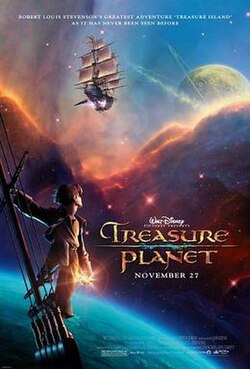

Treasure Planet on PlayStation arrived as one of those licensed tie-ins that had nowhere near the budget of its cinematic cousin but plenty of ambition. Built by Magenta Software and packaged by Sony Computer Entertainment as a 3D platformer/action romp, it attempted to translate Disney's painterly adventure into playable polygon form. The gamble: cram swashbuckling, solar surfing and character-driven cutscenes into the technical shoebox that was late-era PlayStation hardware, while competing for attention with the higher-fidelity PS2 and PC versions. In practice the game shows flashes of clever design but is undermined by a laundry list of technical and mechanical compromises. If you're reading this for a rigorous, tech-forward autopsy rather than nostalgic warm fuzzies, strap in: this review dissects what the PlayStation version does well, what it fails at, and why the numbers (GameRankings ~57.14%, Metacritic ~44/100 for PS) look the way they do.
On paper the gameplay loop is straightforward: you control Jim Hawkins through a sequence of platforming stages, ship-board exploration, and a handful of combat encounters interleaved with film-derived cutscenes. The designers lean into the trilogy of tasks a licensed platformer needs to deliver-traversal, combat, and puzzles-but the implementation is where platform constraints bite. Traversal uses a standard third-person control scheme with a single analogue/digital stick and button set typical of the era. That means limited contextual inputs and a lot of responsibility on level design to telegraph jumps and parkour lines. Level geometry often fails that responsibility: camera and platform placement sometimes conspire to make jumps ambiguous, producing a 'trial-and-repeat' rhythm rather than a skillful one. Camera and collision are the two biggest gameplay-level technical sins. The camera is serviceable on axis but lacks predictive smoothing or dynamic occlusion handling: when the camera clips into geometry it snaps or follows awkwardly rather than offering a cinematic re-frame. That matters because precise platforming needs consistent framing to judge depth-without it, some failures feel like a control fault when they are camera-induced. Collision detection also fluctuates. There are moments where the character's bounding volume feels generous and other points where you snag on invisible ledges or slide off obvious platforms. These are classic symptoms of a codebase wrestling with an engine not originally designed for nuanced platform physics: hitboxes approximated as simple capsules, no layered surface friction model, and rudimentary correction for edge-cases. Combat is light and serviceable: basic strikes, occasional special attacks and scripted enemy patterns. Enemies tend to telegraph motion poorly, which pushes encounters from tactical to rote. Physics during combat-knockback, stun, and ragdoll-like motion-are rudimentary and frequently look like playbook animations rather than emergent interactions. That said, the level designers plant a few clever set pieces (rope swinging in zero-G corridors, timed elevator shafts) where the engine's limitations are used to create tension rather than exposing it. These moments feel like the team understood where the platform could be pushed and where it needed gentle hand-holding. Progression systems are minimal: collectibles and short unlocks rather than deep upgrade trees. This keeps memory footprint modest (smart for a PlayStation cartridge/CD era release), but reduces incentives for replay. Loading times are reasonable for the format, and level streaming is handled conservatively-large environments are segmented into rooms and corridors to keep the memory working set small. Save handling is traditional (save points/checkpoints) and fits the era, though the lack of generous autosaves can make long retry loops more irritating than necessary. Overall, the PlayStation version is credible as a licensed platformer but never transcends the 'movie tie-in' archetype. It scratches the narrative itch with film audio and cutscenes, but mechanically it feels like a compacted, budget-aware adaptation where many design choices are reactions to technical constraints rather than gameplay-first solutions.
Graphically the PlayStation release is a textbook study in squeezing art direction into a tiny polygon budget. Compared to the PS2 counterpart (Bizarre Creations reportedly used Softimage XSI for modeling/animation), the PS1 game has lower polycounts, aggressively compressed textures and far simpler lighting. The result: environments are readable and often nicely framed, but rely heavily on painted textures and clever silhouette design to suggest the film's richer Deep Canvas-inspired visuals rather than recreate them. Texture resolution and filtering are the most obvious tradeoffs. Textures are heavily dithered or low-res when viewed close-up; texture warping and shimmering appear on slanted surfaces-common artifacts when a console lacks hardware perspective-correct texturing. To the team's credit, artists used palette choices and contrast to hide seams and emphasize gameplay cues (bright ledges, distinct enemy colors), which is good use of visual affordances. Character models capture the gist of Disney designs with caricatured proportions and recognizable silhouettes, but facial animation is limited. Expect frame-by-frame key animations rather than fully blended morph targets; lip-sync is passable but seldom expressive. The engine's lighting model is static and baked in the art, with a smattering of vertex lighting for character highlights. Particle effects (sparks, small explosions, energy glows) are present but primitive-sprite-based impostors and alpha planes rather than volumetric effects. This limits the 'spacefaring' spectacle, but again the artists lean into film-stills and color grading to maintain atmosphere. Performance is generally stable for the platform: there are occasional frame dips in crowded areas or large scripted events, but nothing catastrophic. Draw distance and pop-in are managed via segmented loading and fog, a technique that doubles as atmospheric staging. Cutscenes and FMV are the game's narrative glue. These cinematics use highly compressed video or in-engine playback with lowered fidelity; compression artifacts, blockiness, and audio downsampling are common, which undermines some emotional beats inherited from the film. On the audio side, sampled music and effects are recognizable and well-chosen, but compression reduces dynamic range. Voice assets (if included) are truncated or looped sparingly to save space, so don't expect the film's entire vocal performance to be replicated faithfully in-game.
Treasure Planet on PlayStation is competent where it needs to be but compromised where it can't afford not to be. Magenta Software delivered a compact 3D platformer that captures the film's broad strokes-characters, environments and a few standout set pieces-while trimming technical corners to fit the console. For players after a faithful cinematic-to-playable experience, the PS1 title is an alright stopgap, but for those who judge by modern platforming standards or demand mechanical tightness, the camera, collision and visual compression will grate. The reviewer's pragmatic score of 4.5/10 reflects the game's middling aggregate reception (roughly mid-to-low 40s on Metacritic for PS and ~57% GameRankings) and the sense that the project was hamstrung more by hardware and time than by a lack of creative ideas. If you want Treasure Planet nostalgia in handheld polygon form, it's a tolerable trip-just don't expect the full Technicolor sweep of the film, and bring patience for a camera that sometimes has other plans.
 Dragon Quest Treasures on Switch
 One Piece: Tobidase Kaizokudan! on PlayStation
 Lupin the 3rd: Treasure of the Sorcerer King on PS2
 Onimusha: Dawn of Dreams on PS2
 Action Man: Operation Extreme on PlayStation
 Door Kickers: Action Squad on Switch
 Vividred Operation: Hyper Intimate Power on PS3
 Muppet Monster Adventure on PlayStation
 Invizimals: The Lost Kingdom on PS3
 The Cat in the Hat on PlayStation
 Eliminator on PlayStation












 Another SquareThought Site